A helmet camera bores straight into the dirt track, the frame shaking with engine roar and thrown grit, as Vikas Narayan tears through a motocross course he was never supposed to return to. That visceral pull, speed against memory, ambition against domesticity, is precisely where Biker is most alive, and precisely where its emotional architecture struggles to keep pace.
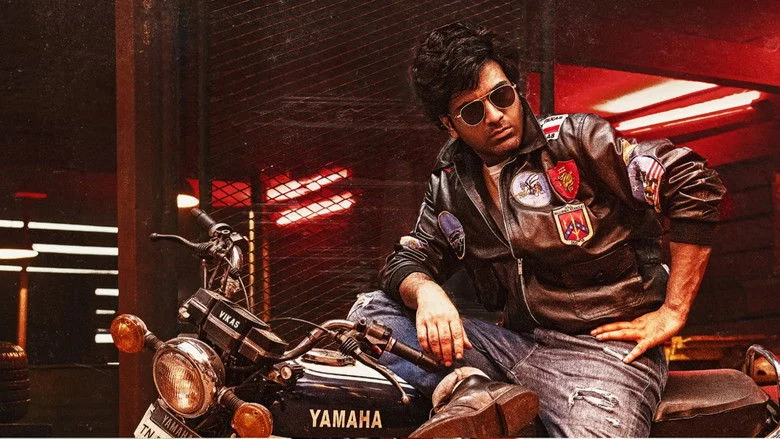
Sharwanand Carries a Bike-Shaped Hole With Quiet Precision
Sharwanand’s Vikas is constructed around a specific kind of suppression, a man who shows up for his wife and child while something restless hums underneath. The performance works because he never overplays it. There is a particular stillness in his domestic scenes that makes the track sequences feel like exhales rather than explosions.
Where the screenplay offers him clichés, he offers nuance. It is not a performance that reinvents the sports drama lead, but it anchors a film that occasionally drifts without it.
Abhilash Reddy Frames the Dust Perfectly, Fumbles the Feeling
Abhilash Reddy Kankara demonstrates a genuine feel for sports cinema’s visual grammar. The non-linear structure, shuttling between the 1990s and 2000s, is handled with surprising smoothness, the period transitions rarely jolt you out of the story’s rhythm.
The screenplay, however, is another matter. It leans heavily on sports drama conventions without interrogating them. The emotional engine stalls in the second half precisely when it needs to accelerate, and no amount of craft in the racing sequences fully compensates for that structural predictability.
At 2 hours 42 minutes, the film also tests patience. Tighter editorial choices in the middle stretch would have sharpened the drama considerably.
The Motocross Sequences Are Built for the Big Screen, and They Know It
The racing craft here is specific and considered. Low-angle tracking shots press against the tarmac, turning the camera into a second rider. First-person helmet footage doesn’t just simulate speed, it communicates danger. The sound design is equally deliberate, with high-RPM engines mixed to land physically in the chest.
The interval segment earns its reputation as a gripping turning point. The narrative momentum it generates is genuine, and the sequence demonstrates that Abhilash Reddy understands how to construct a setpiece with dramatic weight, not just visual spectacle. I found myself leaning forward in ways the emotional scenes rarely managed.
The climax motocross sequence, reportedly a first-of-its-kind in Telugu cinema for this sport, delivers on its promise. It is technically accomplished and visually immersive. The problem is that it works better as spectacle than as emotional culmination, the race resolves the story’s external conflict while the internal one remains underdeveloped.
If you’re interested in Telugu sports drama that pushes against genre limits, there’s more sharp analytical work worth exploring in Telugu Drama reviews across the catalogue.
Rajasekhar’s Return Gives the Film Its Toughest, Truest Relationship
Rajasekhar, returning after a significant gap, plays Bullet Sunil Narayan as a man who communicates love through velocity rather than words. It is a recognizable archetype, the demanding father who cannot separate ambition from affection, but Rajasekhar brings a weathered believability to it.
His scenes with Sharwanand, particularly those building toward the film’s resolution, carry the emotional weight the screenplay often fails to generate elsewhere. The casting signals Biker‘s intent clearly: this is a film about inheritance, not just sport. Malvika Nair and Atul Kulkarni occupy their respective spaces competently, though neither is given material that allows them to register with comparable force.
Audiences Came for the Track, Critics Noticed the Gaps
Times of India awarded the film 3.5 out of 5, reflecting the general critical position: technically impressive, emotionally incomplete. Trade analyst Ramesh Bala flagged it as “another potential blockbuster” for Sharwanand ahead of release, suggesting the commercial machinery around the film had faith in its spectacle appeal.
Audience response has largely aligned with that reading, the racing sequences generate genuine excitement, while the predictable dramatic architecture and underdeveloped emotional turns limit the film’s staying power. UV Creations has produced films with stronger narrative backbone; Biker suggests the production house’s confidence in spectacle occasionally substitutes for deeper storytelling investment.
Biker is worth seeing on the largest screen available, the motocross sequences lose significant force on smaller formats, and the cinematography was clearly conceived for theatrical immersion. If you arrive expecting a sport film with arresting visuals and a committed lead performance, it delivers. Expect a fully resolved emotional drama, and the 2 hours 42 minutes will feel longer than they should.
If the father-son dynamic here interests you, the similarly strained mythological family conflict in Raakaasa 2026 review makes for an instructive contrast in how Telugu cinema handles paternal authority on screen.
Biker is a technically accomplished sports drama worth one theatrical visit, driven by committed work from Sharwanand and genuine motocross craft, though its emotional predictability keeps it from crossing the finish line at the speed it deserves, a firm 3 out of 5.