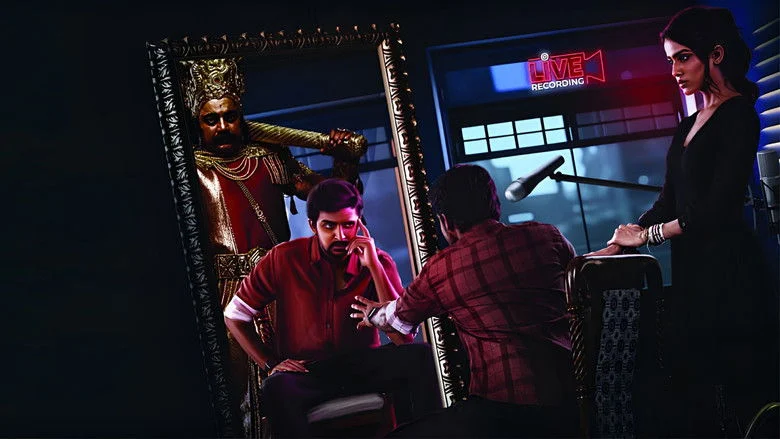
A man who makes sound for a living is suddenly silenced by accusation, his father dead, his past unravelling through visions and a voice only he can hear. Casting Priyadarshi as a Foley artist in a mystery-thriller is the kind of conceptual precision that promises a film far sharper than what Y.S. Madav Reddy ultimately delivers.
Madav Reddy Has an Idea but Misplaces Its Architecture
The premise, a protagonist accused of patricide, haunted by mysterious visions, carries genuine dramatic weight. Madav Reddy clearly understands atmosphere. What he struggles with is discipline. The screenplay by Srinu Dharmarajula and Srinu Kambala plants an intriguing central mystery but never quite decides how much to reveal and when.
The two-hour-ten-minute runtime feels padded in places where tightening would have created genuine tension. I found myself watching a film that keeps gesturing toward a revelation it seems nervous to commit to.
The Mystery Mechanics Are Uneven, Though the Concept Has Real Pull
The Foley artist framing is the screenplay’s cleverest conceit. Sound is memory. Sound is evidence. A man trained to recreate reality aurally being driven mad by an unreal voice is a genuinely compelling dramatic irony. The writers understand what they have.
But the thriller mechanics around it are patchwork. The investigation of the protagonist’s past, filtered through visions, demands rigorous pacing from the edit. Chota K Prasad’s editing keeps things moving but can’t fully compensate for structural inconsistencies baked into the writing.
Kartheek Koppera’s cinematography does atmospheric work, the visual grammar around the mystery sequences carries unease without overstating it. Jay Krish’s score, with lyrics by Ramajogaiah Sastry, fills the emotional gaps competently, though it occasionally signals what the image should be doing on its own.
If you enjoy Telugu thrillers that wrestle with identity and guilt, there’s more like this at Telugu Thriller reviews.
Sai Kumar and Drishika Chander Hold Their Ground With Limited Material
Drishika Chander plays the childhood friend and partner, a role the screenplay gives just enough weight to matter but not enough texture to fully land. Her presence stabilises the emotional register whenever the mystery tilts toward abstraction. The casting signals the film’s intent to ground its supernatural logic in something relational.
Sai Kumar brings the kind of authoritative screen gravity that anchors Telugu dramas even when their scripts are thin. His presence implies history and consequence. Rajshri Nair, Vishnu Oi, and Devi Prasad occupy their respective spaces with competence, though none is given material that stretches them.
No Controversy, but Audience Reception Tells Its Own Story
Suyodhana arrives without the noise of political or censorship controversy. What it faces instead is the quieter problem of a Letterboxd average sitting at 2.5/5, the kind of score that suggests a film respected for its ambition but found wanting in execution. No social media storm, just a collective shrug from audiences who sensed the gap between concept and delivery.
That gap is real. Prajwalaa Line Creations has produced something with genuine craft investment, the technical team is solid, but the film needed a more ruthless screenplay pass to become what its premise promises.
If you’re drawn to supporting performances propping up uneven scripts, George Maryan’s work in Happy Raj review is worth your attention for exactly that reason.
Suyodhana is worth a single watch for Priyadarshi’s casting concept and Koppera’s visual sensibility, but approach it as a fragment of a better film, not the finished article. Stream it at home where patience costs less than a multiplex ticket.
Suyodhana earns a restrained 2.5 out of 5, Priyadarshi’s committed performance and a genuinely clever premise can’t rescue a thriller whose screenplay never fully trusts its own architecture.
For another Telugu drama where slick craft outruns emotional grounding, the Vaazha II verdict maps that tension with similar precision.