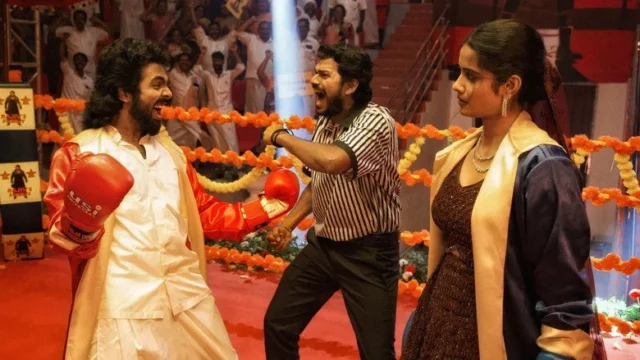
Four young men, branded as failures by everyone who raised them, stumble through adulthood in a country that has already decided their worth is measured in a flight ticket to the Gulf. Savin SA’s sequel arrives louder and sharper than its 2024 predecessor, but loudness, it turns out, is not the same thing as resonance.

Hashir, Alan, Ajin, and Vinayak Hold the Film’s Pulse Steady
The four leads, Hashir, Alan, Ajin, and Vinayak, carry the film’s considerable weight without a single false beat between them. Their chemistry is the one constant the film can always return to when the script runs thin. What these performances signal is that Savin has cast actors who understand instinctively how to be funny without being cartoonish, a genuinely rare calibration in Malayalam comedy.
Savin SA Writes a Better Joke but Forgets the Ache Underneath It
Savin, working again with writer Vipin Das, has tightened every mechanism from the first film. The pacing is sharper, the gags land faster, and the social commentary about migrant pressure on Malayali youth feels more pointed this time. That is real craft, and it deserves acknowledgment.
But there is a critical flaw baked into that same momentum. The film rarely pauses. It moves at the pace of an Instagram reel, which is precisely the criticism that follows it, and not unfairly. Every emotional beat that should hit arrives slightly too quickly to bruise.
I found myself wishing the film trusted its own sadness more. The predecessor earned its tears by sitting inside awkward silences. This sequel seems almost allergic to them, rushing past moments that deserved to be inhabited rather than merely visited.
For more Malayalam comedy and drama analysis, the Malayalam Action reviews section covers a range of recent releases worth your time.
Vijay Babu, Aju Varghese, and Biju Kuttan Add Institutional Weight
Vijay Babu, Aju Varghese, and Biju Kuttan occupy the film’s adult world, the parents, authority figures, and uncomfortable mirrors held up to the boys. Their presence is not decorative. Casting these three together signals that Savin wanted a credible older generation, not a punchline one. Aju Varghese in particular brings a lived-in weariness to whatever parental anxiety his role demands.
Alphonse Puthren’s appearance, the filmmaker turned occasional actor, is the kind of casting that functions as a cultural wink for Malayalam cinema buffs. Angel Maria completes a supporting ensemble that keeps the film grounded even when the screenplay reaches for broader strokes.
The Migration Pressure Theme Gives the Film Its Most Honest Moments
The film’s sharpest observations concern the suffocating Malayali expectation that success only counts if it happens abroad. Vaazha II widens its geographical canvas deliberately, placing the boys’ sense of failure inside a very specific social contract. That specificity is where Vipin Das’s writing lands with the most conviction.
The comedy-drama framework holds together reasonably well across 2 hours 40 minutes, a runtime that does ask for patience. The action element is light enough to be largely cosmetic, present to keep energy levels up rather than to serve any narrative purpose. The chaos feels curated and self-aware, which makes it amusing but never dangerous.
The film takes several leaps forward from the original in message and ambition. It just does not always earn those leaps emotionally. When the first film made you feel something uncomfortable about how we treat young men labeled as wasted potential, it hurt because it slowed down long enough to let that hurt settle.
Vaazha II Reaches a Wider Audience But Talks to Them More Shallowly
There is no controversy or significant political backlash attached to Vaazha II, which is itself revealing. The film plays safely within broadly acceptable observations about youth, migration, and family, real enough to feel recognizable, comfortable enough never to genuinely unsettle. That is not necessarily a failure, but it does explain why the film lands like an enjoyable night out rather than something you carry home.
Audiences who found the first film emotionally resonant may find themselves entertained here but quietly underwhelmed. The film’s target is clearly wider this time, and it likely hits that target with ease.
If Vaazha II’s reluctance to sit inside uncomfortable family dynamics interests you, the Carmeni Selvam review in Carmeni Selvam explores similar social anxieties from a sharply different angle.
Vaazha II is genuinely enjoyable and consistently amusing, bring your college friends, buy the popcorn, and accept it for what it is: a sequel that upgraded its production and downgraded its soul. If you loved the first film for its emotional rawness, manage expectations before walking in.
Vaazha II: Biopic of a Billion Bros is a competent, charming, and ultimately shallow follow-up that earns 2.75 out of 5, funnier than its predecessor on the surface, but considerably less brave where it actually counts.
Fans of the ensemble dynamic in Vaazha II may also find the Leader 2026 verdict explored in Leader equally worth watching for its raw, unpolished sincerity.