A journalist’s daughter vanishes into the desert and returns eight years later as something that should not be alive, not transformed by time, but by something far older and far less forgiving. The premise carries a quiet dread, the kind Lee Cronin earned with Evil Dead Rise, and there are moments here where that dread crystallises into something genuinely unsettling.
Jack Reynor and Laia Costa Hold the Human Core Together
With no single performer clearly designated as lead, the ensemble structure places weight on Jack Reynor and Laia Costa to anchor the horror in something recognisably human. Both actors navigate that assignment with visible commitment.
Costa, in particular, carries the burden of embodying a woman confronting something returning from her own family. The casting of May Calamawy and Veronica Falcón alongside her suggests Cronin wanted textured, layered female performances surrounding whatever horror the desert unleashed.
Cronin’s Direction Has a Grip, Until the Script Loses Its Own Thread
Lee Cronin, who also wrote the screenplay, demonstrates genuine craft in constructing dread through suggestion before unleashing the supernatural. His instinct for atmosphere has grown since Evil Dead Rise, and the visual grammar, shot in a crisp digital 2.39:1 widescreen frame, gives the desert sequences a parched, suffocating width.
The flaw, and it is a significant one, is structural. A 133-minute horror film demands rigorous self-editing, and Cronin the writer does not always discipline Cronin the director. The middle act sags with accumulation where compression would have sharpened the terror considerably.
The Rotten Tomatoes consensus captures it precisely: the film’s “scares get entombed by a padded running time.” That is not a small problem in a genre where momentum is everything.
Horror Craft That Cuts, Then Stalls, Then Cuts Again
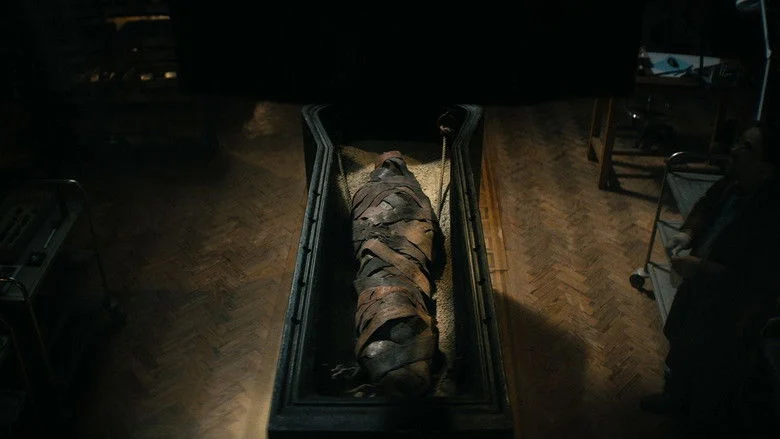
Cronin’s reinvention of mummy mythology as psychological horror rather than action-adventure archaeology is the film’s most interesting creative bet. He is not interested in curse maps or rival archaeologists. The supernatural here feels biological, intimate, and wrong in a way that lodges under the skin.
The gore, delivered under the combined production frameworks of Blumhouse and Atomic Monster, is reportedly purposeful rather than gratuitous, R-rated for strong violent content and gore, but wielded with intent. I find that restraint more disturbing than excess in most horror films, and Cronin seems to understand exactly where the line sits.
The problem is that the horror set-pieces, however effective individually, arrive too sparsely across a runtime that needed at least fifteen minutes removed. The film breathes when it should suffocate.
If you enjoy exploring the craft decisions behind English horror films, the English Horror reviews on this site trace similar filmmaking tensions across the genre.
May Calamawy and Veronica Falcón Signal Serious Casting Ambition
May Calamawy, known for layered, emotionally precise work, is not a performer you cast carelessly. Her presence in this ensemble signals that Cronin wanted the human relationships to carry genuine dramatic weight, not merely serve as space between scares.
Veronica Falcón brings a commanding authority to whatever role she occupies, her casting suggests a figure of knowledge or resistance, someone who understands what has returned. Even without scene-level specifics, this ensemble feels deliberately assembled rather than conveniently populated.
No Controversy, but Audience Expectations Will Be the Real Test
No production controversies surround the film. What will determine its legacy is simpler: whether audiences drawn by the Mummy brand expect action-adventure mythology or are willing to accept a slower, more visceral psychological horror experience. Cronin is making the latter. The marketing, almost certainly, sold something adjacent to the former.
That mismatch between expectation and delivery has derailed smarter horror films than this. James Wan and Jason Blum producing together is a signal of commercial confidence, but commercial confidence has never automatically produced disciplined pacing.
For those who appreciated the stripped-back tension that underpins lean, ambitious genre filmmaking, the conversation around Jana Nayagan review covers similar territory about direction buckling under screenplay weight.
If Cronin’s specific blend of mythological reinvention and domestic horror is working for you by the halfway point, it will reward patience. If the runtime is already testing you then, the final act will not recover what pacing has lost. IMAX is the right format for the scale Cronin is reaching for, the desert photography and the widescreen dread earn that screen.
Lee Cronin’s The Mummy is a film of genuine ambition and intermittent power that earns a 2.5 out of 5, a horror filmmaker with clear craft instincts who has not yet learned that a tighter cut is sometimes the braver one.
Ajith’s Aadharam verdict draws a similar parallel, films that carry real intent but lose their grip when the screenplay refuses to edit itself into shape.