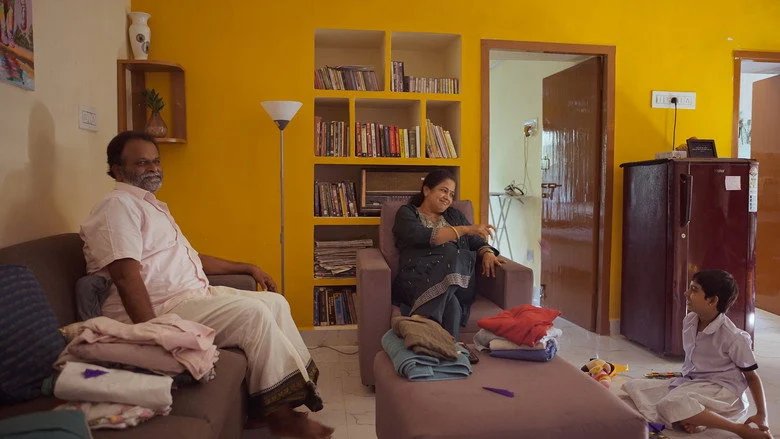
A Hesham Abdul Wahab score arrives before the story earns it, that is, in essence, the quiet problem at the centre of Madhuvidhu. Debutant director Vishnu Aravind has assembled a warm Malayalam family-comedy-romance with genuine craft instincts, but the architecture beneath that warmth feels borrowed rather than built.

Sharaf U Dheen Charms on Instinct, Not on Written Character
Sharaf U Dheen is a performer who communicates ease. His comedy lands not because the lines are sharp but because he inhabits the pauses between them. The problem is that Vishnu Aravind’s screenplay doesn’t give him a character arc so much as a personality trait to repeat across scenes.
Kalyani Panicker brings composure to her role, and her screen rapport with Sharaf is the film’s most watchable quality. But watchable is not the same as written. I kept waiting for a scene that truly tested either of them, it never fully arrived.
Vishnu Aravind Signals Instinct but Not Yet Discipline
For a debutant, Vishnu Aravind demonstrates a genuine understanding of tonal register. He knows the genre he is working in and doesn’t overreach into melodrama. That is a real strength, and it should not be dismissed lightly.
The screenplay, however, lacks structural tension. A comedy-romance-family film lives or dies on the precision of its escalating complications, and Madhuvidhu appears content to drift where it should drive. Scenes exist pleasantly without building consequence.
The direction is confident in the quiet moments and uncertain in the louder ones. When the film needs to shift emotional gears, the editing rhythm and scene transitions feel unresolved, a craft gap that a more experienced collaborator in the cutting room might have corrected.
For more Malayalam comedy and romance reviews covering films like this, browse Malayalam Romance reviews on this site.
Jagadish and Saikumar Anchor the Family Register With Practiced Economy
Jagadish is one of Malayalam cinema’s most reliable comic presences, and his casting here signals that Ajith Vinayaka Films wanted the family audience firmly onside. Even without a standout scene to point to, his presence normalises the film’s emotional grammar for older viewers.
Saikumar occupies a different register entirely, sturdier, more grounded. His inclusion suggests the film is attempting a multi-generational tonal balance. Whether the screenplay fully utilises either actor is a separate, more troubling question. Both men deserve writing that matches their calibre.
Audience Reception Reflects the Film’s Own Ambivalence
Madhuvidhu arrives in April 2026, a release window that historically favours lighter, family-friendly Malayalam entertainers. The film fits the season more than it transcends it. Early audience response appears to reflect exactly that, appreciation for the warmth, quiet frustration at the thinness underneath.
Bindu Panicker and Sreejaya round out the family ensemble with the kind of reliable support that Malayalam family films depend on. Their presence is functional, not transformative. The film needs them to hold the domestic scenes together, and they do, efficiently, if not memorably.
Madhuvidhu is the kind of film that works better as a Sunday afternoon OTT watch than a theatrical event. The Hesham Abdul Wahab score will sound best through decent speakers at home, where the film’s gentle rhythms can breathe without the pressure of a paying crowd expecting more.
If the craft-versus-script tension in Madhuvidhu interests you, the Bhooth Bangla review in Bhooth Bangla traces a strikingly similar pattern of a director’s instincts outpacing the written material.
Madhuvidhu earns a cautious 2.5 out of 5, a film you won’t resent watching, but one that Vishnu Aravind himself will likely outgrow within two projects if the script quality catches up to his evident tonal instincts.
Films where Gore craft and bloated structure create the same unresolved tension are worth tracking, that tension defines Lee Cronin verdict in his recent work just as clearly as it defines Madhuvidhu’s quieter failings.