Violence erupts against Lakhujirao Jadhav’s family as Jijabai carries her unborn child, and the film’s entire thematic weight settles into this brutal prelude. Before Shivaji draws breath, the grounds for his rebellion are already soaked in blood, a narrative choice that signals neither romance nor hesitation about the material’s political teeth.
Riteish Deshmukh’s directorial debut as Chhatrapati Shivaji Maharaj unfolds across nine chapters, each one climbing toward the coronation that history has already promised. The question becomes not whether he will wear the crown, but whether the film can justify three hours of political staging without collapsing into hagiography.
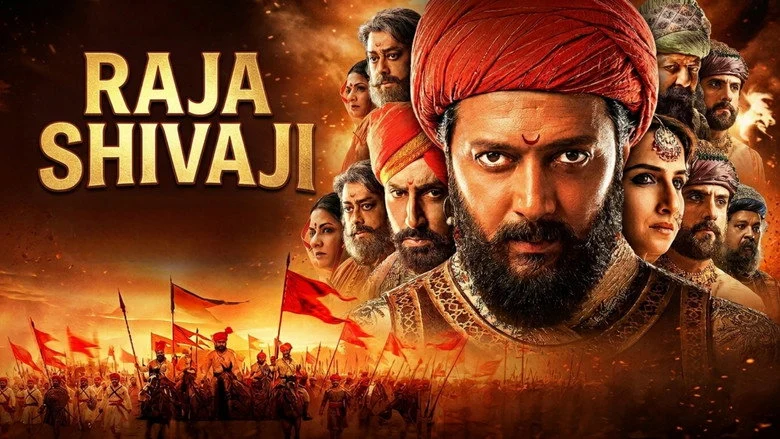
Riteish Deshmukh Carries a 195-Minute Frame Without Visible Strain
Early reactions consistently isolated Deshmukh’s central performance as the film’s emotional anchor. He appears positioned as a leader of quiet resolve rather than theatrical grandeur, a choice that either deepens the political narrative or flattens it, depending on whether the screenplay around him earns that restraint.
The performance reportedly tracks Shivaji’s arc from resistance fighter to statesman without the melodrama that often bloats historical biopics. Whether this restraint reads as conviction or as insufficient charisma remains the film’s core gamble.
Deshmukh’s Nine-Chapter Structure Risks Episodic Drift
Dividing a biopic into chapters invites either novelistic depth or fragmentation. The Marathi version runs 195 minutes; the Hindi cut shaves eight minutes, suggesting post-production struggles to maintain momentum.
A linear progression through Shivaji’s resistance and consolidation of power should theoretically carry weight, yet chapter-based storytelling often trades narrative tension for historical completeness. No verified screenplay criticism surfaces in available material, which itself signals either restraint or an absence of scrutiny.
Historical Action Drama Scales Ambition But Sacrifices Momentum
The opening violence against Jadhav’s family establishes causality before the protagonist’s birth, a tactic lifted from prestige historical cinema. This framing prioritizes political genealogy over dramatic immediacy, asking audiences to invest in systems rather than individuals.
Battle sequences and period staging receive emphasis in marketplace descriptions as grand spectacle, yet no scene-specific choreography analysis has surfaced. The film appears positioned as visual grandeur in service of nationalist narrative rather than kinetic cinema demanding frame-by-frame study.
Ajay-Atul’s music emerges as the most consistently praised technical element across early reception. This suggests the score may be compensating for screenplay passages that rely on historical momentum rather than emotional crescendo. The coronation finale presumably rewards three hours of political accumulation, though whether that payoff justifies the runway remains critic-dependent.
Audience reception gravitates toward Sanjay Dutt and Abhishek Bachchan’s supporting turns, singled out as notable even without confirmed scene specifics. This casting, two A-list antagonists or political adversaries, signals the film’s intent to foreground conflict with established power rather than Shivaji’s internal psychology. Genelia Deshmukh, Vidya Balan, Fardeen Khan, Boman Irani, and Mahesh Manjrekar round out an ensemble scaled for a multilingual, high-budget biopic, though individual role clarity remains opaque from available material.
For seasoned viewers of Hindi and Marathi cinema, the performer roster itself becomes readable text. A production backing this cast across six languages for a historical drama signals confidence in the material’s pan-Indian appeal. Whether that appeal translates to critical durability depends on execution the supply of public criticism cannot yet confirm.
Further historical epics can be explored through Marathi Action reviews, where similar large-scale narratives receive sustained examination.
No Verified Controversy Exists; Mainstream Reception Holds Steady
The absence of backlash around a Shivaji biographical narrative released across six language versions suggests either consensus approval or limited critical engagement. Early reactions focus on Deshmukh’s performance, Ajay-Atul’s music, and supporting cast, but no verified audience complaint trend, regarding pacing, runtime, or historical accuracy, has crystallized in public discourse.
This silence may indicate audience satisfaction or simply that the film has not yet entered sustained critical conversation beyond opening-weekend enthusiasm.
Whether to see this film depends entirely on your tolerance for historical spectacle that privileges political breadth over dramatic velocity. Deshmukh’s performance and Ajay-Atul’s score provide anchors, but three hours of chaptered biography asks patience most contemporary viewers no longer freely give. The Marathi version likely preserves the director’s intended pacing; if available in your region, it may reward more fully than the trimmed Hindi cut.
Riteish Deshmukh’s directorial ambition mirrors the measured reserve of lead performances in Ek Din review, where restraint either deepens character or reduces dramatic stakes.
Raja Shivaji (2026) is a competent, well-cast historical drama that prioritizes scope and subject matter over narrative surprise, a solid 3/5 film for viewers who value political genealogy and Ajay-Atul’s compositions above pacing.
Riteish Deshmukh’s mythological scale parallels the restrained grandeur attempted in Krishnavataram Part verdict, where historical reverence sometimes crowds dramatic momentum.