Krishna’s separation from Radha bleeds through every frame in Hardik Gajjar’s sprawling devotional epic, a journey that begins in emotional wreckage and spirals toward divine duty. The film asks whether love and spirituality can occupy the same space, then spends nearly two and a half hours answering through spectacle, song, and restrained performance instead of dramatic momentum.
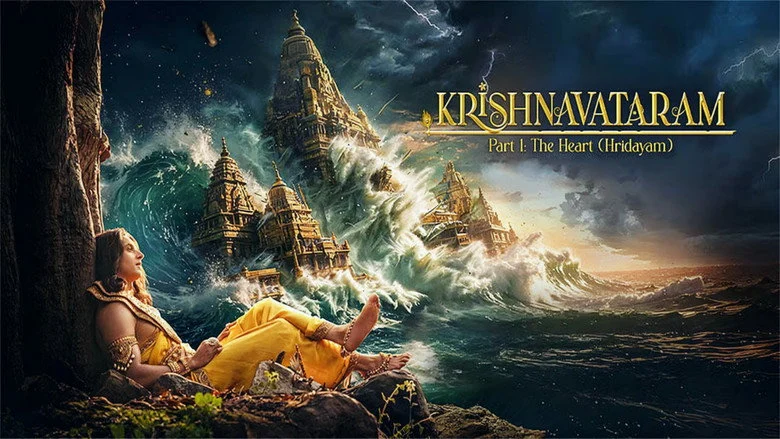
Siddharth Gupta’s Krishna Chooses Vulnerability Over Godly Certitude
Gupta’s portrayal trades the commanding authority typically assigned to Krishna for something riskier: a man caught between personal attachment and larger purpose. His performance centers on what remains unsaid, the flicker of hesitation before duty demands he turn away from Radha. This choice works best in quieter relationship scenes where restraint carries weight; it struggles when the film expects presence to fill the sprawling devotional canvas around him.

Gajjar’s Direction Privileges Visual Scale Over Pacing Control
The filmmaker commits fully to a mythological canvas painted in broad, color-rich strokes. Sequences designed around Krishna’s separation and the journey toward Kurukshetra achieve genuine visual grandeur. Yet the screenplay, penned by Gajjar alongside Prakash Kapadia and Raam Mori, meanders through exposition and relationship explanation, allowing dramatic momentum to calcify beneath layers of devotional framing.
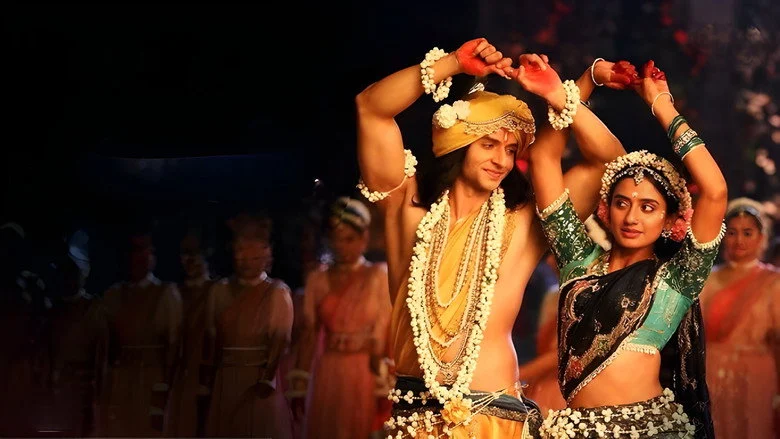
Devotional Drama Lives and Dies by Its Visual Language
The opening passages establishing Krishna’s emotional distance from Radha carry real weight, anchored by the film’s strongest asset: a willingness to treat mythological narrative as lived relationship rather than historical recitation. Visuals dominate these moments, transforming spiritual conflict into something almost tactile. The problem emerges when dialogue and exposition take over, slowing the machinery to explain what the imagery already communicates.
The journey sequences toward Kurukshetra attempt to make geography itself thematic, movement becomes spiritual progression. This works when the film trusts its audience; it falters when it pauses to clarify mythology instead of letting atmosphere carry meaning. The pacing fractures across both halves, though the opening moves with more deliberate slowness than the broadened scope of the second act.
Where the film asserts itself most convincingly is in the devotional-romantic framing of Krishna’s relationships with Sathyabhama, Radha, and Rukmini. These connections anchor the story’s emotional argument about separation and duty. When visual presentation drops away, however, the writing struggles to maintain that tension through dialogue alone.
For those seeking deeper analysis of mythological cinema, we recommend exploring Hindi Drama reviews and recent devotional storytelling approaches across Indian cinema.
Sanskruti Jayana’s Sathyabhama Commands Narrative Perspective
Jayana’s casting signals a deliberate choice to view Krishna’s journey through a woman’s lens rather than his own mythology. Her performance as Sathyabhama/Bhama functions as the emotional counterpoint that makes Krishna’s restraint meaningful. She carries scenes through directness where Gupta relies on stillness, creating dynamic tension between her characterization and his.
The Devotional Epic Gambles on Trilogy Scale Without First-Act Payoff
The film’s structural risk, positioning itself as Part 1 of a larger Krishna narrative, amplifies its pacing problems. Audiences expecting resolution or dramatic urgency from a 149-minute investment may find the ending more transitional than climactic. The mythological scope justifies the sprawl; narrative urgency does not.
Gajjar’s ambition to treat Krishna as a devotional figure shaped by love, separation, and duty rather than military conquest or divine performance speaks to genuine artistic intent. The songs, particularly Irshad Kamil’s lyrics paired with Shreya Ghoshal and Sonu Nigam, position music as essential emotional vocabulary. Yet the film’s reliance on visuals to carry dramatic weight leaves stretches feeling inert when spectacle recedes.
This is devotional cinema as visual essay rather than narrative engine. For viewers patient with mythological pacing and drawn to Krishna-centered retellings, the grand framing and Siddharth Gupta’s vulnerable performance offer genuine rewards. Those demanding tighter writing or dramatic propulsion will find the first installment testing their tolerance for visual ambition unchecked by structural discipline. Watch for the devotional imagery and Gupta’s nuanced work; skip if mythological exposition exhausts your interest before the story earns its weight.
Krishnavataram Part 1: The Heart reaches for mythological intimacy but settles for grand presentation, a risk that yields visual beauty without equivalent dramatic tension, earning a measured 2.5/5 for ambition that outpaces execution.
Gupta’s understated approach to Krishna echoes the tonal restraint seen in Star Wars review.
The challenge of inheriting a mythological role larger than individual performance mirrors the casting dynamics explored in Michael verdict.