Din Djarin emerges from the shadows of a post-Empire galaxy, tasked by the New Republic to navigate a world still bristling with Imperial warlords and criminal syndicates. The return to theaters after the television saga feels less like a fresh narrative and more like an extension of existing momentum, competent, familiar, and deliberately engineered for those already invested in this universe.
Jon Favreau’s theatrical pivot of *The Mandalorian* marks a calculated gamble: can a streaming success translate into cinematic stakes without reinvention? The answer is complicated by what remains fundamentally a continuation rather than a destination, a bridge film rather than an event.
Pedro Pascal Buried Beneath Armor and Franchise Obligation
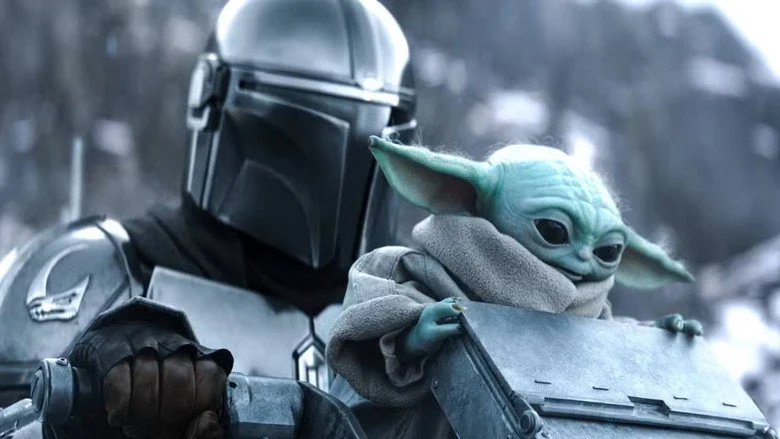
Pascal carries this film almost entirely through physical restraint and vocal modulation, a peculiar acting challenge that turns the actor into a vessel for audience projection rather than a fully inhabited character. The Mandalorian’s helmet remains his prison and his shield, limiting facial expression to a register of subtle vocal inflection and body language. This constraint, while thematically consistent with the character’s isolation, also means Pascal’s performance becomes a footnote to the mythology surrounding him rather than its anchor.
Within the New Republic mission framework, Pascal executes the dutiful professional: a soldier operating within bureaucratic systems he doesn’t fully trust. Yet the performance reads as restrained by design rather than deepened by it. We sense competence, not revelation.
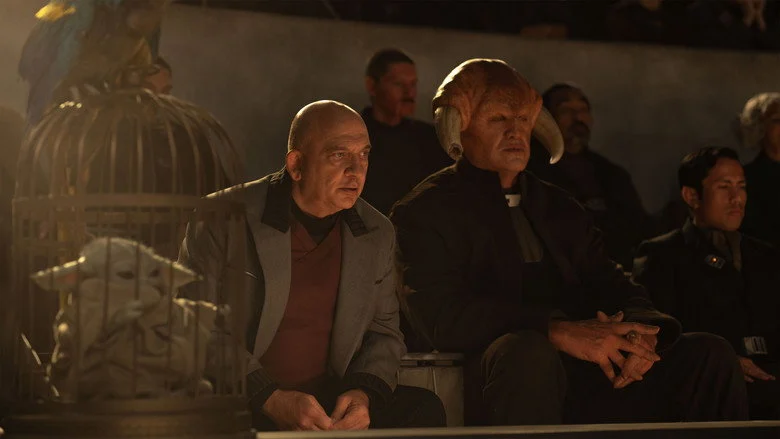
Favreau’s Direction Balances Spectacle Against Narrative Hesitation
Favreau demonstrates clear command over scale and visual continuity, inheriting the television aesthetic and enlarging it for theatrical presentation without fundamentally reconceiving the material. His strength lies in maintaining tonal consistency, the film knows what it is and commits to that identity without apology. Yet this same certainty becomes a limitation: the director appears reluctant to risk the established formula for thematic or narrative surprise.
The screenplay, co-written by Favreau and Dave Filoni, moves linearly through its post-Season 3 timeline without exploring what has genuinely changed in Din Djarin’s interior life. Character continuity substitutes for character development.
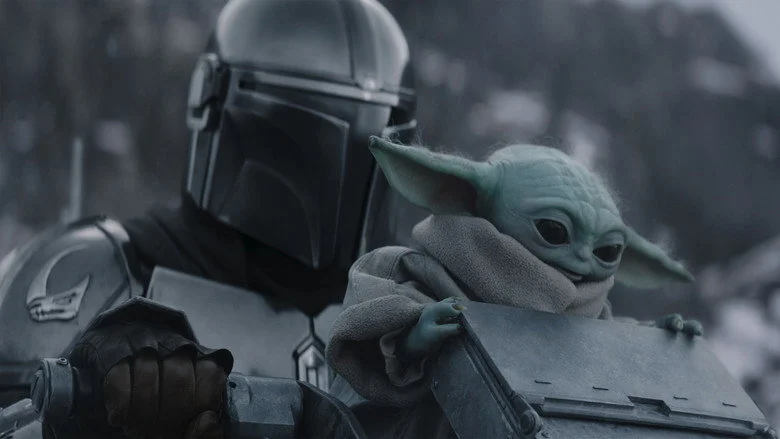
Action Sequences Serve Franchise Machinery Rather Than Human Stakes
The film’s action-adventure DNA manifests through a mission-driven structure that prioritizes political intrigue over kinetic innovation. Din Djarin and Grogu navigate a galaxy fractured between New Republic authority, Imperial remnants, and organized crime controlled by the Hutts, three opposing forces that should theoretically create explosive conflict.
Instead, the setpieces function as connective tissue between plot points rather than moments of genuine eruption. The New Republic’s reliance on our protagonist signals that action here serves narrative convenience; the Hutts appear as criminal obstacles rather than truly menacing antagonistic forces. Each sequence appears meticulously planned rather than anarchically alive.
What emerges is competent world-building rendered through action beats that prioritize franchise continuity over audience viscerality. The adventure elements exist to sustain the mythology, not to test the characters within it.
Readers interested in how franchises balance actor performance against narrative constraint may find value in exploring English Action reviews that examine similar pressures on ensemble storytelling.
Grogu’s Presence Dominates Through Absence of Traditional Performance
The unnamed creature at the film’s emotional center operates outside conventional acting entirely, functioning as pure cinematic symbol rather than character with agency or growth. Grogu’s muteness becomes thematic, a vessel into which audiences pour their own affection rather than a being who reciprocates it. This reduces the duo to a archetypal pairing: protector and protected, duty and vulnerability.
The casting of a non-human entity as co-lead signals the film’s true priority: not human drama but mythological completion. Grogu anchors the story through design and audience expectation rather than performance.
The Franchise Calculation Overshadows Political Complexity
The narrative positioning of Din Djarin within New Republic structures suggests thematic exploration of post-authoritarian governance and the moral compromises required to build stability from rubble. The presence of Imperial warlords and Hutt crime lords indicates a universe still fractured, still dangerous. Yet the film appears reluctant to interrogate these tensions with genuine consequence.
No production controversies have emerged around this theatrical extension. The project exists as pure franchise administration, competent in execution, cautious in ambition. The real tension lies between what the film is (a continuation) and what audiences might hope it becomes (a statement).
This is a film for those already emotionally invested in Din Djarin and Grogu’s survival, not for viewers seeking thematic complexity or character revelation. The theatrical format offers scale and spectacle, IMAX presentation maximizes its visual ambitions, but scale cannot substitute for narrative risk. Pascal performs within constraints so strict they become invisible; Favreau directs with professional efficiency that avoids genuine provocation. The result satisfies franchise obligation without achieving transcendence.
What works here belongs entirely to existing infrastructure. Anyone unburdened by *Mandalorian* mythology should avoid this entry; those seeking a standalone adventure will find only franchise machinery dressed as narrative.
*Star Wars: The Mandalorian and Grogu* delivers exactly what it promises, continuation without reinvention, earning a respectable 2.5 out of 5 stars for technical proficiency that masks thematic timidity.
Pedro Pascal’s restraint in similar masked-performer narratives finds an echo in Michael review, where the actor must negotiate expectation against expression.
For further exploration of how franchises navigate character continuity across formats, consider examining Chand Mera verdict and cinematic ambition.