Jaafar Jackson stands beneath stage lights in a Jackson 5 formation, executing movements that feel less like acting and more like hereditary muscle memory. The film doesn’t hide behind subtlety, it leans into the uncanny resemblance, the familial bloodline, the idea that sometimes casting *is* the story. What emerges from this gamble is a portrait of ascending talent suffocated by the very machinery designed to amplify it.
Antoine Fuqua’s Michael arrives as a straightforward biographical sprint from child prodigy to early solo phenomenon, banking heavily on recreation over revelation. At 127 minutes, it prioritizes charting Michael Jackson’s rise through the Jackson 5 and into his first ventures as a solo force rather than excavating the contradictions that made him singular. The film knows what it is: a performance-focused biopic that treats his stage presence as both shield and confession.
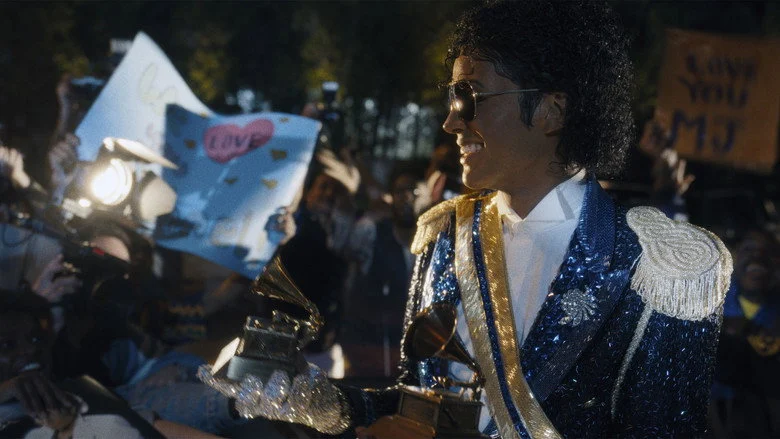
Jaafar Jackson’s Physical Inheritance Anchors What Dialogue Cannot
Jaafar Jackson carries this film less as an actor and more as a living echo. His resemblance to his uncle is not incidental, it’s the entire transaction. In staged sequences, where he inhabits Michael’s body through dance and public performance, the role finds its footing; the physical imitation becomes a form of biographical truth. But when the camera requires him to sit across from Colman Domingo as Joe Jackson and articulate internal conflict through dialogue, the performance fractures. He speaks the lines competently enough, yet lacks the interpretive depth needed to suggest layers beneath the surface.
The role itself may be partially culpable. Fuqua seems less interested in introspection than in spectacle, in documenting what Michael Jackson looked like ascending, not what it cost him to arrive. Jaafar’s strongest moments come during performance recreation, where imitation becomes legitimate artistic work. His weakest come when the film asks him to be psychologically present in family scenes.
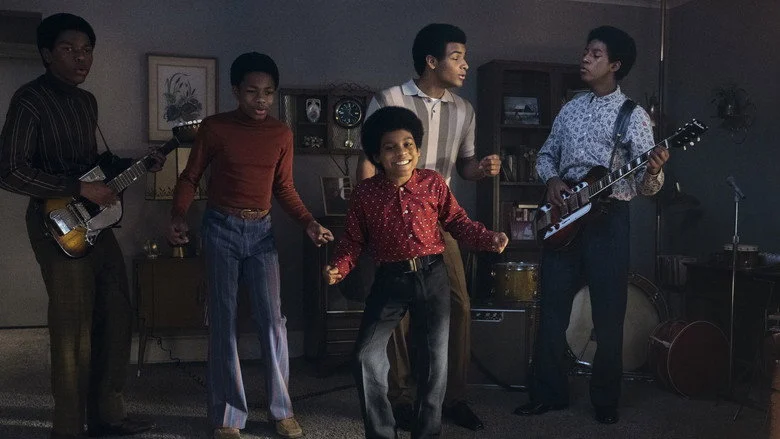
Fuqua’s Direction Prioritizes Chronology Over Complication
Antoine Fuqua brings a clean, linear structure to the material: childhood establishment, family formation through performance, transition to solo ambition, and the surge toward global dominance. This clarity is functional but uninspired. The screenplay by John Logan follows the standard biopic skeleton, origin, rise, conflict, triumph, without interrogating why this particular life story warranted reimagining.
The direction’s weakness lies not in incompetence but in caution. Where the film could have risked formal innovation, fragmented chronology, unreliable memory, dreamlike performance sequences that blurred boundary between public Michael and private boy, it instead opts for the familiar beats of the music biopic. Fuqua’s strength is in staging recognizable moments; his liability is in making them feel necessary rather than inevitable.
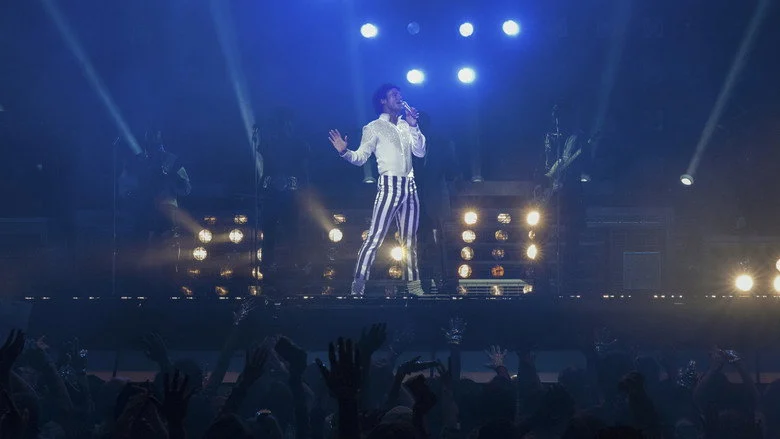
Performance Recreation Outpaces Dramatic Scaffolding at Every Turn
The Jackson 5 performance sequences are the film’s most assured work. These scenes don’t pretend to be drama, they *are* the drama. Watching Jaafar Jackson replicate movements from decades past, within a period-authentic frame, creates a temporal echo that feels earned. The staging captures something true about how performance itself becomes a historical record, how Michael Jackson’s body was always the text.
The early solo performance recreations function similarly. Rather than staging dialogue-heavy scenes exploring Michael’s artistic ambitions, Fuqua lets the choreography and stage presence communicate transformation. These moments register emotionally because they bypass interpretation and lean into documented fact, we know what Michael Jackson looked like performing; the film simply reconstructs it with careful precision.
But the dramatic scenes, particularly those involving Joe Jackson’s controlling influence and Michael’s creative tension with management, fall flat. The film frames these conflicts conventionally, without the visual or narrative sophistication to suggest why this particular collision of ambition and control matters beyond the surface story. Dialogue becomes expository rather than revelatory. Family struggle registers as plot function rather than psychological wound.
If you’re seeking deeper analysis of music biopics and their risks, English Biography reviews explore how contemporary cinema handles iconic lives.
Colman Domingo Brings Gravity Joe Jackson Never Receives
Colman Domingo’s portrayal of Joe Jackson functions as the film’s dramatic anchor, though the role itself resists complexity. Domingo channels control through physicality and measured fury, the father as pressure apparatus rather than human being. His scenes with Jaafar carry weight, but only because Domingo understands how to play authority without justification.
Nia Long as Katherine Jackson exists primarily as stabilizing presence, the mother who absorbs chaos without agency. Miles Teller’s John Branca appears in scenes connecting biography to business infrastructure, though his character remains underdeveloped. The supporting cast works competently within roles that function more as biographical infrastructure than fully realized characters.
Critical Dismissal Signals the Gap Between Recreation and Revelation
Deep Focus Review’s single-star assessment suggests something fundamental misaligns between ambition and execution. The criticism surrounding dramatic construction versus performance efficacy points to a structural problem: the film excels when it abandons dramatic pretense and embraces documentary fidelity. It falters when it attempts to *interpret* Michael Jackson rather than simply chronicle him.
Viewer response clusters around two poles: appreciation for Jaafar Jackson’s casting and the performance reconstructions, alongside frustration with narrative conventionality and compressed biographical scope. Audiences note the film’s structural familiarity, acknowledging it hits the expected beats of music-biopic machinery without surprising or challenging the form. The second-highest-grossing film of 2026 with a worldwide gross exceeding $716 million, it clearly connects with audiences seeking accessible Michael Jackson documentation rather than revisionist portraiture.
Here’s the honest assessment: *Michael* works precisely when it stops trying to be a drama. The performance sequences achieve something real, they document transformation through movement, they respect the historical record, they trust Jaafar Jackson’s physical inheritance to communicate what dialogue cannot. But the film’s dramatic spine never develops sufficient pressure. Joe Jackson becomes a symbol rather than a person; Michael’s internal conflict remains stated rather than demonstrated. This is a competent biopic that knows its subject better through stage light than through intimate conversation.
The film warrants viewing if you’re interested in how contemporary cinema approaches iconic figures through performance recreation and familial casting. It deserves skepticism if you expect psychological depth or formal innovation from your music biopic. Michael is a 3 out of 5, watchable, occasionally compelling, ultimately cautious in the presence of material that demanded genuine risk.
Jaafar Jackson’s inherited role echoes themes explored in Chand Mera review, where youth confronts the collision between ambition and identity.
Both films examine how pressure shapes performance in Commandovin Love verdict.