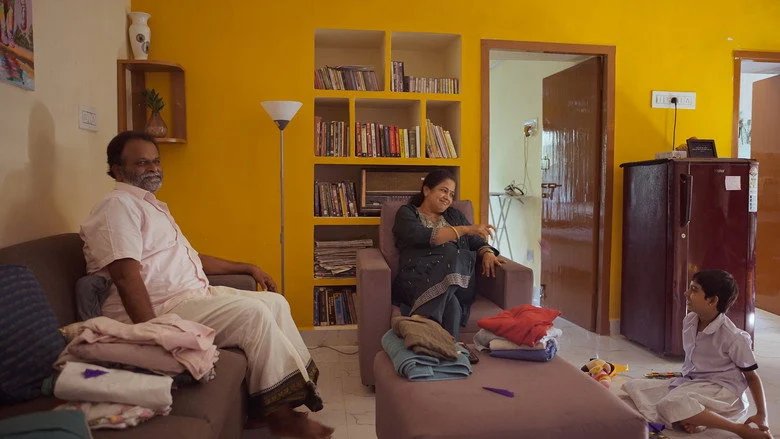
“Daddy, when I made mistakes as a child, you would scold me and hit me!”, that opening line from the son lands like a slap across decades of silence. Roopesh Peethambaran sets up a dysfunctional household where hatred between father and son is the only constant, and the dark comedy tone emerges from the raw, unvarnished pain beneath every line.
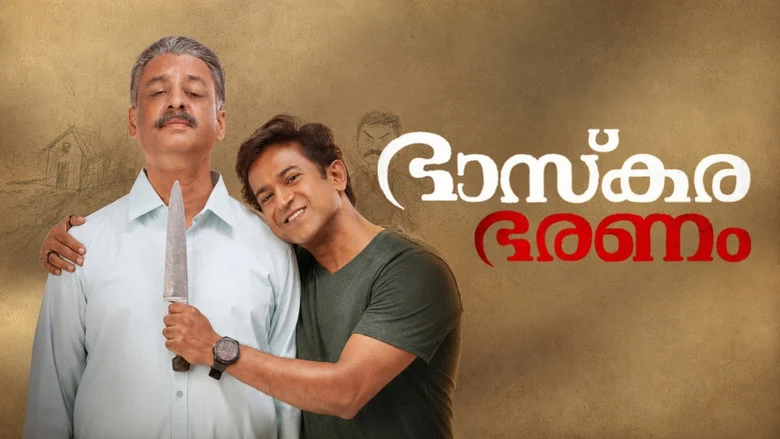
Roopesh Peethambaran: Director vs. Actor
Peethambaran wears two hats as both director and lead, and this duality serves the character of Bhaskara well. He plays the abusive father with a stubborn, unyielding physicality that never flinches, especially during the climax confrontation where emotional truths surface.
But the directorial side shows cracks in pacing. The shift between dark comedy and thriller feels less like a calibrated blend and more like a gear that grinds mid-journey, leaving certain stretches tonally adrift.
Ajay Pavithran’s Vengeance-Filled Son
Ajay Pavithran plays the son with an intensity that carries the film’s emotional weight. His confrontation scene, “But when you make mistakes, no one speaks up; everyone is afraid of you”, is the moment where the script’s moral ambiguity peaks.
The actor sells the accumulated rage of years without overplaying, and his physical stillness in the face of his father’s dismissiveness makes the silence between them almost unbearable. It’s a performance that insists you pay attention, even when the screenplay loses focus around him.
Dark Comedy Meets Thriller: A Tricky Tightrope
The film’s primary gamble is its genre mash-up. Dark comedy works best when it finds the absurd in tragedy, and the opening narration achieves that, the son’s monologue feels like a tragicomic confession that sets the rules of this world. The thriller elements, however, arrive through the son’s plan to “fix” his father, and here the pacing stumbles.
Scenes of domestic tension are interrupted by plot mechanics that feel rushed, as if the film knows its emotional core but not how to sustain suspense around it. The background score by Arun Thomas adds a melancholic undertone, but it cannot salvage the tonal whiplash between a dinner-table argument and a near-violent confrontation.
Where the craft truly works is in the close-ups during emotional confrontations. The camera stays tight on faces, weathered, tired, refusing to look away, and that intimacy anchors the film even when the narrative logic wobbles. The climax reveals an emotional truth about loving a father despite abuse, but the resolution remains ambiguous in a way that frustrates as much as it provokes thought.
Supporting Cast: Missed Opportunities
Sonika Meenakshi appears as a key family member, and her presence adds a quiet gravitas to the household dynamics. She has a brief scene where her silence speaks volumes about the collateral damage of this father-son war.
Midhun K. Das and Parvathy Kalarikkal get limited space, and their roles feel underwritten. Jishnu Mohan offers subtle support but never quite registers as more than a narrative placeholder.
These actors are competent, but the script’s lack of clarity about supporting arcs robs them of moments that could have deepened the film’s emotional ecosystem.
Controversy and Audience Reception
No political or social controversy has surfaced around Bhaskara Bharanam, but audience reception on social media has been mixed. The teaser received a strong emotional response, especially for the narration scene, but complaints about inconsistent tone and unclear character roles have emerged in early chatter.
The film’s attempt to tackle complex father-son trauma with dark comedy is bold, but audiences expecting a clean genre experience may find the ambivalence unsatisfying.
To Watch or Skip?
If you admire directors who take creative risks within the Malayalam indie space, Bhaskara Bharanam offers a flawed but honest attempt at blending genres. Watch it for the opening narration and Ajay Pavithran’s raw performance, but brace for a second half that loses its grip on tonal consistency. Regular theaters will serve the close-up-heavy cinematography better than streaming.
Bhaskara Bharanam is a messy, bruised family portrait that earns one strong scene but staggers through the rest, a 2.5/5 effort from Roopesh Peethambaran that shows ambition without fully mastering its craft.
For more on Malayalam dark-comedy crossovers, browse our Malayalam Comedy reviews.
Roopesh Peethambaran’s previous directorial Theeviram shared similar father-son tension, but Bhaskara Bharanam struggles with the same pacing issue that Angikaaram review .
This film’s tonal inconsistency mirrors the craft friction found in Con City verdict .