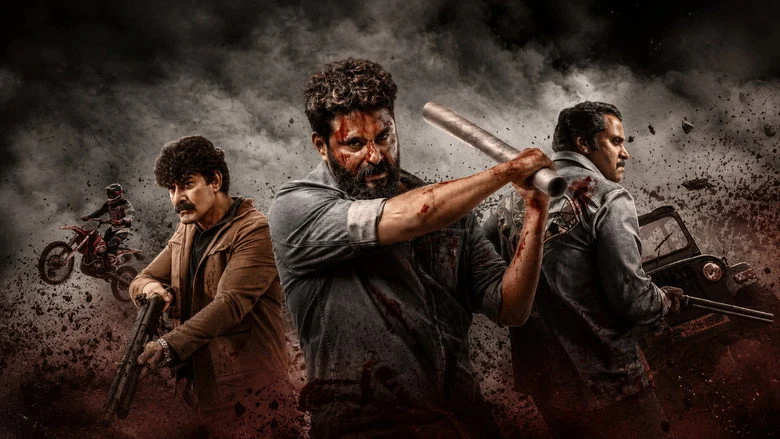
A middle-class family trained in martial arts finds their quiet routine shattered when a powerful mafia gang targets them for destruction. What begins as a home invasion becomes a survival battle where the wife and daughter reveal themselves as martial-arts champions capable of fighting back with devastating precision.
Director Subash K Raj’s *Blast* arrives as a Tamil action thriller betting heavily on a single premise: ordinary people with extraordinary combat skills defending their home against extraordinary violence. At 3 hours and 2 minutes, the film asks audiences to commit to an extended action-family drama hybrid, a gamble that hinges entirely on execution quality and sustained momentum.

Arjun’s Dual Register Across Family Drama and Combat
Arjun carries the film as protagonist, positioned to balance domestic vulnerability with action-hero physicality. The role demands he function as both father-figure anchor and fight performer, a register that often splits the difference between emotional realism and spectacle.
Whether he sustains that balance across three hours remains unclear from available material, but the structural choice signals intent: this is not a pure action film, but a family under siege narrative where the lead must ground both halves convincingly.
Subash K Raj’s Linear Conflict Structure Against Extended Runtime
The director’s strength lies in clarity: family setup, mafia threat, escalating danger, survival fight. The conflict arc is direct and high-contrast, designed for action cinema rather than narrative complexity. That simplicity serves the genre well, audiences know what they’re walking in for.
The weakness is architectural. Three hours demands either deeper character work or varied setpiece geography. The available structure suggests a mostly linear escalation, which risks padding over pacing. Runtime this long needs structural surprises to justify its length, not just extended fight sequences.
Action Thriller Mechanics: Combat Skills Over Investigation
The film abandons procedural investigation entirely, positioning trained martial artists as the central asset rather than detectives solving crime. This choice streamlines the action thriller into pure physical confrontation, a clean design that suits mass audience expectations for the genre.
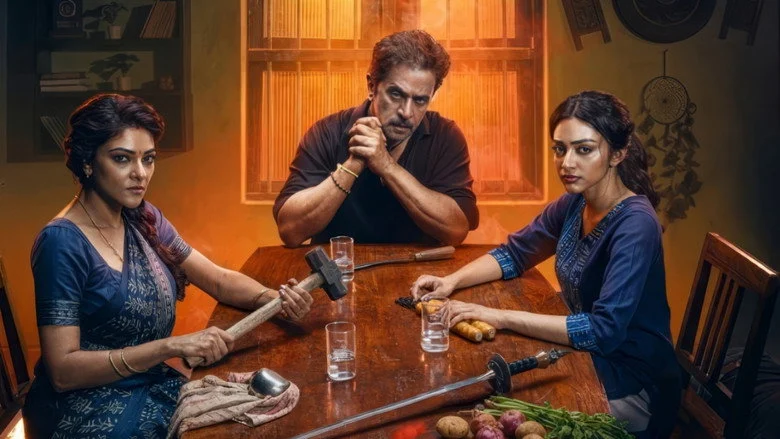
The home-invasion setup creates immediate spatial tension. A family under attack in their own domestic space generates instinctive audience investment without complex backstory. The trailer reveals the wife and daughter as martial-arts champions, which inverts the typical “wife needs protection” trope into a women-as-warriors subversion that the film appears to lean into.
The long runtime allows room for multiple combat beats beyond a single climax sequence. Whether those beats vary in choreography, scale, or emotional stakes, and whether they feel earned rather than repetitive, determines whether length serves the action grammar or undermines it.
For those seeking larger-scale Tamil action cinema, Tamil Thriller reviews offer context for how *Blast* positions itself within contemporary regional filmmaking.
Preity Mukundhan and Abhirami in the Family Unit
Preity Mukundhan and Abhirami anchor the supporting family structure, though character specifics remain unconfirmed in available material. Their casting in a martial-arts-trained family suggests the film intends them as active defenders rather than damsels, shifting the action burden across multiple family members rather than concentrating it on the male lead.
This distribution of combat responsibility signals thematic intent: the family survives as a unit because every member possesses training. No single hero carries the film; instead, collective capability becomes the story’s spine.
No Documented Controversy, But Premise-Heavy Marketing
No verified controversies or censorship issues emerge from available sources. The film’s U/A certification suggests violence within acceptable thresholds, though a 3-hour runtime with repeated combat sequences may test viewer endurance rather than regulatory boundaries.
What does emerge is a marketing strategy built entirely on the premise reveal: wife and daughter are fighters. That hook carries the trailer, which suggests the marketing team believes the action-family angle alone justifies theatrical investment. For audiences hungry for that specific combination, the bet may pay off. For those skeptical of whether 182 minutes of family-versus-mafia combat sustains engagement, the extended length becomes the central risk factor.
If the action choreography maintains novelty across multiple sequences and the family drama carries genuine emotional stakes, *Blast* could deliver for viewers seeking mass-appeal Tamil cinema with female-forward combat roles. The three-hour commitment demands precision execution, though, padding or repetitive setpieces will expose the runtime as a liability rather than a feature. Watch this in regular theatrical format, where the action scale justifies the screen investment; streaming would flatten the spectacle that this film relies upon entirely.
*Blast* is a premise-driven action thriller that gambles its entire appeal on family martial arts versus mafia conflict sustained across 182 minutes, a bet that hinges on whether Subash K Raj can maintain choreographic variety and emotional stakes, not just fight-scene volume.
The similar family-under-siege action structure in Pati Patni review offers a contrasting approach to domestic conflict cinema.
Historical spectacle demands comparable visual commitment to what *Blast* attempts in its action design, as explored in Raja Shivaji verdict.