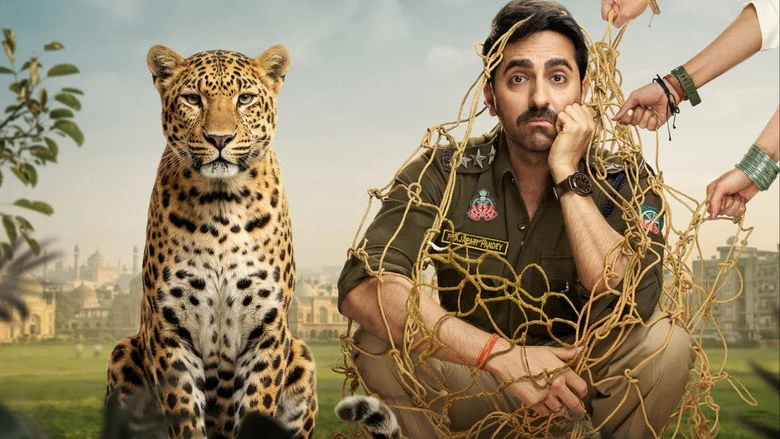
Prajapati Pandey wakes up as a forest officer in Prayagraj with a journalist wife, a stable domestic life, and one catastrophic decision waiting to unravel everything. Within minutes, the film pivots him into a collision course between marital duty, workplace temptation, and the escalating chaos that follows, a setup that promises situational comedy but delivers mostly exhausted repetition of a formula that worked a decade ago.
Mudassar Aziz’s second swing at the “Pati Patni Aur Woh” territory arrives weighted by expectation and hindered by a screenplay that mistakes familiarity for comfort. The romantic-comedy apparatus here runs on misunderstanding fuel, the kind where one lie spawns five others and everyone stays confused until the final act absolves itself through convenient revelation.
Ayushmann Khurrana’s Reaction-Machine Leaves No Room for Character
Ayushmann plays Prajapati as a man permanently caught mid-flinch, reacting to circumstances rather than driving them. His forest-officer profession becomes pure window dressing, a career detail with no texture, no thematic weight. The film positions him at the center of a triangular romantic conflict, but his performance architecture relies entirely on comic timing through hesitation rather than on building a believable man torn between competing desires.
What works intermittently are the dialogue-heavy moments where Aziz allows Khurrana to land a punchline through delivery, not through character choice. Beyond that, the role asks him to sustain confusion for 117 minutes, which becomes visually and emotionally monotonous by the second act.
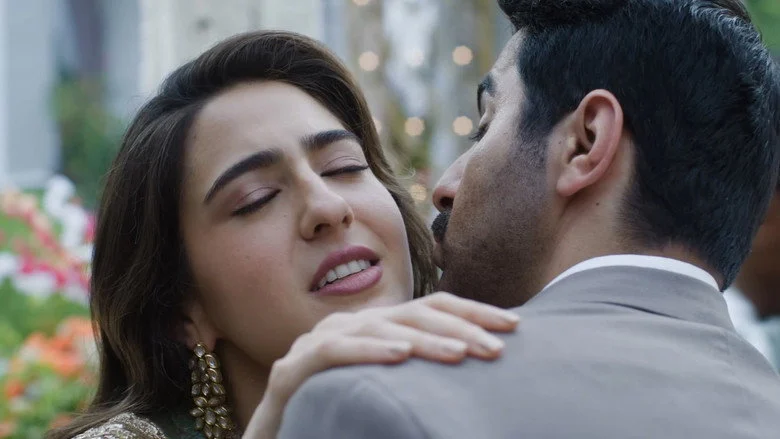
Mudassar Aziz Chains Himself to Situational Mechanics Without Structural Invention
Aziz understands how to stack comic confusion, the escalation of one misunderstanding into five simultaneous ones is controlled, sometimes effective. His strength here is in clarity of premise: audiences grasp instantly what Prajapati’s dilemma is and how it will spiral. The weakness, however, is terminal: he relies on this mechanism alone. No character arc beneath the chaos, no thematic interrogation of marriage or temptation, no formal risk that might refresh the material.
The screenplay by Aziz and Ravi Kumar treats the domestic setup as a launchpad for gags rather than as a dramatic foundation. Once the misunderstandings are established, the film simply replays them in louder, broader strokes.
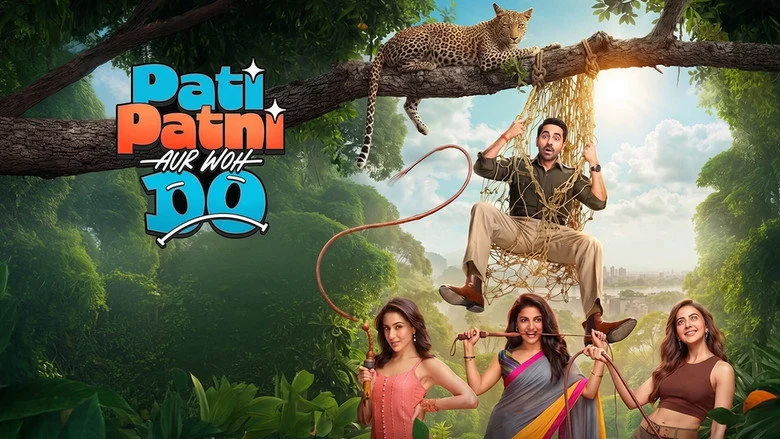
Romantic Comedy as an Engine Running on Empty Repetition
The genre core here depends on escalating confusion, Prajapati caught between his wife Aparna and two other romantic entanglements, each interaction spawning fresh misinterpretation. The trailer framing promised a clean triangular conflict, and the film delivers exactly that: clean, predictable, and drained of stakes. A situational-comedy sequence in the mid-film section generates momentary laughter through sheer absurdity, but the laugh fades the moment you recognize the structure.
What the film fails to do is make the emotional cost of these misunderstandings matter. Aparna, played by Wamiqa Gabbi, exists primarily as the wronged party, a journalist wife whose professional identity dissolves the moment suspicion sets in. The romance here becomes mechanical: misunderstand, escalate, resolve through dialogue clarification, repeat.
The setting in Prayagraj and the professional identities scattered across the cast suggest potential for satirizing small-town morality or examining contemporary marriage through a sharper lens. Instead, the film treats these details as mere staging for confusion sequences. Nilofer Khan (Rakul Preet Singh), positioned as Prajapati’s colleague and best friend, becomes a prop in his dilemma rather than a character with her own stakes or agency.
For those seeking deeper analysis of Hindi cinema’s romantic-comedy tradition, explore more Hindi Comedy reviews that examine how the genre continues to evolve, or stagnate.
Wamiqa Gabbi and Rakul Preet Singh Buried in a Script That Underutilizes Them
Wamiqa carries the domestic conflict with a restraint that suggests she understood the assignment better than the material deserved. Her Aparna functions as the emotional anchor, yet the screenplay denies her the depth such a role demands. Rakul Preet Singh, cast as Nilofer, occupies an ambiguous position in Prajapati’s crisis without ever becoming a fully realized character, she’s the best friend, the temptation, the catalyst, but never the person with interior conflict of her own.
The ensemble assembly, Ayushmann, Wamiqa, Rakul, and Sara Ali Khan, was positioned as the film’s primary selling point, but the script distributes opportunity unevenly. Supporting players Vijay Raaz and Ayesha Raza appear to serve functional roles without detailed character work emerging from the available material.
Box Office Underperformance Reflects Audience Fatigue With the Formula
The film landed with a reported production budget of ₹50–60 crore and a final collection of ₹46.6 crore, translating to a commercial failure that signals audience resistance to the romantic-comedy template when executed without novelty or thematic depth. The opening premise generated interest through its triangular setup in promotional material, but sustained engagement appears to have collapsed once audiences recognized they were watching a mechanical replay of a 2019 film with marginal structural changes.
This is a film made for viewers who want situational comedy without ambition, misunderstandings without consequence, and resolution without character transformation. If you’re looking for mainstream Hindi romantic comedy that entertains through dialogue timing and familiar structures, this lands in that category. For audiences seeking a fresh take on marriage, temptation, or the romantic-comedy genre itself, this offers nothing beyond what you’ve seen before, and often worse. Watch it on streaming if the cast alone hooks you; a theatrical visit demands more than escalating confusion and comic timing can provide.
Pati Patni Aur Woh Do mistakes situational density for comedic sophistication, a 2.5-out-of-5 entertainer that confirms Mudassar Aziz’s ideas have calcified into formula.
Raja Shivaji similarly explores how history and spectacle can serve as mere backdrop without thematic engagement, though in Raja Shivaji review.
Like Ek Din’s struggle with Ek Din verdict, this film reveals how casting alone cannot compensate for structural exhaustion.