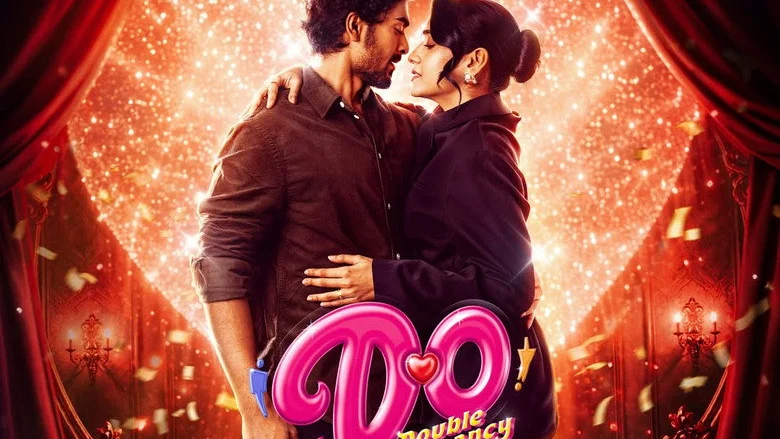
A woman by day becomes someone else by night, sharing one body while trying to sustain a love affair that demands she be singular. Aswin Kandasamy’s *Double Occupancy* takes a premise most films would milk for broad comedy and plants it squarely in the romantic-fantasy zone, asking what happens when intimacy meets duality.
Santhosh is tasked with the impossible: switching between contrasting day and night states while anchoring emotional stakes that hinge on deception and desire. The role demands transformation without the luxury of clarity, a performance trap that could collapse under shallow staging. Whether he navigates this tonal tightrope remains the film’s central gamble.
Kandasamy’s Concept Is Sharp; Execution Remains Opaque
The director has framed his premise with admirable clarity: romantic conflict built around identity instability rather than the familiar obstacle-course of standard love stories. The fantasy element integrates into the love narrative through a single-body dual-identity premise, unusual enough to distinguish itself from formula.
What’s absent is any verifiable sense of how Kandasamy controls tone across two hours. A film this conceptually risky needs precise modulation between romance and the uncanny, between the tenderness of connection and the horror of coexistence. The synopsis promises coherence; whether the screenplay delivers it remains unknowable without viewing.
The Day/Night Split Drives Genre Stakes But Risks Monotony
Romance cinema relies on conflict born from desire meeting resistance. Here, the resistance is ontological: two identities, one body, love trying to survive the mathematics of impossibility. The fantasy framework allows Kandasamy to sidestep mundane obstacles, mismatched careers, family disapproval, and chase something stranger.
The secret threatening to upend their lives functions as the main tension device, but the synopsis reveals nothing about its nature or timing. A romance where the central revelation remains obscured can either deepen emotional investment or feel like withholding essential context. That line separates sophisticated storytelling from narrative evasion.
The emotional beats described in promotional material, love, identity, concealment, suggest the film knows what it wants thematically. Whether each scene earns its setup, whether transformation looks deliberate rather than convenient, whether the audience believes in this coupling across two distinct personas: these are execution questions the sources cannot answer.
Fans of Tamil fantasy-romance concepts and viewers interested in identity-based high-concept narratives will find the premise distinctive enough to warrant investigation. Our Tamil Drama reviews dig deeper into how regional cinema handles genre hybrids like this one.
Reshma Venkatesh and the Supporting Architecture
Reshma Venkatesh anchors the romantic core, though her specific role, whether she knows, suspects, or remains blind to the dual identity, shapes how the entire film lands emotionally. Her positioning among the leads suggests she carries equal narrative weight.
VTV Ganesh and Bagavathi Perumal round out the ensemble. Both actors carry recognizable presence in Tamil cinema, signaling the production’s interest in audience familiarity. Their function in a story this conceptually unusual will likely be stabilizing: grounding the impossible in familiar comedic or dramatic registers. Vinoth Kishan and Samyuktha Viswanathan’s roles remain undefined in available sources, though their casting suggests investment in depth beyond the central romance.
A High-Concept Bet in Tamil Genre Cinema
Tamil film audiences have increasingly welcomed non-formula material, and *Double Occupancy* arrives as a calculated risk within that openness. The premise is immediately graspable yet narratively demanding. The film asks viewers to accept the fantastical while remaining emotionally invested in romance, a combination that works when tone is precise and casting is trusted.
Whether Kandasamy achieves that balance, whether Santhosh and Reshma Venkatesh build chemistry across two identities, whether the secret lands as revelation rather than contrivance: these are questions only the film itself answers. The concept promises something worth the risk. Execution will determine if that promise holds.
Go if you’re fatigued by conventional romance structures and willing to sit with conceptual ambition. Skip if you need proven critical consensus or traditional narrative satisfaction. The theatrical experience will matter here, this is a film built on visual transformation and intimate scenes that demand the scale of a screen.
*Double Occupancy* is a risk worth taking if Kandasamy sticks the landing, though without critical evidence the gamble remains exactly that, a gamble that merits curiosity but not blind faith, a 2.5-out-of-5 proposition that could tip either direction.
Kandasamy’s willingness to use identity as romantic conflict echoes the thematic ambition found in VENDETTA BEAST review to unconventional premises.
Both films navigate the tension between high-concept setup and emotional execution in ways that demand active viewer investment, as seen in Sing Geetham verdict of similar fantasy-grounded narratives.