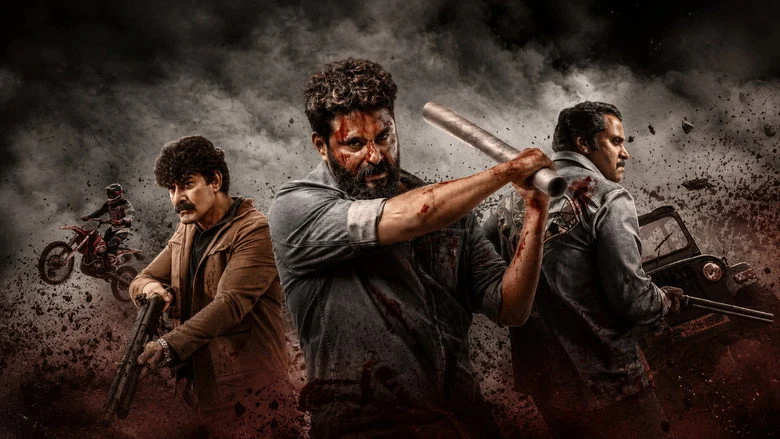
A young girl stumbles into the forest and witnesses something that shatters her understanding of family, her father’s body convulsing, his form shifting into something that doesn’t belong in daylight. The moment arrives without fanfare or orchestral swelling, which is precisely the problem. What should anchor a horror-thriller’s central spine instead floats untethered, a premise with weight but no structural purpose.
Vendetta: The Beast Within arrives as a film caught between two genres, never fully committing to the mechanics that would make either work. The screenplay knows what it wants to provoke, transgression, body horror, the corruption of paternal safety, but the direction refuses to do the heavy lifting necessary to earn those provocations.
Alexander J. Farrell’s Direction Prioritizes Atmosphere Over Narrative Momentum
Farrell constructs scenes with visual discipline, favoring shadow and suggestion over explicit revelation. The forest sequences carry genuine unease; cinematography does genuine work here. Yet the screenplay’s central conflict, what the father has become and why Willow must carry that knowledge, never crystallizes into dramatic shape. Atmosphere without architecture leaves audiences adrift.
The Body-Horror Premise Demands Genre Precision It Doesn’t Achieve
Body-horror cinema requires either grotesque intensity or philosophical clarity. The transformation sequences arrive without the visceral commitment that would make them memorable. The film hints at cosmic or supernatural explanation without the mythic grounding that justifies withholding answers. Early scenes establish Willow’s isolation competently enough, but her arc never deepens beyond witnessing, she remains observer rather than agent of her own narrative resolution.
The second act sustains tension through environmental design rather than character revelation. Isolation works as a tool, but only when the protagonist actively struggles against it. Here, the struggle feels muted, as though the screenplay trusts the setting to carry emotional weight that only character motivation can truly bear.
A third-act pivot attempts philosophical commentary on familial obligation and inherited darkness, but arrives too late and lands too softly. The thematic payload, parenthood as source of both protection and contamination, deserves sharper screenplay architecture to penetrate. Instead, it dissolves into ambiguity that feels unearned rather than haunting.
Our Hindi, Telugu, and regional cinema audiences deserve genre stories that respect both their intelligence and their appetite for transgressive material. This film respects neither sufficiently to recommend unconditionally.
The Supporting Cast Underutilizes Its Ensemble Potential
The father’s performance, though committed to physical transformation work, lacks the grounded vulnerability that would make his mutation genuinely tragic. Willow’s character design, the 10-year-old witness, recalls successful child-protagonist horror (The Ring, Hereditary) but without the screenplay depth those films provide. The supporting household members function as atmosphere generators rather than emotional anchors, a missed opportunity for interpersonal texture.
Body-Horror Cinema Thrives on Specificity; This Film Remains Deliberately Vague
The marketing suggests hybrid creature mythology, but the film withholds explanation with the confidence of films that have earned narrative ambiguity through earned craft. Mystery works in horror when characters actively pursue answers; here, avoidance feels like a script limitation rather than character choice. Genre audiences recognize the difference immediately and feel cheated by it.
The theatrical release in July 2024 gave way to streaming positioning by mid-August, a trajectory that suggests audience and distributor misalignment from opening weekend. Horror-thriller audiences wanted either the creature-feature intensity or the psychological sophistication promised by the premise. The film delivered neither with sufficient conviction to justify either theatrical commitment or streaming patience.
If you’re drawn to atmospheric indie horror, the visual craft justifies a single viewing on a platform where you control pacing. Skip theatrical expectations; this is a film that works better in isolation, where its structural hesitations feel less like failures than intentional mystery. The craft deserves attention even as the screenplay doesn’t.
Vendetta: The Beast Within assembles competent technique but squanders its transgressive premise through narrative ambiguity that feels accidental rather than purposeful, a 2.5 out of 5 thriller.
Craft-forward horror fans may find resonance with Sing Geetham review, another film where directorial vision shapes atmosphere above plot clarity.
Similar tension between directorial restraint and genre expectation marks Abadameva Jayathe verdict, though that film weaponizes its ambiguity far more deliberately.