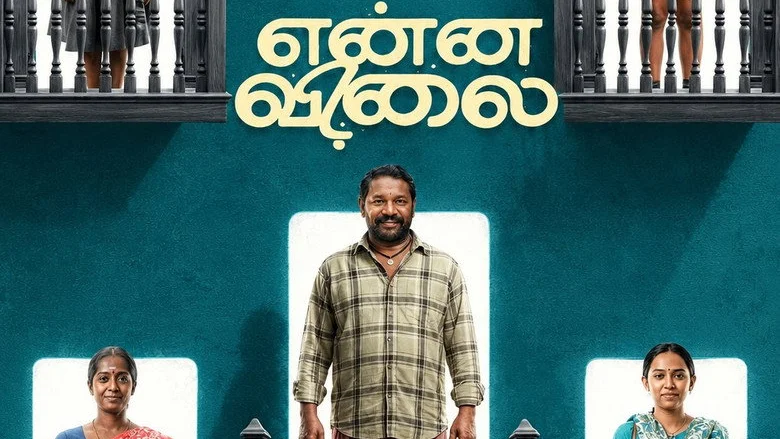
A widow stands at the threshold of remarriage, her personal longing colliding headlong with the suffocating weight of village custom. Nooru Sami plants itself firmly in that tension, the quiet rebellion of a woman choosing herself over the sanctified memory that her community demands she preserve forever.
Director Sasi’s family drama arrives at a moment when Tamil cinema has begun interrogating the cost of tradition, yet this film’s central conflict, personal happiness pitted against social expectation, remains one of cinema’s most urgent moral knots. The 131-minute runtime suggests ambition; whether it justifies its length depends entirely on how deeply the performances dig into that contradiction.

Vijay Antony’s Restraint in a Role Demanding Vulnerability
Vijay Antony carries the emotional architecture of this film without ever announcing his effort. His presence here suggests a performer willing to inhabit grief and its afterlife, the strange territory where a widow must navigate desire while standing in the shadow of duty. The specificity of this restraint, avoiding melodrama where lesser actors would indulge, becomes the film’s greatest asset.
Sasi’s Direction Balances Intimacy Against Structural Predictability
Sasi demonstrates genuine fluency in extracting nuance from domestic spaces and village interiors. The strength lies in his willingness to let scenes breathe, to find meaning in silences rather than exposition. Yet the screenplay’s adherence to a familiar trajectory, the widow’s defiance meets community resistance, emotional climaxes arrive on schedule, suggests a director more comfortable with tradition than willing to break it.
Family Drama’s Emotional Language Struggles for Originality
The film understands that family drama thrives on the friction between individual desire and collective expectation. Scenes involving the widow’s private moments of longing, contrasted against public moments of conformity, hit the emotional registers the genre demands. This duality, inner world versus outer performance, is where the narrative finds its genuine power.
Yet the execution follows the well-worn path of its predecessors. Conversations about remarriage feel scripted toward resolution rather than genuine moral ambiguity. The village as antagonist, while narratively convenient, lacks the specificity required to make social pressure feel lived rather than imposed. Tamil family dramas have refined this template for decades; this film refines it further without fundamentally reimagining it.
What prevents the family drama from feeling entirely conventional is Antony’s commitment to portraying the widow’s internal conflict as something that cannot be resolved through grand gestures or tear-soaked monologues. His performance suggests that some choices never feel entirely resolved, they simply become survivable.
Lijomol Jose and Swasika Vijay Navigate Patriarchal Scaffolding
Lijomol Jose and Swasika Vijay operate within a film that gives them limited agency to define their characters beyond their relationship to the widow’s central choice. Jose carries the weight of someone caught between familial loyalty and personal sympathy, while Vijay’s presence suggests another layer of complexity regarding how widowhood functions across different social positions. The casting signals the film’s intent to examine widowhood as a collective female experience rather than an isolated tragedy.
Village Morality and the Politics of Female Remarriage
The film engages directly with a social reality that Tamil cinema has only recently begun exploring with genuine sincerity: the weaponization of tradition against women’s autonomy. Nooru Sami doesn’t shy from this politics, though it stops short of articulating a radical argument. The widow’s remarriage becomes both personal rebellion and social transgression, and the film respects this dual significance without reducing either dimension.
Tamil family drama frequently asks audiences to sympathize with progressive choices while retaining respect for traditional values, a comfortable moral position that avoids genuine conflict. This film sustains that balance, which means it satisfies without disturbing.
For family audiences seeking character-driven drama grounded in recognizable social conflict, Nooru Sami delivers what it promises: a thoughtful examination of personal happiness measured against community expectation. Vijay Antony’s performance anchors the material with a quietude that elevates the proceedings beyond melodrama, though the screenplay’s predictable architecture prevents this from becoming the urgent moral reckoning the subject deserves.
Viewers drawn to action-driven entertainment should seek elsewhere; this is a slow-burn character study built for patient observation. The regular theatrical format suits the intimate scale of the storytelling, where expressions and silences matter as much as dialogue.
If you appreciate performances that whisper rather than shout, and can tolerate familiar structural patterns in service of character exploration, this merits a theatrical visit, though it won’t surprise anyone attuned to the rhythms of contemporary Tamil family cinema. Nooru Sami is a competent, occasionally moving examination of its subject, earning a solid 3 out of 5 for Antony’s graceful restraint anchoring material that finds comfort in convention.
The quiet persistence of Antony’s work here echoes the unresolved tensions in Maa Inti review.
For comparison with similar character studies navigating village sociology, see Valluvan verdict balance performance against expectation.