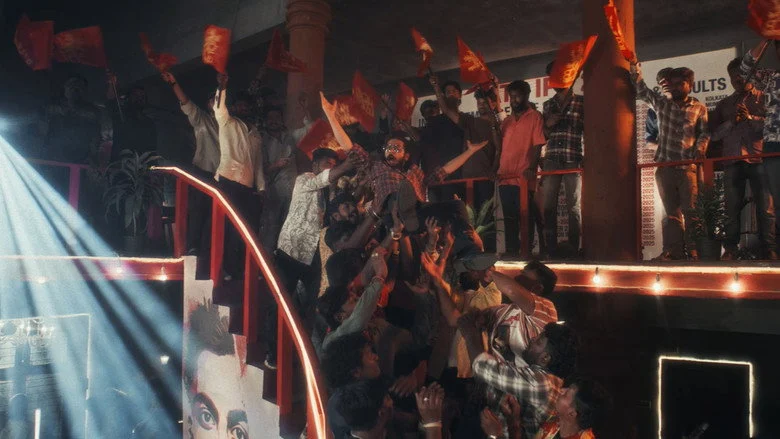
A movie star named ‘Golden Star’ Kulkanth Kumar walks into the arena of Tamil Nadu politics, and every corridor he enters feels like a trap set by men who were there long before him. Natarajan Subramaniam, known simply as Natty, carries this central premise on his shoulders, and the casting alone signals that Umapathy Ramaiah wants someone the Tamil audience both trusts and questions simultaneously.
The role of Kulkanth Kumar is a mirror held up to a very specific Indian fantasy, the celebrity-turned-politician who believes stardom is currency enough for governance. Natty plays this with a careful restraint that prevents the character from becoming cartoonish. Whether he fully convinces across 2 hours and 18 minutes is a more complicated verdict.
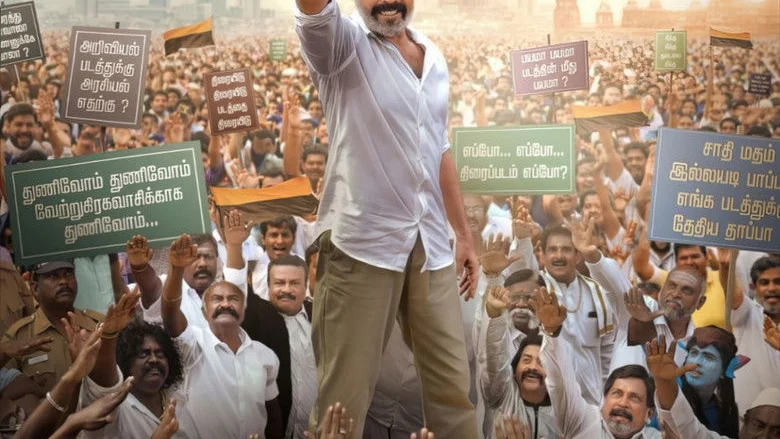
Umapathy Ramaiah’s Direction Has Ambition, But the Screenplay Leaves Gaps
This is Umapathy Ramaiah’s sophomore directorial venture, and his ambition is legible. He wants TN 2026 to be a satirical portrait of Tamil Nadu’s political circus, not just a star vehicle. That intent gives the film a backbone that many similar projects lack.
The weakness, however, is in the screenplay’s architecture. The story of a superstar facing political opposition is a premise rich with tension, but without a tightly wound second act, that tension risks dissipating before it lands any meaningful blow. Ramaiah writes with satirical instinct, the question is whether the structure can sustain it.
The Political Satire Cuts Unevenly, Sharp in Intent, Softer in Execution
Political satire in Tamil cinema carries the burden of context. Every scene exists against a backdrop the audience already knows, recent incidents, recognisable power structures, familiar archetypes. TN 2026 leans into this familiarity, drawing from Tamil Nadu political events to shape its comic and dramatic beats. That specificity is both its strength and its risk.
The action and comedy threads work best when they serve the satire rather than interrupt it. The ‘Kulkanth Kumar’ song, featuring Natty in a retro avatar with Premgi Amaren’s vocals and Mohan Rajan’s lyrics, scored by Darbuka Siva, signals the film’s tonal register early. It is a film that wants to be entertaining and pointed in equal measure.
The moments where the drama threads into the political satire feel earned. The moments where it retreats into conventional masala territory feel like a missed opportunity. I find myself wishing the film trusted its sharpest instincts more consistently throughout.
For more Tamil political drama and action reviews, Tamil Action reviews covering recent releases are available across the site.
Thambi Ramaiah and a Veteran Ensemble Holding the Edges Together
Thambi Ramaiah’s presence in a Tamil political drama is rarely accidental. He carries the weight of familiar authority, the kind of supporting performer who can make even a thin scene feel inhabited. His casting here suggests the film needs someone who can ground the satirical exaggeration in something recognisably human.
The supporting ensemble, M.S. Bhaskar, Ilavarasu, Thalaivasal Vijay, Vaiyapuri, Chandini Tamilarasan, Redin Kingsley, reads like a deliberate stacking of Tamil cinema’s most reliable character actors. Each of these names brings institutional memory to the screen. When a film populates its frame with this kind of experience, it is signalling that it wants texture, not just plot momentum.
A Petition Before the Elections Makes TN 2026 a Film You Cannot Ignore
The most telling indicator of TN 2026’s potential impact arrived before the film even screened widely. A petition was filed seeking the Election Commission to halt its release ahead of Tamil Nadu’s assembly elections on April 23, just thirteen days after the film’s April 10 release date. The decision on that petition was reportedly pending.
That a film about a movie star entering politics should arrive precisely as Tamil Nadu enters election season is not coincidence, it is a provocation. Whether Ramaiah intended this timing as commentary or simply as marketing leverage, the result is the same: the film enters the cultural conversation loaded with real-world stakes. That context is impossible to separate from how any audience will receive it.
If you are drawn to films that use celebrity identity and political power as dramatic friction, the Love Insurance review review explores how another recent Tamil film navigated the tension between entertainment ambition and thematic overreach.
TN 2026 is worth the watch for Tamil cinema followers who enjoy political satire with a masala spine, go in with calibrated expectations, and the film’s sharper edges will land more cleanly. It is not a seamless piece of work, but its timing, its ensemble, and Natty’s committed lead performance make it more than a curiosity. A theatrical watch, if you are close enough to the political pulse it is trying to strike.
TN 2026 is a flawed but provocative Tamil political satire that earns a 2.75 out of 5, Natty’s grounded performance and the film’s well-timed boldness keep it afloat even when Ramaiah’s screenplay loses its grip.
Made in Korea explores cross-cultural identity with a surface-level confidence similar to TN 2026’s political posturing, the Made Korea verdict in both films ultimately tests whether premise alone can carry a feature.