The first three minutes of Yezhu Kadal Yezhu Malai arrive like a held breath. Ram, the filmmaker who has spent his career chasing the metaphysical through the mundane, opens his latest with rain hammering against the windows of a moving train, the rhythmic clatter of wheels on track serving as both lullaby and countdown. It is a sequence the makers were confident enough to release ahead of the film’s October 1 debut, a three-minute flex that announces precisely what kind of experience awaits: patient, sensory, and unapologetically consumed by the weight of time.
What follows is a two-hour-and-fifteen-minute meditation on love, endurance, and the peculiar agony of never being able to let go. Nivin Pauly, in a performance that trades his usual affable charm for something considerably more haunted, plays an 8, 000-year-old immortal who has witnessed civilisations rise and crumble but cannot shake the one thing that keeps him tethered to his own humanity: the memory of love. Opposite him, Soori, yes, that Soori, the comedian turned character actor, embodies a 32-year-old man returning home after years of what the director describes as “working like a slave in the desert.” The collision of these two lives, one ancient beyond comprehension, one battered by the ordinary brutalities of survival, forms the film’s philosophical spine.

The Train as Confessional: Ram’s Contained Cosmos
Ram’s decision to anchor the encounter within a train carriage is neither incidental nor merely atmospheric. The train, that most democratic of Indian cinematic spaces, becomes a pressure cooker for existential interrogation. In the film’s most discussed sequence, the immortal and the traveller find themselves alone in a compartment as the rain intensifies outside. The blocking here is precise: Ram keeps his camera largely static, allowing the two actors to occupy the frame in a visual grammar that mirrors their power dynamic. Pauly’s immortal sits with the stillness of someone who has long since stopped being surprised by anything. Soori’s traveller fidgets, shifts, looks toward the door. It is a masterclass in using physical comportment to articulate interiority.
The dialogue that emerges from this exchange, “He has seen everything in life, but love is the only thing he never gets tired of”, lands not as aphorism but as confession. Pauly delivers it with a weariness that suggests the line has been rehearsed across millennia, repeated to himself in countless languages, in countless lifetimes, until the words have lost their shape but retained their ache.
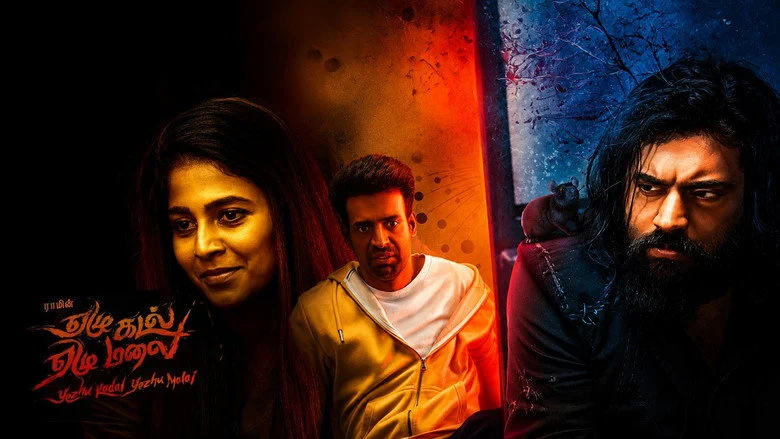
Soori’s Grounding Presence and the Problem of Anjali
The film’s smartest structural decision is positioning Soori as the audience surrogate. His traveller is not a hero; he is a man who has spent years performing invisible labour, returning to a home that may no longer recognise him. Ram has spoken about this character with evident affection, and Soori rewards that faith with a performance stripped of his comedic instincts. Watch his eyes during the train sequence, they dart, calculate, assess. This is a man who has learned to read rooms for survival, and the immortal’s serene indifference unnerves him precisely because it suggests a threat he cannot categorise.
Anjali’s role, frustratingly, remains the film’s most opaque element. Confirmed as central to the narrative, her character’s function within the immortality framework is left largely unexplored in pre-release material. One suspects Ram is withholding her contribution as a third-act revelation, but the absence of any concrete detail about her performance in the promotional apparatus is a curious omission for a film that otherwise wears its philosophical ambitions proudly.
For those tracking how Tamil cinema’s most interesting filmmakers are handling high-concept material, the comparison to Baththa review is instructive, both films trap their protagonists in confined spaces and ask them to confront the architecture of their own beliefs. Ram’s train, however, moves. The world outside shifts. The confinement is temporary, which makes the existential crisis all the more urgent.
Where the Film Risks Losing Its Grip
Here is where critical honesty demands caution. No verified post-release reviews were available at the time of writing, which means any assessment of the film’s second half, the movement from encounter to confrontation, from philosophical debate to emotional resolution, must be extrapolated from the structural blueprint. The available plot descriptions suggest a largely linear journey: encounter, development, resolution. Ram has never been a filmmaker interested in conventional three-act mechanics, and the risk with a premise this conceptually dense is that the middle section becomes a series of conversations rather than dramatic escalation.
The film’s festival pedigree, a world premiere at IFFR 2024, signals that this is not a commercial compromise. But festival acclaim and theatrical satisfaction are not always aligned. The 2h15m runtime, modest by contemporary Tamil standards, suggests Ram has resisted the temptation toward bloat. Whether he has found a way to sustain tension across the middle act without a conventional antagonist remains the film’s most significant question mark. The sources are clear: this is not a villain-driven narrative. The conflict is existential, relational, internal. That is a harder sell than a man with a gun, and Ram knows it.
Yuvan’s Score and the Sonic Architecture of Eternity
Yuvan Shankar Raja’s involvement is the film’s most intriguing technical variable. The composer has spent recent years oscillating between commercial assignments and more experimental work, and the opportunity to score a story about an 8, 000-year-old being should theoretically unlock something primal. No song titles or score feedback are available yet, but the opening title sequence, that three-minute showcase, reportedly leans heavily on sonic texture to establish the immortal’s temporal dislocation. If Yuvan has delivered a score that treats silence as carefully as sound, the film’s slower passages may achieve a hypnotic quality that the plot descriptions alone cannot convey.
For another perspective on how Tamil cinema is currently negotiating the tension between artistic ambition and commercial expectation, see our analysis of City Lights verdict, which similarly finds a filmmaker wrestling with the weight of his own ideas.
The Immortal Question: Does Pauly Have the Gravity?
Nivin Pauly has spent the last decade proving he is more than the charming everyman of Premam and Bangalore Days. His recent filmography suggests a deliberate pivot toward darker, more challenging material. The immortal is his most ambitious swing yet, a character who must convey wisdom without smugness, weariness without self-pity, and love without sentimentality. The pre-release material positions him as the film’s dramatic centre, and the opening sequence was designed to showcase his ability to hold the frame with minimal movement. If he succeeds, this could be the performance that redefines his career. If he falters, the film’s philosophical ambitions collapse under the weight of a single miscast presence.
Verdict: A Bold, If Uncertain, Swing
Yezhu Kadal Yezhu Malai arrives as a genuine curiosity, a romantic psychological thriller that treats immortality not as superhero origin story but as existential wound. Ram’s direction, Pauly’s commitment, and Soori’s grounding presence suggest a film of unusual texture and ambition. The absence of verified critical or audience response makes definitive judgement premature, but the structural risks are evident: a middle act that must sustain philosophical inquiry without conventional dramatic propulsion, a supporting role (Anjali’s) that remains frustratingly undefined in the promotional material, and a resolution that reportedly favours emotional catharsis over action spectacle.
This is not a film for viewers seeking the kinetic satisfactions of mainstream Tamil action. It is for those who found something resonant in the quieter moments of Tamil Thriller reviews, audiences willing to sit with ambiguity, to let a film’s ideas wash over them rather than demand immediate resolution. For Ram devotees and Pauly completists, the ticket is essential. For everyone else, approach with the patience the film itself demands.
Rating: 3.5/5, A haunting, imperfect meditation on love and time, anchored by a career-best turn from Nivin Pauly and Ram’s unwavering commitment to the metaphysical.