The gold pendant does not arrive like treasure. It washes in with the tide, the way everything else reaches Thavasi Muthu’s shore, unasked for, unearned, and destined to be taken back. Sajeev Pazhoor’s directorial debut opens on this image of ambiguous providence: a fisherman from Rameswaram whose survival depends on coins devotees drop into the sea, suddenly holding something worth more than a month of those coins. It is a quietly devastating premise, one that understands something most social dramas forget: for the poor, a windfall is never a gift. It is a debt collector in disguise.
The Writer’s Eye, the Director’s Hand
Pazhoor arrives at the director’s chair with a National Award already on his shelf for Thondimuthalum Driksakshiyum, and Enna Vilai carries that film’s DNA, the same forensic interest in how ordinary people negotiate with systems designed to grind them down. But where that earlier screenplay worked through dark comedy and procedural irony, this one plays it straighter, almost solemnly. The pivot from coin-gathering to pendant-discovery to false accusation happens with the quiet inevitability of a tide, and Pazhoor refuses to sensationalize it. The film’s central question, what is the price of dignity for a man who owns nothing?, is posed without a question mark, as though the answer is already carved into the courtroom walls.
That the film won Best Feature at the Mannheim Arts and Film Festival and Best Screenplay at the Dadasaheb Phalke International Film Festival suggests the festival circuit recognized something structurally sound here. Approximately thirty international selections is not nothing. But festival laurels and theatrical stamina are different currencies, and Enna Vilai occasionally confuses the two.
Karunaas and the Weight of Twenty-Five Years
This is Karunaas’ twenty-fifth year in Tamil cinema, and he plays Thavasi Muthu like a man who has been storing up stillness for a quarter century. His performance is built on restraint, the way his shoulders drop when the accusations begin, the way he looks at the pendant not with greed but with the exhausted recognition of a man who knows he cannot afford to keep it. In a film that could easily tip into melodrama, Karunaas anchors every scene in the specific gravity of a body that has spent decades hauling nets. When he says he connected immediately with the story narration, you believe him, because the performance has the quality of muscle memory.
Nimisha Sajayan, as Advocate Kanchana, brings a different register, sharper, more angular, a legal mind navigating a system that has already decided the outcome. Her presence in the courtroom is the film’s structural fulcrum, and Pazhoor wisely lets her reactions carry exposition that dialogue would otherwise have to explain. That she reportedly had an emotional reaction to being cast speaks to how the role sits at the intersection of professional duty and personal conviction. Vijayalakshmi’s Pallama is described by co-stars as “hard-hitting, ” and Shasha Shivakumar’s Manimeghala represents a deliberate departure into rural territory for an actor whose previous work rarely demanded it.
Fifty-Six Locations, One Courtroom
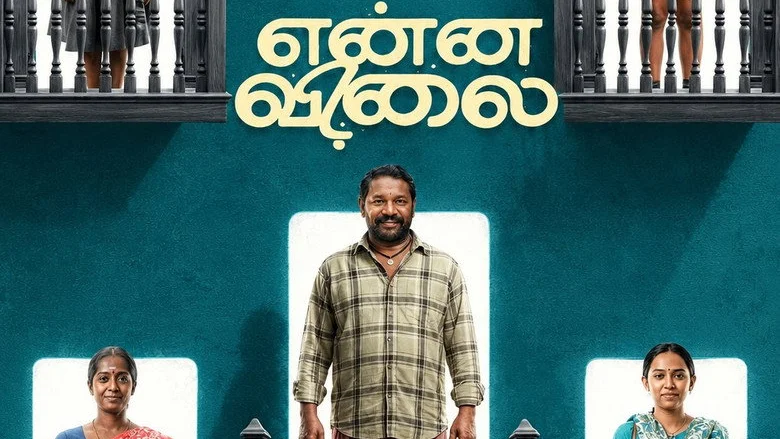
Cinematographer Alby Antony shot across fifty-six locations, Rameswaram, Chennai, Puducherry, Kochi, and the film’s visual strategy mirrors its thematic concerns: the sea is vast and indifferent, the courtroom is cramped and hostile. The first-look poster, with characters arranged in a witness box and Nimisha in advocate’s robes, announces the film’s true arena before a single frame unspools. That Pazhoor’s story begins with a discovery and ends in a legal battle is not a spoiler; it is the architecture.
Sam C.S.’s score, with the first single “Kadaladum” featuring Antony Daasan’s vocals, leans into the tidal rhythms of the setting. The music knows when to recede, during the pendant’s discovery, there is almost silence, and when to surge. It is competent, occasionally inspired, rarely intrusive. The same cannot be said for Sreejith Sarang’s editing, which in the middle stretch struggles to find a rhythm between the family drama’s slow burn and the legal thriller’s forward momentum. The second act sags under the weight of its own procedural obligations.
The U/A Certificate and the Illusion of Cleanliness
Pazhoor expressed surprise at receiving a U/A certificate when he sought a U, describing the film as a “clean entertainer.” This is revealing. Enna Vilai is clean in the sense that it avoids explicit content, but its cleanliness is also its limitation, the film sands down the rougher edges of its own anger. The systemic injustice it depicts is real, but the film’s approach to it is so measured, so determined not to offend, that the rage at its center occasionally feels theoretical rather than lived. Compare this to the jagged, uncontained fury of something like Maremma review, which trusts its audience to sit with discomfort rather than guiding them toward resolution. Enna Vilai wants to be dignified. Sometimes that dignity costs it the very thing it is about.
The supporting ensemble, Y. Gee Mahendran, Poornima Bhagyaraj, Mottai Rajendran, Nizhalgal Ravi, and a small army of recognizable Tamil character actors, fills the frame with lived-in specificity. Every character, we are told, has a deep emotional arc. In practice, this means the film occasionally spreads itself thin, giving us glimpses of lives that feel truncated rather than fully rendered. For a more streamlined approach to similar socio-political territory, our review of Aasha verdict explored how a tighter focus can yield sharper results.
The Verdict: A Debut of Promise, Not Yet of Power
Enna Vilai is a film that knows exactly what it wants to say, that dignity is not a luxury but a necessity, that the poor are guilty until proven innocent, that the sea gives and the system takes. What it struggles with is how to say it without softening the blow. Pazhoor the writer has crafted a screenplay of genuine moral complexity; Pazhoor the director is still learning how to trust that complexity without explaining it. The result is a film that earns its festival accolades but not quite its theatrical urgency.
Who should watch: Audiences who appreciate socially conscious Tamil cinema with strong central performances, particularly fans of Karunaas and Nimisha Sajayan. Those who value character-driven drama over plot mechanics will find much to admire.
Who should skip: Viewers seeking the propulsive energy of a true legal thriller or the raw intensity of a film unafraid to alienate. Enna Vilai is a film that wants to be liked, and that wanting occasionally shows.
Rating: ★★★☆☆ (3/5), A promising directorial debut that prioritizes dignity over devastation, sometimes to its own detriment. Karunaas’ performance alone justifies the ticket; the film around him is still finding its footing.