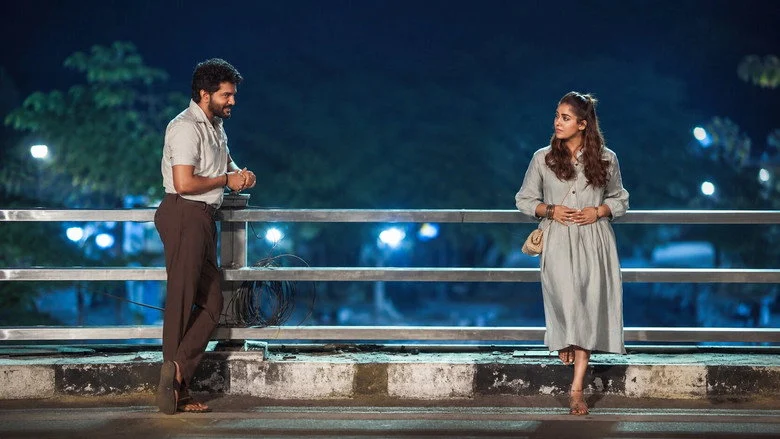
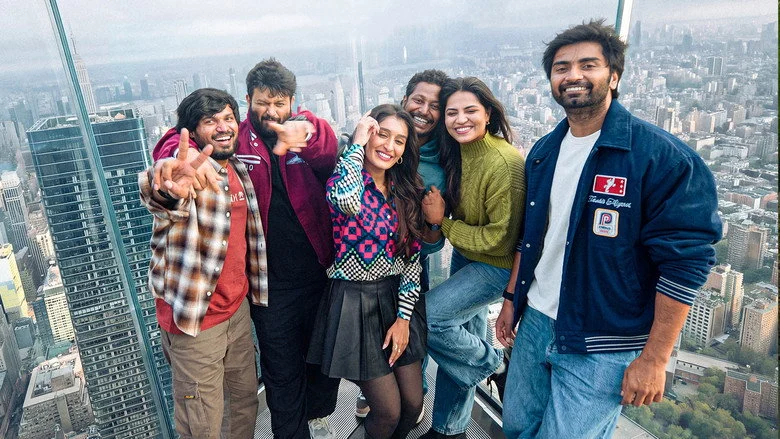
Duniya Vijay has spent his post-Salaga career building a very specific grammar: the Bengaluru underbelly as a living, breathing organism, the rowdy as a philosopher-king, the city as both womb and meat grinder. With City Lights, he hands the reins to a new lead (Vinay Rajkumar) while retaining his signature obsessions, and the result is a film that feels less like a fresh thesis and more like a director grading his own past papers.
What works here works loudly. What doesn’t work here collapses with equal volume. The problem is that Vijay’s visual and tonal language, as the Times of India noted, is “recognisable by now”, and recognisable, in this case, has begun to curdle into predictable.

The Majestic That Breathes, The Script That Suffocates
The film’s greatest asset is its geography. City Lights doesn’t just set itself in the Majestic area of Bengaluru, it inhabits it. The opening company theatre sequence, attended by politicians and corporators, establishes the transactional rot of the city’s power structure with a single, efficient image: the powerful watching, the powerless performing. It’s a strong cold open, and for a while, the film maintains that granular specificity.
Then comes “Alakh Niranjan, ” the song that introduces the sex workers of Majestic. Charan Raj’s composition, built on tamate beats and Dakhni rap, is genuinely electrifying, folk-infused but modern, rooted but restless. It’s the kind of musical sequence that makes you lean forward, that tells you the film has something to say about who these people are and why they matter. The staging is vibrant, the choreography unforced, and for three minutes, City Lights feels like it might be the definitive Bengaluru-underworld musical.
But a song is not a screenplay. And here is where the film begins to falter.
The Second Half Problem: When Scenes Don’t Talk to Each Other
The most criticised element of City Lights, and rightly so, is the second half’s structural incoherence. Scenes arrive without transition, characters pivot without motivation, and the film’s focus drifts from its central pair (Shivu and Monisha) to a rotating cast of side figures who never quite earn their screen time. The narrative becomes a series of stitched-together vignettes rather than a building story.
The most praised sequence, Umashree’s Ammaji entering in the second half, actually illustrates both the film’s strengths and its weaknesses. Umashree is commanding. She owns the frame with the kind of presence that doesn’t require lengthy dialogue; her authority is physical, almost gravitational. The scene works because she works. But the scene also arrives out of nowhere, a deus ex machina in human form, and the film never quite integrates her into the narrative fabric. She’s a guest star in her own movie.
This is where the comparison to Vijay’s earlier work becomes inevitable, and unflattering. Unlike the star-heavy bloat of Dark Heaven review, which at least maintained a coherent throughline even as it sprawled, City Lights loses its narrative spine entirely in the back half. The film forgets its own stakes.
Vinay Rajkumar’s Body, Monisha’s Soul, and the Dubbing That Betrays Them
Vinay Rajkumar, stepping into the Vijay mold, does what he can. In the early scenes, he’s convincing as a quiet, vulnerable migrant, a young man whose body carries the weight of displacement. His physical intensity in the action sequences is real; he moves like someone who has something to protect. But the dubbing is out of sync throughout, a technical failure that constantly pulls you out of his performance. It’s hard to judge an actor when the audio doesn’t match the lips.
Monisha Vijayakumar, in her debut, has the harder role. Monisha’s search for her transitioning sibling is the film’s emotional core, and she handles the shifts between desperation and resolve with surprising maturity. There’s a scene late in the film where she confronts the reality of her sibling’s life, no dialogue, just a look, and it’s the most honest moment in the entire runtime. The film should have trusted her more.
The supporting cast is uneven. Umashree is magnificent, as noted. Puneeth Kumar’s antagonist, the MLA’s assistant, is appropriately menacing in the exploitation scenes, but his character never develops beyond “gang leader.” Vasantha Krishnamurthy and Veera Devaraj add emotional depth where they can, but the script doesn’t give them room to breathe.
A Musical High, A Visual Low
Charan Raj’s music is the film’s undisputed highlight. The folk elements, the Malemahadeshwara references, the rap interludes, it all coheres into a soundscape that feels both rooted in Karnataka and plugged into contemporary Indian cinema. The background score elevates scenes that would otherwise collapse under their own weight. At times, the film feels built around the music, which is both a compliment and a criticism.
The cinematography, however, is a mess. Critics have noted the film switches between handheld RGV-style shots and conventional framing based on convenience, and they’re right. During conversations, the camera seems unsure where to look. The inconsistency is distracting, pulling focus from performances that need all the help they can get.
What City Lights Gets Right, and Why It Still Doesn’t Fully Work
Let’s be fair: City Lights tackles subjects that mainstream Kannada cinema often avoids. The film’s treatment of trans acceptance, handled without preachiness, as the research notes, is genuinely progressive. The focus on financial independence for sex workers, the emphasis on community over individual salvation, the refusal to moralise: these are choices that matter.
And yet, the film’s formulaic execution undermines its own ambitions. As India Today put it, “The shallow story and formulaic execution renders an underwhelming experience.” That’s harsh, but it’s not wrong. The film recycles elements from Salaga and Bheema without finding a fresh narrative engine. It hits familiar beats, the rescue, the gang confrontation, the underdog triumph, without interrogating why those beats matter.
For another perspective on recent Kannada cinema’s bold gambles, see our analysis of HALF verdict. That film took risks that City Lights only gestures toward.
The Verdict
City Lights is a film of moments, a great song, a commanding supporting performance, a handful of scenes that crackle with authenticity. But it’s not a film of cohesion. The second half collapses under the weight of its own ambition, the dubbing undercuts the performances, and the cinematography never settles into a consistent visual language.
Duniya Vijay’s fans will find enough here to satisfy them. The music alone is worth the ticket price, and Umashree’s Ammaji is a genuine creation. But for those seeking the kind of fresh, non-formulaic storytelling that Kannada cinema has been delivering lately, as we frequently examine across Kannada Thriller reviews, City Lights will feel like a step backward.
Who should watch it: Duniya Vijay completists, fans of Charan Raj’s music, and anyone interested in seeing Bengaluru’s Majestic underbelly rendered with genuine texture. Who should skip it: Viewers seeking narrative coherence or family-friendly entertainment. The A certificate is earned.
Rating: 2.5/5, A musical triumph trapped inside a structural failure.