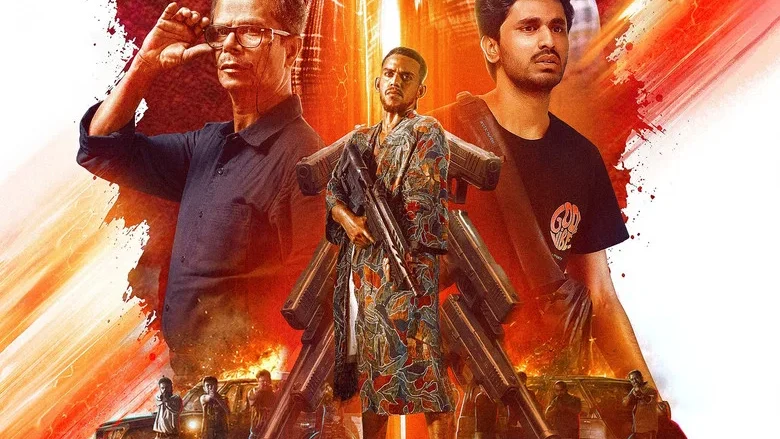
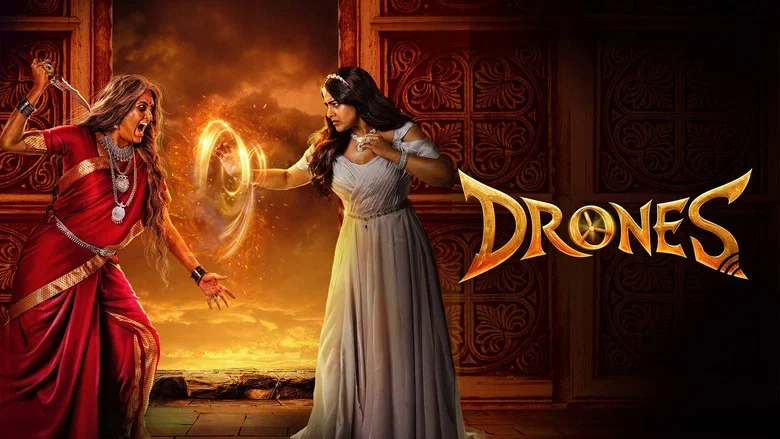
R. Raghav Mirdath’s Drones opens with a suspended astrophysics student hijacking a surveillance drone to spy on a mansion across town. What he finds there, a miniature artist named Prakruthi and the witch who keeps her, should be the film’s engine, not its thesis statement.
A Drone As Romantic Proxy Is A Provocation The Film Won’t Interrogate
Kish’s first glimpse of Prakruthi arrives through Sampangi’s lens, a mechanical intermediary that transforms voyeurism into courtship. The framing is deliberate: technology enabling desire, distance manufacturing intimacy. It’s the film’s most genuinely unsettling idea, and it’s abandoned within twenty minutes.
What replaces it is a recurring courtship ritual, poems, dolls, rings, promises of eternal devotion, performed by every man who encounters Prakruthi. The repetition is meant to expose how quickly attraction calcifies into performance. Instead, it exposes the screenplay’s unwillingness to trust its own critique.
When The Thesis Contradicts The Casting, The Film Loses Its Argument
Siddhi Idnani’s Prakruthi exists to be looked at, introduced through Kish’s remote gaze and framed as an object of immediate, universal desire. The film wants to critique beauty-based attraction while its camera participates in the same visual economy it condemns. That contradiction isn’t productive tension, it’s a structural failure.
Devadarshini’s witch, by contrast, carries genuine menace when the supernatural threat turns physical. Her stillness in the mansion’s interior scenes, the way she occupies doorways without entering rooms, suggests a director who understands spatial intimidation better than he understands his own screenplay.
Rush’s Confrontation Is The Film’s Spine, Buried Midway Through A Crowded Middle
Anjali Nair’s Rush delivers the film’s strongest sequence: a confrontation with the witch that articulates the emotional damage inflicted by narrow beauty standards. It’s the only moment where the social argument becomes dramatic action rather than repeated comic staging.
That the film buries this scene inside a middle section crowded with a bachelor inspector, a palmist’s death-curse, and Padmanaban’s eccentric-scientist theatrics suggests a fundamental confusion about what story it’s actually telling. The inspector’s “I love you” death-warning is a clever suspense gag, but it competes with the witch’s doll-transformation mythology for narrative oxygen.
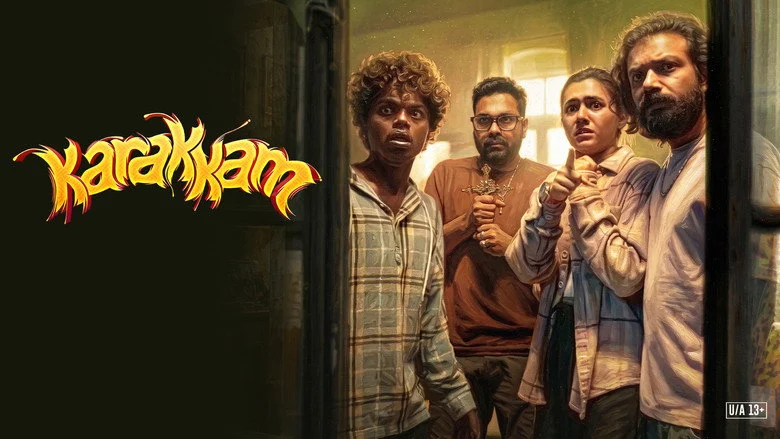
The tonal congestion recalls the structural looseness that undermined Karakkam, another recent Tamil horror that mistook accumulation for atmosphere. Both films share a willingness to introduce supernatural rules without committing to their consequences.
Dravid Selvam’s Comic Timing Carries What The Screenplay Cannot
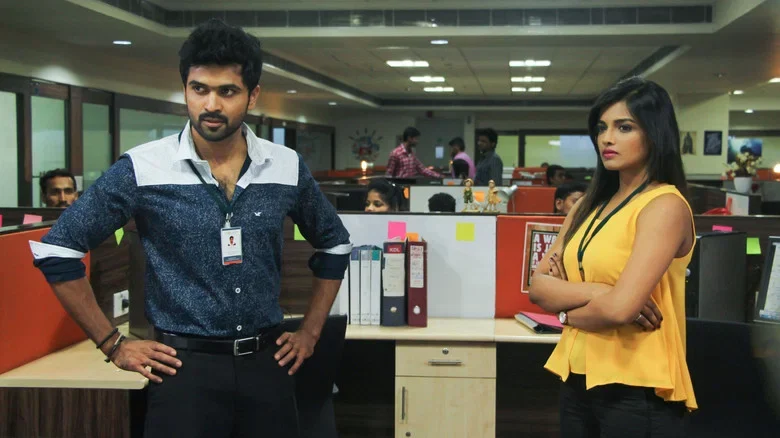
Dravid Selvam plays Kish as a curious student whose scientific detachment slowly erodes into romantic fixation, and his performance carries the transition with understated physical comedy. His scenes with RJ Deepak’s Dush establish the student trio as a functional comic unit rather than isolating Kish as a conventional romantic hero.
The lightness Selvam brings here contrasts sharply with the emotional restraint he demonstrated in Once More, where his romantic register operated in a completely different key. That range suggests an actor who understands how to calibrate performance to genre, even when the genre itself is uncertain what it wants to be.
Directional Ambition Outpaces Structural Discipline
Mirdath links scientific setting, drone surveillance, and supernatural transformation into a single comic-fantasy premise, and the integration of Padmanaban’s “Black Hole” residence as the students’ refuge shows genuine world-building instinct. The drone’s movement toward the mansion functions as both point-of-view device and narrative bridge.
But the direction lacks the tonal control to sustain its multiple registers. The horror beats and comedy beats don’t escalate, they alternate, creating a stop-start rhythm that prevents either mode from building momentum. The film’s visual vocabulary of miniatures and dolls suggests a richer thematic exploration of scale and artifice than the screenplay ever delivers.
The Commercial Math For A Crowded Horror-Comedy In A Saturated Market
With no verified production banner and no established box-office figures, Drones enters a Tamil horror-comedy landscape already crowded with genre hybrids competing for the same audience. The film’s UA13+ rating positions it for family-adjacent viewing, but its crowded subplot structure may limit repeat theatrical business.
Dravid Selvam’s theatrical leverage remains modest compared to established stars, and the film’s reliance on premise rather than spectacle makes premium-format exhibition unlikely. The real commercial question is whether Tamil horror-comedy can sustain itself on repeated courtship gags and social messaging when audiences have shown appetite for tighter, more focused genre entries.
The film’s fate may hinge on whether word-of-mouth emphasizes Rush’s confrontation, its genuinely affecting moment, or the repetitive middle section that surrounds it. That’s a coin-flip no distributor wants to depend on.
The Witch Deserved A Better Film Than The One She’s Trapped In
Drones ends with its social argument intact: love should recognize character, not appearance. But the film never earns that conclusion because it spends too much time indulging the visual idealization it claims to critique. Devadarshini’s witch, menacing, still, genuinely strange, belongs to a sharper, more disciplined horror-comedy that understands its own supernatural logic.
What remains is a film caught between its ambitions and its execution, asking audiences to accept a message its own camera refuses to embody. The drone sees everything. The film sees less.