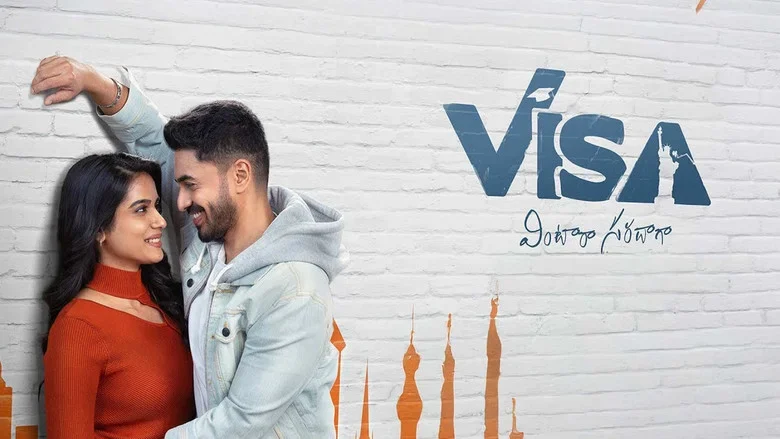
VISA – Vintara Saradaga opens with its hero behind a microphone, narrating the small humiliations of an Indian student in America as if confessing to a late-night radio audience. The premise promises a romantic comedy rooted in the specific texture of migrant student life; what arrives is a film content to skim that texture rather than press into it.
Udbhav Raghu’s debut arrives with the polished sheen of a Sithara Entertainments production and the burden of a familiar template. It wants to be a generational document of the Telugu student abroad. It settles for a pleasant postcard.
A Narrator Who Explains The Joke Before Delivering It
The film’s defining structural gamble is Ashok Galla’s direct-address voiceover, which frames the romance as a series of comic dispatches from the front lines of homesickness. In the opening stretch, this device carries real charm, his conversational timing is loose and disarming, and the film leans on it heavily.
But the narration becomes a crutch. Every emotional beat gets pre-digested by the voiceover before the scene has earned it, so we are told a moment is awkward or tender rather than allowed to feel it. By the midpoint, the device has flattened the drama into commentary.
This is where the film diverges from sharper recent work in the same register. Abadameva Jayathe understood that comedy sharpens when conviction is rigid enough to break against reality; here the convictions are soft, and so is the friction.
The Romance Works Until The Script Asks It To Carry Weight
Galla and Sri Gouri Priya Reddy share an easy, unforced chemistry in the early meet-cute stretches, the kind of low-key rapport that makes you lean in. Their scenes together have a lived-in rhythm, and Reddy in particular gives her character a watchful stillness that keeps the romance from feeling like a checklist.
The trouble arrives when the screenplay needs the relationship to bear dramatic weight. The complications are sketched in broad strokes, distance, ambition, the quiet selfishness of youth, and resolved with a speed that betrays how little the film trusts its own conflict.
Reddy’s work here recalls the grounded emotional register she brought to Happy Raj, where she anchored a lopsided drama through sheer presence. She is doing the same salvage work again, but the material gives her less to hold.
The Ensemble Fills Space Without Generating Pressure
The supporting cast of friends and fellow migrants is deployed as ambient comedy rather than as characters with competing desires. Harsha Chemudu lands a handful of laughs through pure timing, and the group scenes have a loose, collegiate energy that is pleasant without ever being essential.
What the ensemble never does is complicate the hero’s choices. These friends exist to react to him, to set up his punchlines, to fill the frame during musical montages. A romantic comedy about growing up abroad needs the group to exert gravitational pull; this one orbits the lead too obediently.
The India-and-USA production geography is used as visual variety rather than as psychological terrain. The American setting supplies campuses and apartments and the occasional wide establishing shot, but the film rarely dramatizes the dislocation it keeps announcing.
Vijai Bulganin’s Melodies Do The Emotional Labor The Script Avoids
Vijai Bulganin’s music is the film’s most reliable emotional engine. “Anaga Anaga America” is genuinely melodious, and the score swells at precisely the moments the screenplay has failed to build toward, doing the feeling on the film’s behalf.
That is a compliment and an indictment. When a song has to manufacture the ache that the preceding scene should have earned, the film is outsourcing its own heart. The background score is warm and well-placed; it is also doing work that belongs to the writing.
Raghu’s visual approach is clean and unfussy, favoring warm interiors and natural light, but it rarely finds an image that lingers. Compare the tighter spatial discipline displayed in THE BRANDOS, and you notice how much tension can live in a single well-blocked room.
Sithara’s Bet On A Debut Director And A Young Lead
For Sithara Entertainments and Fortune Four Cinemas, VISA represents a calculated swing at the youth-romance market with a first-time director and a lead still building his theatrical draw. The production values are polished, the marketing has been aggressive, and the pairing has been positioned as fresh.
The commercial math is trickier. The overseas-student rom-com has become one of the most crowded lanes in Telugu cinema, and a film that neither reinvents the template nor executes it with unusual precision has to rely on word-of-mouth in a market that rewards novelty.
Galla’s box-office leverage remains unproven, and this film does little to clarify it. It presents him as a likable presence rather than a star with range, which may sustain a career but will not, on its own, open a weekend.
A Pleasant Film That Never Risks Being More
VISA – Vintara Saradaga ends where these films always end, with reconciliation and a soft-focus acknowledgment that love is complicated and youth is fleeting. The resolution is competent and entirely unsurprising, and it leaves no residue once the lights come up.
What lingers instead is the sense of a film that had the ingredients for something specific, a real voice, a real setting, a real pairing, and chose the safest possible arrangement of them. Across contemporary telugu comedys, that instinct toward safety is becoming the genre’s defining limitation.
Raghu directs with warmth and no particular urgency. The film is watchable, occasionally charming, and almost entirely frictionless, which is precisely the problem. A movie about young people taking a risk on a life far from home should not itself be so afraid to take one.