There is a moment in Abhishek Pathak’s *Drishyam: The Conclusion* where Vijay Salgaonkar simply sits in silence, and the camera holds on Ajay Devgn’s weathered stillness long enough for you to remember why this franchise became a phenomenon. It is a film that opens with the weight of an empire – the Salgaonkars have built a cinema empire in their small town – but the shadows of the past refuse to stay buried.
This is a two-hour-and-forty-minute exercise in deferred gratification, and for those who have followed the saga since 2015, it is a patient, often rewarding, sometimes frustrating homecoming.
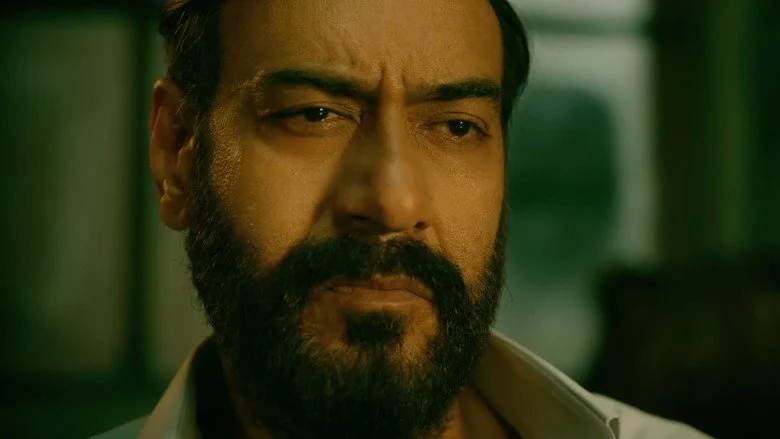
Ajay Devgn’s Vijay Has Become a Ghost in His Own Home
Devgn plays Vijay with a monk-like restraint that borders on the spectral. He has traded the frantic improvisation of the first film for a calculated, almost detached calm – a man who has outsmarted death so many times that he now walks through life as if he is already invisible.
The finest beat arrives when Vijay watches his own family from a distance, unable to bridge the silence that his lies have created. It is a performance of quiet erosion, and Devgn delivers it without a single theatrical flourish.
Tabu Returns as the Wounded Predator, and She Owns Every Frame
Tabu’s Meera Deshmukh is no longer the raging IG who lost a son; she is a woman who has learned to weaponize her grief into cold calculation. Her scenes with Devgn crackle with a shared history of mutual destruction – two chess players who know each other’s moves but are forced to play anyway.
There is a moment where Meera smiles at Vijay across a courtroom, and it is the most chilling thing in the film. Tabu finds the tragedy in the villainy, making her pursuit feel less like revenge and more like a woman trying to reclaim her own sanity.
Pathak’s Direction Is Confident, But the Screenplay’s Middle Is a Waiting Room
Abhishek Pathak understands the grammar of the thriller: he knows when to withhold information, when to release it, and how to stage a reveal with maximum disorientation. The opening hour is taut, economical, and trusts the audience to remember the franchise’s intricate web of lies.
But the second act sags under the weight of its own setup. Entire stretches feel like a procedural checklist rather than organic storytelling, with characters shuffling between locations to deliver exposition that could have been cut in half.
I found myself checking the runtime more than once during the middle passages, waiting for the film to remember that it is a thriller, not a family drama with a crime backdrop.
The Thriller Mechanics Are Solid, But Familiarity Breeds Contempt
Pathak stages the film’s central setpiece – a tense, rain-soaked confrontation that recontextualizes an event from the previous film – with genuine craft. The editing here is sharp, cutting between multiple timelines without losing coherence, and the sound design amplifies every drip of water into a heartbeat.
Yet for every clever beat, there is a moment of pure convenience. Characters appear exactly when the plot needs them, and the antagonist’s plan relies on a level of omniscience that strains credibility even for a franchise built on improbable genius.
The climax, while emotionally resonant for long-time fans, lacks the gut-punch of the original’s twist. It resolves with a whimper that feels earned but not electrifying – a conclusion that prioritizes closure over catharsis.
The Supporting Cast Carries the Film’s Emotional Weight
Shriya Saran’s Nandini is the quiet moral center, and she delivers the film’s most devastating line reading when she confronts Vijay about the cost of his protection. Ishita Dutta’s Anju has grown into a sharp, wary presence, and her distrust of her own father is a subtle but crucial thread.
Jaideep Ahlawat enters the frame as a new antagonist with a coiled menace that threatens to upend the film’s equilibrium, while Rajat Kapoor and Prakash Raj add heft to scenes that could have felt like filler. Each actor understands the assignment: this is Vijay’s tragedy, but they are the ones making it hurt.
Venky’s early review, cited by NDTV, gave the film 2.25/5, and it is easy to see why a critic would bristle at the film’s self-indulgence. But the audience response tells a different story – the film crossed 107.33 crore net domestic by June 10, 2026, and ultimately grossed 237.70 crore worldwide, per Reporter Live, making it the highest-grossing film of 2026.
Those numbers, sourced from Sacnilk and reported by Hindustan Times, suggest a franchise that has outgrown its critical detractors and found a permanent home in the mass imagination.
For fans of Hindi thrillers, the film’s patience is both its strength and its weakness – it trusts you to stay invested, but it rarely rewards that trust with genuine surprise.
If you are looking for more such layered mysteries, our Hindi Thriller reviews may offer you your next binge.
This is a film made for the faithful, not the curious. If you have lived with the Salgaonkars for a decade, the conclusion will feel like a long-awaited exhale; if you are new to this world, you will spend most of the runtime playing catch-up.
Watch it on a regular screen, with the lights off, and let the silence do its work.
*Drishyam: The Conclusion* is a dignified, overlong farewell that earns its emotional payoff but loses its edge – a solid 3 out of 5 for devotees, and a patient watch for everyone else.
For a deeper dive into how this franchise’s layered storytelling compares to other recent mysteries, check out Rock review.
Fans of slow-burn thrillers with domestic stakes might also find resonance in Dose verdict.