Pugazh spends the first minute of Nizhalilirundhu Velicham doing nothing, and that nothing is the point. The comedian has built a career on filling silence with noise; here he lets it pool around him like water in a basement.
A Comedian Stripped of His Timing
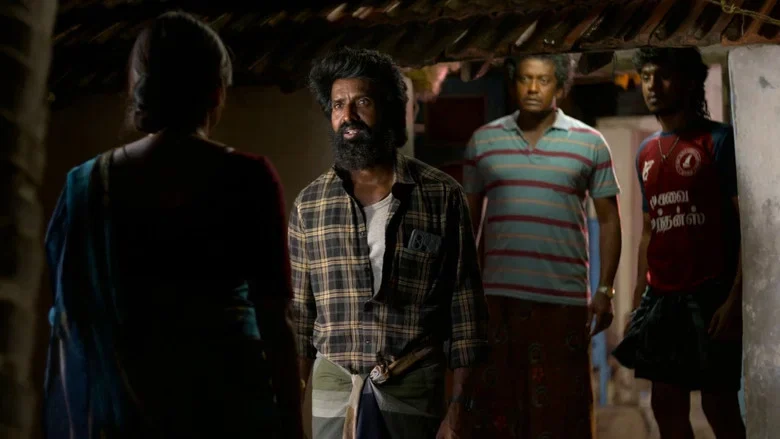
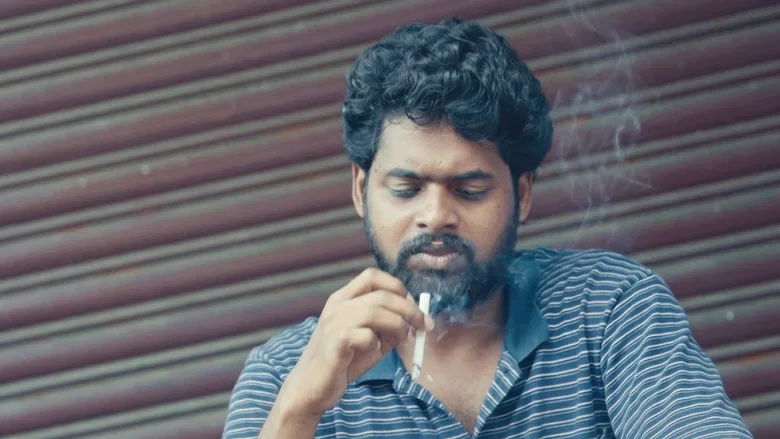
Vinith is a man ground down by rejection, and the film’s opening strategy is to deny him the comic safety net of a punchline. What registers is the stillness: a jaw held tight, a gaze aimed just past whatever he’s looking at, hands that don’t know where to land.
Pugazh has spent years playing the guy who talks his way out of rooms. Watching him try to sit still in one is the film’s most interesting gambit, and its most uncertain one.
The tonal shift is legible in the body before it’s legible in the writing. There’s a sequence where Vinith simply listens to someone talk at him, and Pugazh’s face does the work of a slow drain, the eyes going flat, the mouth settling into a line that’s less sadness than exhaustion.
It’s a genuinely disciplined piece of screen acting, and it’s the reason the 23-minute runtime doesn’t feel like a stunt.
When a Supporting Bond Carries the Entire Reversal
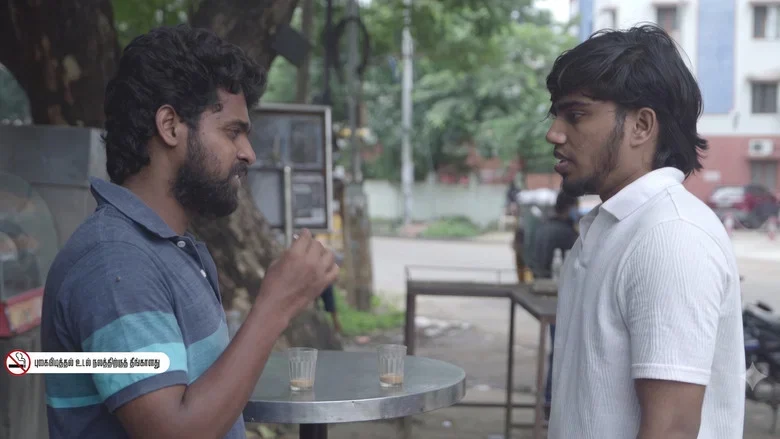
The film’s emotional architecture rests on Kavin, played by Roshan, and this is where the mechanism starts to strain. Kavin is the anchor, the bond that pulls Vinith back from the edge, and the screenplay asks that relationship to do almost all of the dramatic lifting.
What’s on screen is warmth without much friction, a steady presence that reassures but rarely challenges. The problem isn’t the performance; it’s that the film can’t quite dramatize why this particular bond works when everything else in Vinith’s life has failed.
The character study depends on contrast, and the contrast here is underlit. Roshan registers as gentle and available, but the writing gives him little to push against, so the recovery arc arrives as a mood rather than an argument.
Compare the spatial discipline on display in Haiku, where the framing itself did the relational work, and this film’s reliance on dialogue to explain the bond feels like a missed opportunity.

The Father Who Never Quite Becomes a Force
Senthil’s Appa occupies the frame with a certain gravity, a man whose expectations hang in the room without being spoken. The performance is economical, and there’s a moment where he simply looks at his son and the generational weight is clear.
But the role stays at the level of suggestion. The film wants Appa to represent tradition and quiet support simultaneously, and the compression of the runtime means neither reading gets a full scene to land.
Manoj Sivakumar, meanwhile, casts himself as Barani and gives the character the least defined function in the ensemble. Whether Barani is ally, obstacle, or witness remains genuinely ambiguous by the end, and not in a way that feels deliberate.
The writer-director’s dual role suggests a unified vision, but it also means the film’s most underdeveloped character is the one behind the camera.
A Darkness-to-Light Motif That Never Finds Its Image
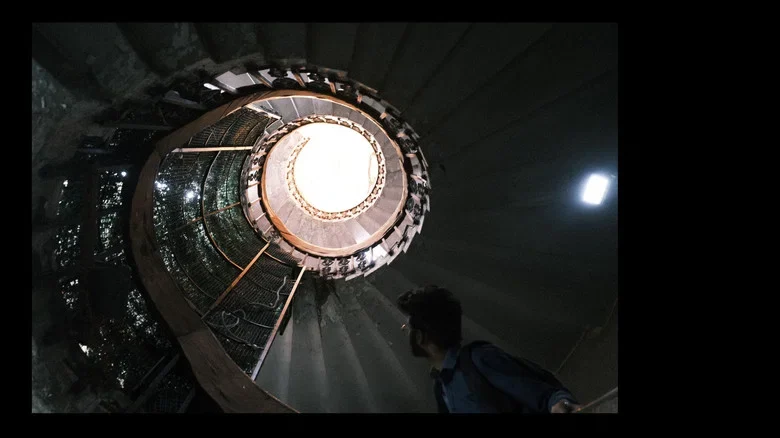
The title promises a journey from shadow to illumination, and the film gestures at that arc without ever committing to a visual grammar that would earn it. The lighting stays even and unremarkable; the camera holds at a respectful distance.
There’s no sequence where the image itself transforms alongside Vinith’s state. The recovery is narrated by the performances rather than composed by the frame.
This is the central craft failure of a film that otherwise understands its own intimacy. A 23-minute character study lives or dies on the precision of its visual choices, and here the choices feel functional rather than expressive.
The sound design is similarly restrained, but the restraint reads as absence rather than intention. When the score does arrive, it’s asked to do emotional work the staging hasn’t prepared.
The best comparison is the kind of textured physical performance that anchored Mandaadi, where the body carried the argument. Here, the body is willing; the frame isn’t always there to meet it.
The Ending That Resolves Without Convincing
Vinith is pulled back into the light, and the film treats this as a genuine arrival. But the recovery feels asserted rather than dramatized, the crisis was built through accumulation, and the resolution arrives as a single emotional beat.
What lingers is the sense of a film that knows exactly what it wants to say about connection and despair, but hasn’t found the scene that would make the audience feel the turn rather than simply witness it.
The thematic kinship with the emotional architecture of Titanic is instructive: that film earned its catharsis through spatial scale and accumulated image, while this one asks a single glance to carry the same weight.
The result isn’t failure so much as incompletion, a film that has the right instincts and the wrong number of scenes to realize them.
A Short Film Asking to Be Judged as a Feature
70mmScreenProduction has positioned this as an independent Tamil short, and the economics of that framing matter. A 23-minute film doesn’t carry the box-office risk of a feature, but it also doesn’t get the luxury of a slow build.
The theatrical date listed for October 2026 sits awkwardly against the digital-release language in the promotional material, and that ambiguity reflects a broader uncertainty about where short-form Tamil drama actually lives in the current exhibition market.
Pugazh’s box-office leverage has always been tied to his comic persona, and this film tests whether that goodwill transfers to a solemn register. The answer, based on what’s on screen, is that the instinct is right but the vehicle is too slight to prove the point.
The larger question is whether contemporary Tamil dramas can sustain a viable short-form theatrical pipeline, or whether this remains a festival-and-streaming proposition dressed in release-date clothing.
The Verdict: A Serious Actor Trapped in an Unfinished Film
Nizhalilirundhu Velicham is worth seeing for what Pugazh does with silence, a comedian discovering that the hardest thing to play is a man with nothing left to say. But the film around him never quite earns the despair it asks him to inhabit.
It’s a calling card for a performer ready to be taken seriously, and a reminder that the transition from comedy to drama requires more than a change of expression. It requires a frame willing to hold the weight.
This one holds the actor and lets the rest slip through its fingers.