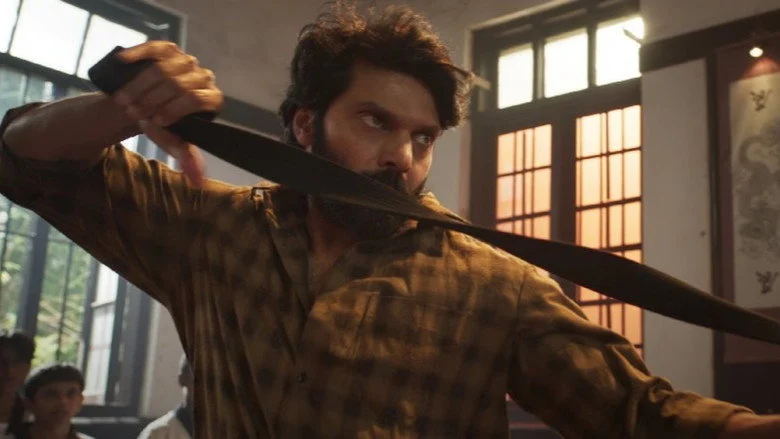
There is a moment, roughly halfway through Mandaadi, when the wind dies and the sail hangs slack as a dead lung. The camera holds on Soori’s face, salt-crusted and unreadable, and the film briefly forgets it is a box-office machine.
That stillness is the most honest thing in a 154-minute sports action drama that otherwise treats subtlety like a leak in the hull.
Soori Finally Gets a Frame Wide Enough to Hold Him
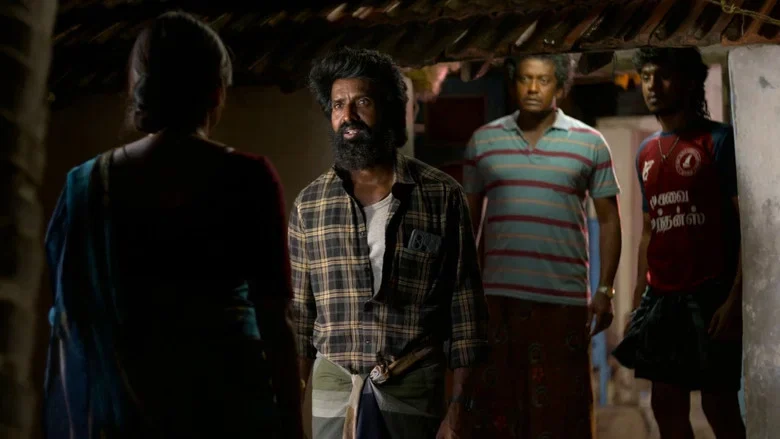
For years Soori has been the pressure valve in other men’s movies, the comic relief who enters, deflates a scene, and exits before the hero returns. Much like the vintage South action revivals tracked on MP4Moviez, Mandaadi hands him the wheel with complete unapologetic confidence.
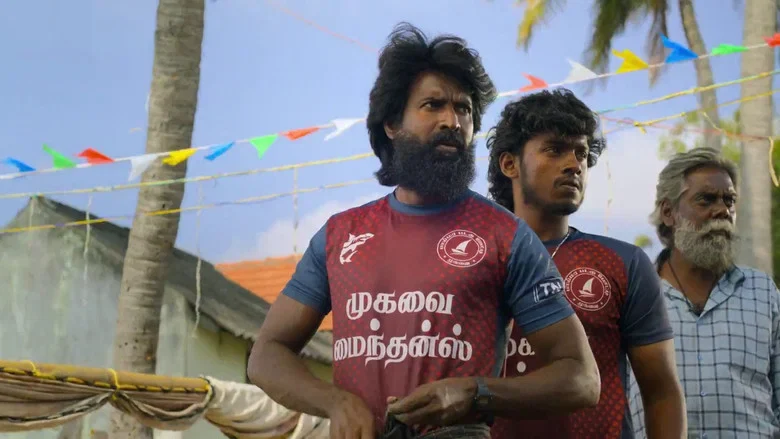
His Kaali is a man of few words and fewer smiles, and Soori plays the restraint with a jaw that stays clenched even when the crew celebrates around him. Watch how he stands at the stern during the early team assembly: feet planted wide, arms loose, eyes scanning the water instead of the men.
It is a performance built on posture rather than dialogue, and it works precisely because Soori resists the urge to charm. The comic timing that defined his turn in Yezhu Kadal Yezhu Malai is buried under a fisherman’s stillness here, and the burial is the point.
When the Race Becomes the Only Character With a Backstory
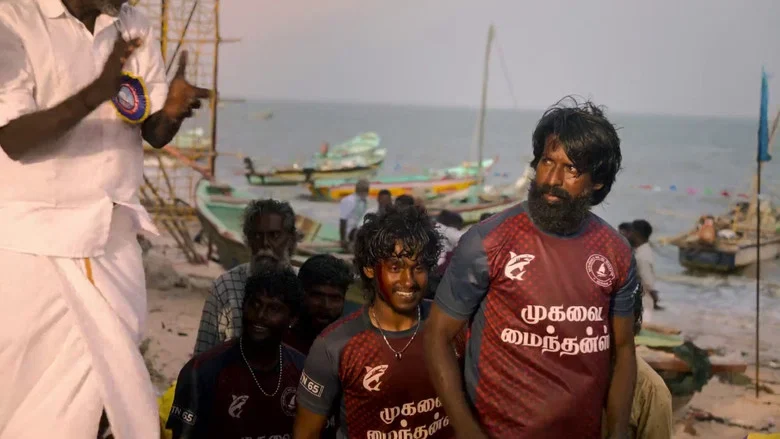
The film’s central mechanism is a traditional South Indian sailboat race, and to its credit, the screenplay treats the water as a living antagonist rather than a backdrop. The rivalry between Kaali’s crew and Saattaappuli’s team is legible within minutes: two captains, two crews, one finish line.
What the script never quite solves is why we should care beyond the scoreboard. The opposing captain, Saattaappuli, arrives with menace in his shoulders and a voice pitched low, but the film gives him no interior life, he is a rival because the plot requires a rival.
The same thinness afflicts the supporting ranks. Sathyaraj appears in a handful of scenes with the weary authority of a man who has done this before, and Mahima Nambiar registers in glimpses that never cohere into a character arc.
The Water Has a Body, and the Camera Knows It
Where the film genuinely distinguishes itself is in the physical staging of the race itself. The cinematography leans into the horizontal, long lenses compressing the distance between hulls, water spraying across the frame in sheets that catch the afternoon light.
There is a sequence in the second hour where the two boats converge at speed, and the editing cuts from rope to hand to face to water with a rhythm that finally justifies the runtime.
The sound design does the heavy lifting: the creak of wood under strain, the snap of canvas, the silence before a gust.
It is muscular, tactile filmmaking, and it makes the dialogue scenes feel like waiting rooms. That imbalance is the film’s central flaw, the action is cinema, the drama is filler.
The Director Builds a Stadium and Forgets the Locker Room
The director’s instincts for crowd-scale spectacle are evident in every race sequence. The camera placement is aggressive, the geography of the competition is clear, and the escalation from qualifier to final has a clean, almost procedural momentum.
But the same director shows little interest in the spaces between races. The crew’s interpersonal conflicts are sketched in shorthand, the training montages are obligatory, and the emotional beats land with the thud of a sail catching wind too late.
Compared to the tighter spatial discipline on display in Titans, this film’s second act sags under the weight of its own scale. The director trusts the water more than the words, and the water, to be fair, rarely lets him down.
A Sports Drama That Forgets the Sport Needs Stakes
Here is the uncomfortable truth about Mandaadi: it is a sports film that never quite explains what winning means to these men. The race is the plot, but the plot is not the story.
Kaali’s motivation is gestured at, pride, community, maybe a debt, but the screenplay never commits to a single emotional anchor. The result is a film that thrills in the moment and evaporates on the drive home.
The genre sibling it most resembles is the recent wave of Tamil action spectacles that mistake scale for substance, a trend visible in the diminishing returns of Jailer 2. Mandaadi is better than that film, but it shares the same blind spot: it believes the audience will supply the feeling the script forgot to write.
Panorama Studios Bets on Salt Water and Soori’s Shoulders
The commercial math here is straightforward. A reported ₹45 crore budget against a ₹101.92 crore India net and ₹136.68 crore worldwide gross makes Mandaadi a hit by any reasonable ledger, and the producing banners behind it have every reason to greenlight a second voyage.
What is less certain is whether this film represents a sustainable template or a one-off. The traditional sailboat race is a genuinely novel arena, and novelty is the scarcest currency in the current Tamil action market.
Soori’s box-office leverage is now a proven quantity, but the film’s success owes as much to the spectacle as to the star.
That is a fragile foundation for a franchise, and the industry’s broader appetite for culturally specific action, a growing current across contemporary Tamil action cinema, will determine whether Mandaadi becomes a blueprint or a footnote.
The Wind Dies, and So Does the Argument
By the final race, the film has spent its best ideas on the water and has nothing left for the shore. The climax is loud, well-staged, and emotionally hollow, a finish line crossed by men we never truly met.
And yet, there is that moment again, the slack sail and Soori’s unreadable face, reminding you what this film could have been if it had trusted its star half as much as it trusts its stunts.
Mandaadi is a hit, and it deserves to be seen for the water alone. But it is a film that wins the race and loses the story, and that is a strange kind of victory.