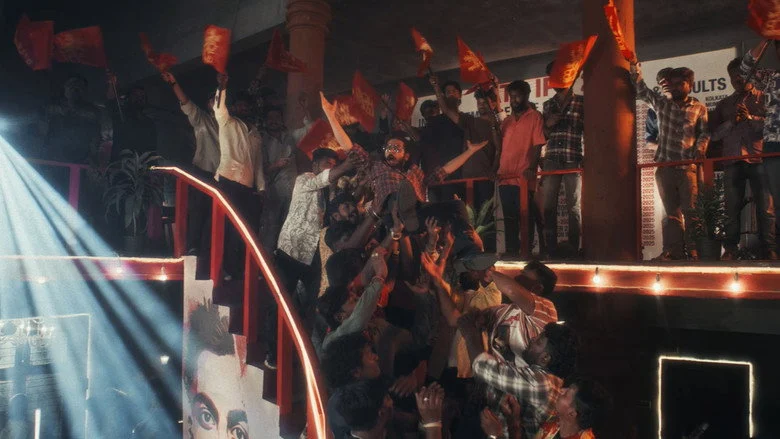
The first male student walks into Arul Bodhi Girls College and the camera holds on him a beat too long, a man entering a space that was never built for him.
That image contains the entire thesis of Yuvaraj Chinnasamy’s Haiku, a film that knows exactly what it wants to say and never quite finds the voice to say it.

A Gender-Reversed Campus That Never Becomes a Character
The film opens with Manohar (Aegan) enrolling as the inaugural male admit at a formerly women-only institution in Coimbatore. It is a premise built for friction, for comedy, for the slow dismantling of institutional habit, and the screenplay treats it as a hallway to walk through on the way to a love story.
Kodi (Sri Devi) arrives as the bold, tradition-rooted counterweight: a woman who speaks first, decides first, and loves without apology. Their courtship has the texture of a campus romance shot in flat, even daylight, Priyesh Guruswamy’s frames favour medium shots that keep both performers visible but rarely press them into the intimacy the material needs.
What the film does with that premise is less interesting than what it refuses to do. The gender reversal becomes a talking point, not a dramatic engine, a distinction that separates Haiku from the more spatially disciplined work in Mandaadi, which understood that environment is argument.
Possessiveness Diagnosed, Never Dramatized
Mano’s insecurity is the film’s real subject. He loves Kodi and then he manages her, questions her movements, resents her independence, mistakes surveillance for devotion. The screenplay states this plainly and then moves on, as though diagnosis were the same as drama.
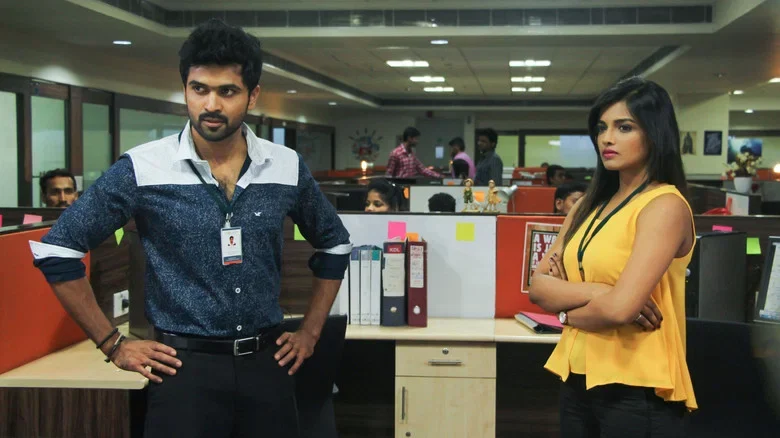
When the relationship collapses under long-distance strain and his controlling behaviour, the film jumps three years forward. Mano is now a lead designer at an IT firm. Nivetha (Femina George) joins as an intern, a woman raised by a single mother, emerging from an abusive relationship with a man named Arul.
The structural intelligence here is genuine: the second romance reverses the power dynamic of the first. Mano must now support a woman’s independence rather than curtail it.
Nivetha must decide whether his patience is growth or performance. The film asks a question most Tamil romances avoid entirely, can a man who once loved through control love without it?
Aegan Carries Two Men in One Body, and Only One of Them Breathes
The role demands a visible behavioural split. College Mano leans forward when he talks, fills silences with nervous chatter, touches Kodi’s wrist a half-second too long. IT Mano sits back, listens, waits. Aegan manages the physical contrast, the younger man’s restless hands, the older man’s stillness, with a commitment that occasionally approaches the material’s demands.
But the film needs more than posture. It needs the moment where Mano recognizes his own pattern in real time, and Aegan plays that recognition as a mood rather than a rupture. The performance remains legible when it needs to be volatile.
Femina George does more with less. Nivetha’s recovery is written as a sequence of small refusals, declining a call, correcting a colleague, standing a fraction taller in a doorway, and George plays each one with a quiet precision that keeps the second half from collapsing into lecture. The film’s emotional weight lands most reliably on her shoulders, not the protagonist’s.
The Revelation That Should Break the Film Open, and Doesn’t
Nivetha learns about Kodi. The disclosure arrives as the third act’s ignition point, the moment where Mano’s history becomes Nivetha’s evidence, where his plea for a second chance collides with the wreckage of his first.
It is the right scene. It is the scene the entire film has been building toward. And it plays as exposition delivered in medium close-up, the camera holding still while the screenplay explains what the audience already understands.
The confrontation lacks the spatial pressure that a scene like this requires, no doorframe to lean against, no distance to close, no object to fidget with. Just two people talking about a third who isn’t there.
The final conflict is emotional rather than physical, which is the correct choice for this material. But emotional conflict needs physical grammar, and Haiku too often mistakes sincerity for staging.
Siddhu Kumar’s Score and the Editing Rhythm That Betrays the Drama
Siddhu Kumar’s background score does the film’s emotional labor in the spaces where the screenplay leaves gaps, swelling under a silence that should have been allowed to sit, cueing heartbreak before the image has earned it.
The music is competent and occasionally beautiful, which is precisely the problem: it fills rooms the direction should have furnished.
The editing tells the story of the film’s structural hesitancy. The first half moves through the college romance with an unhurried rhythm that suits the material.
The second half compresses three years of transformation into a title card and a change of office lighting, then rushes toward a resolution that the screenplay hasn’t fully argued for.
What Haiku lacks is the patience for the uncomfortable middle, the stretch where change is attempted and fails, where Mano backslides, where Nivetha tests him and he flunks. Instead, the film skips to the lesson learned and asks the audience to trust that the learning happened off-screen.
Vision Cinema House’s Gamble on a Romance Without a Villain
Produced by Dr. D. Arulanandhu and Mathewo Arulanandhu under the Vision Cinema House banner, Haiku arrives in a theatrical market that rewards scale and spectacle.
The producers reportedly declined minimum-guarantee distribution offers in Tamil Nadu and chose to self-distribute, a decision that signals faith in the film’s niche appeal but exposes them to significant downside in a crowded October release window.
Netflix reportedly acquired digital rights before filming was complete, which softens the theatrical risk considerably. But the commercial question remains: who is the audience for a two-and-a-half-hour romantic drama about a man learning not to control women, released without a stars-as-bankability anchor or a genre hook beyond its premise?
The answer, based on the film’s own instincts, is the same audience that has sustained the quieter end of contemporary Tamil dramas, viewers who come for emotional texture rather than plot mechanics.
Whether that audience is large enough to justify self-distribution is a question the box office will answer, but the film’s craft suggests a production team that prioritized intention over commercial calculation.
The Second Chance That Never Earns Its Forgiveness
What Haiku gets right is the architecture of its question. The film understands that second-chance romance is not about reunion but about accountability, that Mano’s redemption depends not on Nivetha’s forgiveness but on his willingness to sit with what he did to Kodi. That is a mature premise, and it deserves a more rigorous execution.
The film’s final image, Mano and Nivetha in a space that could be a beginning or a repetition, is the right note to end on. It refuses to answer whether he has changed. It asks the audience to weigh his history against his effort and decide.
But a question is not a conclusion, and Haiku mistakes ambiguity for depth. The film wants credit for refusing easy answers while doing the narrative work that would make the ambiguity feel earned. It is a romance about learning to love without control that never quite learns to control its own storytelling.
Theatre owners in Coimbatore and Chennai will decide whether Haiku finds its audience. But the film’s real reckoning is quieter: a man walks into a girls college as its first male student, and the camera holds on him a beat too long. The film never quite knows what to do with him after that.