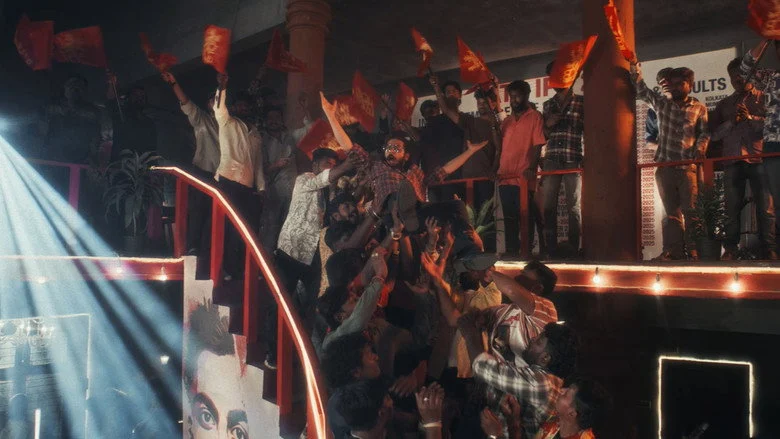
The opening frames catch Deepu at his village threshold, a bag slung over his shoulder and the weight of expectation already pressing down. He is leaving for the city, chasing a hero’s dream that has powered countless Kannada and Tulu dramas before him.
It is a scene we have seen before, but Sandeep Bedra’s framing keeps it intimate, suggesting a filmmaker more interested in the emotional cost of ambition than the glamour of the destination.

Nithyaprakash Bantwal Anchors the Film’s Emotional Core
Bantwal’s Deepu is a study in contained restlessness. He does not play the aspiring hero with loud desperation; instead, his performance leans into the quiet anxieties of a young man who has promised his family more than he can guarantee.
The romance with Nidhi, played by Amrutha Sudu, develops against this career ambition, and the conflict between the two gives Bantwal his most compelling material. His scenes negotiating love against his own expectations carry a sincerity that elevates the predictable structure.
Bedra’s Screenplay Balances Humor With a Structural Flaw
As both writer and director, Sandeep Bedra has unified authorship, and it shows in a story that knows exactly what it wants to be. The comedy is gentle, the emotional beats land without manipulation, and the family dynamics feel rooted in genuine observation rather than formula.
But the screenplay’s linear structure is also its weakness. The middle section, described as a journey of twists and chaos, struggles to find a distinct rhythm, and the pacing dips noticeably before the third act regains its footing.
The director’s strength lies in his restraint. He trusts the ensemble and the premise, never forcing a joke or a tear, which keeps the film’s tone consistent even when the plotting wanders.
The Comedy-Drama Balance Holds Its Ground
As a comedy-drama, Picture understands that the genre’s contract is about warmth, not just laughs. The UA 7+ certification signals a broad family-friendly approach, and the film honors that promise by keeping its humor grounded in character rather than slapstick excess.
The emotional turning points, such as Deepu’s relationship with Nidhi developing amid personal expectations and chaos, work because the stakes feel personal. The film never inflates its conflicts into melodrama, which is a welcome discipline in a genre prone to excess.
That said, the film does not reinvent the wheel. The village-to-city arc is familiar territory, and viewers expecting a novel take on the aspirational dreamer will find the structure predictable, even if the execution is consistently pleasant.
If you are inclined toward more of this flavor, our Kannada Drama reviews offer a wider look at the regional landscape.
A Supporting Cast That Signals Intent
Devadas Kapikad, Naveen D. Padil, Aravind Bolar, and Bhojaraj Vamanjoor are all recognized faces in Kannada and Tulu cinema, and their casting is a deliberate signal of the film’s cultural grounding. Their presence assures the audience that the comedy will come from a place of lived-in familiarity.
Kapikad, in particular, brings a seasoned comic timing that the younger leads can lean on. Bolar and Vamanjoor round out the ensemble with the kind of reliability that makes the family scenes feel authentic, even if the research does not pinpoint a single standout moment for any of them.
The film’s decision to lean on this established pool of performers rather than stunt casting is a smart one. It tells the audience that the comedy is the priority, and the actors deliver the necessary support without overshadowing the central romance.
Reception and Release: A Quiet, Family-First Rollout
Picture was initially scheduled for 24 July 2026 before being postponed to 7 August 2026, a minor scheduling shift that did not generate controversy. The film is presented as wholesome entertainment for families, and that positioning is consistent with its content and certification.
There is no verified critical aggregate or box office reporting available at this stage, which makes a definitive verdict difficult. What the available data does suggest is a film that knows its audience and serves it without pretension.
I suspect this will find its strongest reception in family screenings and among viewers who appreciate light, emotional storytelling in their native languages. It is not a film designed for critical dissection, but it does not need to be.
Picture is a comfortable watch for those who enjoy the familiar rhythms of Kannada and Tulu comedy-drama. It is best experienced in a regular theater with a family audience, where the shared laughter will amplify the film’s gentle charms. For those seeking a more complex or challenging narrative, this is not the ticket.
Picture earns a modest but honest 2.5 out of 5, a recommendation reserved for fans of the genre who will find its warmth worth the runtime.
For a deeper dive into a similar aspirational arc, consider Photographer review.
If you prefer a punchier take on regional ambition, KJQ verdict offers a more energetic counterpart.