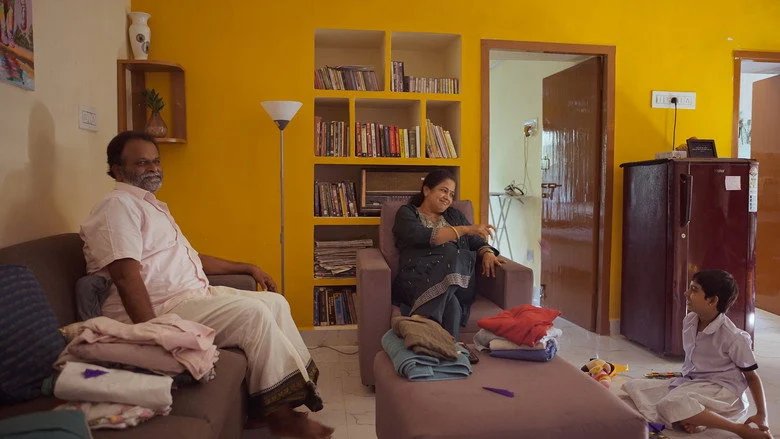
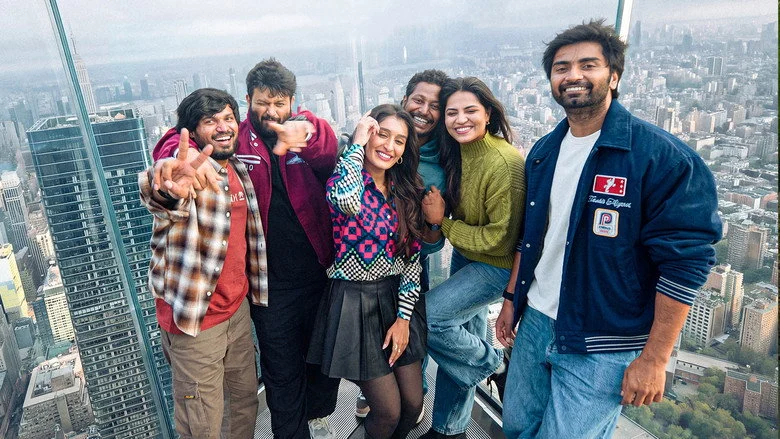
The groom’s suitcase lands on the bride’s family doorstep, not for a visit, but for a lifetime. That single image, the husband moving into his wife’s ancestral home because Pavi refuses to leave, is the entire engine of Elan’s Tamil romantic comedy, and for a while, it hums with promise.

Elan’s Double Duty: Director and Groom in a Reactive Role
Elan, making his acting debut alongside his directorial debut, plays the husband who must navigate a household where every tradition is inverted. His performance is built around reaction, absorbing relatives’ stares, deflecting pointed questions about his living arrangement, trying to find footing in a space where he is perpetually the guest.
There’s a certain charm in watching a lead actor who doesn’t try to dominate scenes but instead lets the chaos wash over him. The post-wedding decision scene, where the arrangement is first proposed, gives him his best material, the quiet resignation mixed with love that defines his entire arc.
A Screenplay That Sets Up but Struggles to Pay Off
Director Elan deserves credit for a high-concept domestic premise that is immediately legible. The reversed household dynamic creates natural friction, and the family-home setting provides endless opportunities for situational comedy.
But the screenplay’s linear structure leans heavily on the initial hook without building sufficient dramatic layers. The middle section’s culture clashes and domestic friction repeat similar beats, and the resolution, a reconciliation around the definition of happiness, feels earned but arrives without the narrative complexity the premise deserves. One wishes the conflict had been pushed further, testing the couple’s bond beyond family interference.
The Genre Core: Romance Through Domestic Warfare
As a romantic comedy, the film’s craft rests entirely on making the reversed living arrangement feel both absurd and believable. The family confrontation scenes, where relatives openly question the groom’s place in the bride’s home, generate the film’s sharpest comedy and its most honest emotional beats.
The romance itself is expressed through the couple’s alliance against convention rather than grand gestures. Their private moments, brief respites from the household chaos, suggest a partnership that the world hasn’t yet caught up to. It’s a quietly modern idea wrapped in a very traditional cinematic package.
Where the film loses steam is in its repetitive reliance on the same comedic situations. The domestic spaces, which initially feel fresh, become familiar, and the comedy starts to circle rather than escalate. The genre demands invention; this film settles for consistency.
The Ensemble: Veterans Who Anchor the Comedy
Radhika Sarathkumar’s presence signals the film’s intent, she is the family anchor, the gravitational center around which the role-reversal drama spins. Her casting suggests a matriarch who both enforces and eventually questions tradition.
Yogi Babu brings his reliable comic timing to the ensemble, his scenes promising the kind of broad, accessible humor that family audiences expect. M.S. Bhaskar adds veteran weight to the domestic exchanges, while Geetha Kailasam, Elango Kumaravel, Senthil, and Maran round out a cast designed to keep the comedy engine running even when the central couple’s conflict stalls.
Each supporting player feels chosen for a specific comic function, and the ensemble chemistry suggests the film works best when it lets these actors bounce off each other. The family-clash sequences, where multiple relatives weigh in on the unconventional arrangement, are where the film’s energy peaks.
Audience Fit and the OTT Advantage
With no theatrical box office to speak of, this is a direct Netflix release, the film’s success depends entirely on streaming discovery. The platform strategy positions it for accessible family viewing, and the premise is fresh enough to generate curiosity among Tamil comedy fans.
There are no verified controversies or political angles here; the film’s battleground is purely domestic. For viewers seeking a light family entertainer with a modern twist, this fits the bill. Those expecting high-intensity drama or action should look elsewhere, this is a film about who does the dishes, not who saves the world.
I found myself wishing the film trusted its premise more, pushing the role reversal into genuinely uncomfortable territory rather than settling for comfortable laughs. The setup is genuinely clever; the execution plays it safe. For more Tamil comedy explorations, browse our Tamil Romance reviews for similar family entertainers.
At two hours and three minutes, the runtime is lean, and the film never overstays its welcome. The linear screenplay keeps things simple, and while the lack of plot complexity might frustrate seasoned viewers, it also makes the film an easy, undemanding watch. For families looking for a Sunday evening pick with a progressive twist on marriage dynamics, this works.
The role-reversal premise, the ensemble warmth, and the clear thematic focus on redefining marriage on one’s own terms make this a pleasant, if not essential, addition to Tamil romantic comedies. It’s the kind of film that earns appreciation for its intent more than its execution, a debut that shows promise rather than polish.
Pyaar Prema Kalyanam is a gentle, well-meaning comedy that never quite becomes the sharp social satire its premise hints at. For a debut, it’s respectable, for a film about breaking convention, it’s surprisingly conventional. Watch it for the ensemble and the fresh hook, not for narrative daring. A solid 2.5 out of 5, a film that will please its target family audience but leave cinephiles wanting more bite.
For another take on unconventional family dynamics, check out Irumudi review.
If you’re drawn to films that examine marriage on unconventional terms, Khalifa Part verdict offers a different kind of relationship tension.