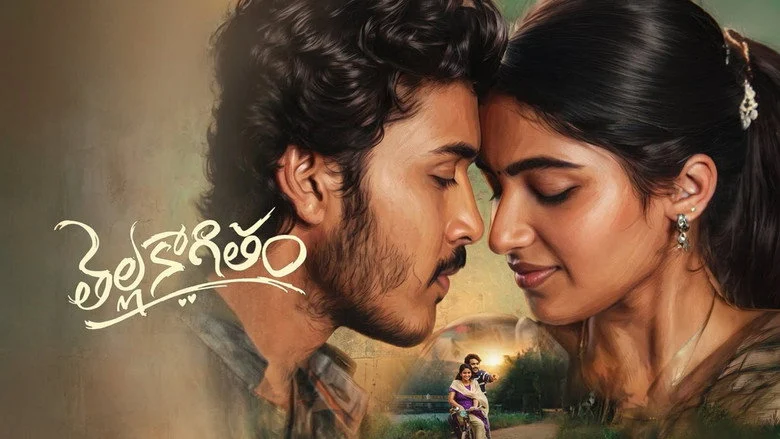
There is a specific kind of silence that falls over a theatre when a romance is working, the collective held breath of an audience waiting for two people to finally touch. Itlu Kanmani never earns that silence, settling instead for a gentle hum of pleasantry that drifts in one ear and out the other. Vishwanathan Ramachandran’s Telugu romantic drama, arriving with a modest 50-minute runtime, feels less like a feature and more like an extended music video waiting for a hook that never quite lands.

Paruchuri Venu Carries a Slight Frame on His Shoulders
Paruchuri Venu is the quiet engine of this film, and the lack of scene-level detail about his performance speaks to how little room he is given to expand. He brings a naturalistic ease to the frame, the kind of leading-man warmth that smaller Telugu romances desperately need to sell their central conceit.
Yet without a defined character arc or a single memorable dialogue to anchor him, Venu is left swimming in a script that seems content to let him exist rather than act. The chemistry with Thrayoshini is implied rather than dramatized, a missed opportunity that a tighter screenplay might have turned into the film’s saving grace.
Ramachandran’s Direction: A Strong Eye, A Weak Pen
Ramachandran demonstrates a clear visual sensibility, framing his leads with the kind of soft-focus romanticism that suggests he has studied the greats of the genre. The problem is structural, a linear narrative that moves from point A to point B without any of the detours that make love stories feel lived-in.
The screenplay’s weakness is its refusal to complicate. Conflict arrives and dissolves without friction, leaving the audience with a series of pretty pictures rather than a story that demands engagement. One wishes the director had trusted his actors enough to let them stumble, to let them fail, to let them fight for the love the film insists they share.
The Genre-Core: Romance That Forgets to Woo
For a film classified under Romance, Music, and Drama, Itlu Kanmani is remarkably stingy with its emotional beats. The romance genre demands a turning point, a moment where the audience gasps or sighs or feels the ground shift beneath the lovers’ feet. This film has none, coasting on the pleasant but unremarkable chemistry of its leads.
The music, anchored by the song “Thaanu Choosthene, ” suggests an attempt at melodic storytelling, but without verified reception data, it reads as a placeholder rather than a centerpiece. A romance that cannot articulate its own longing through song or scene has failed its most basic brief.
The drama component fares slightly better, with Rashmitha Rao and E. Ravi Shankar Reddy providing the supporting texture that the leads cannot generate on their own. Yet even they are given so little to work with that their presence feels like a promise the film forgets to keep.
Supporting Cast: Wasted Potential in Familiar Faces
Rashmitha Rao’s casting signals an intent to build a world beyond the central pair, but the film never delivers on that promise. She appears, she reacts, she recedes, a pattern that undercuts whatever dramatic weight her presence might have carried.
E. Ravi Shankar Reddy, meanwhile, brings a gravitas that feels imported from a more serious film. His moments on screen hint at a subplot that was either cut for time or never fully conceived, a frustration that compounds as the credits approach. The 50-minute runtime is the culprit here, there simply isn’t room for a supporting cast to breathe.
For those interested in exploring more Telugu romantic dramas that execute this formula with greater confidence, our Telugu Drama reviews might point you toward richer territory.
The Missing Conversation: What We Don’t Know
There is no verified critical consensus on Itlu Kanmani, no publication scores, no audience ratings, no box office figures to ground the conversation. That silence is itself a statement. A film that cannot generate discussion, even negative discussion, has failed to make its case in a marketplace that rewards noise.
The audience profile listed as “fans only” suggests a film aimed at a narrow constituency, presumably those already invested in the cast or director. That is a thin foundation for a theatrical release, and the absence of any promotional footprint in the research only reinforces the sense of a project that slipped through the cracks.
I cannot pretend to have seen a film whose details remain so stubbornly opaque, but the available evidence paints a picture of a work that is pleasant, forgettable, and ultimately unnecessary.
Perhaps the most telling detail is the runtime itself. At 50 minutes, Itlu Kanmani is barely longer than a television episode, a length that suggests either a truncated vision or a director who knew he didn’t have enough story to fill a conventional feature. Either way, the audience is left with a fragment rather than a film.
If you are a completionist of Telugu cinema, this is a curiosity worth a stream on a slow evening. If you are looking for a romance that will move you, that will make you believe in the possibility of love against the odds, look elsewhere. The film’s best format is likely a quick watch on a phone during a commute, something to pass the time, not to hold in your heart.
Itlu Kanmani is a whisper in a genre that demands a shout, a 2 out of 5 that will fade from memory faster than its own runtime. For a more satisfying dose of understated Telugu storytelling, consider how Gladiators review manages tension with far less material. And for a comic take on regional cinema’s quirks, Gaayapadda Simham verdict offers a sharper edge.