There’s a moment in Ram and Leela where the film’s entire premise hinges on a single, absurd condition: Leela can only be seen before 6 pm. It’s a genuinely intriguing hook for a Tamil romantic comedy, one that promises a fresh twist on the familiar boy-meets-girl formula.
But as the runtime stretches past the two-hour mark, director Ramachandran Kannan’s debut struggles to sustain the novelty, leaving us with a film that is as repetitive as it is inventive.
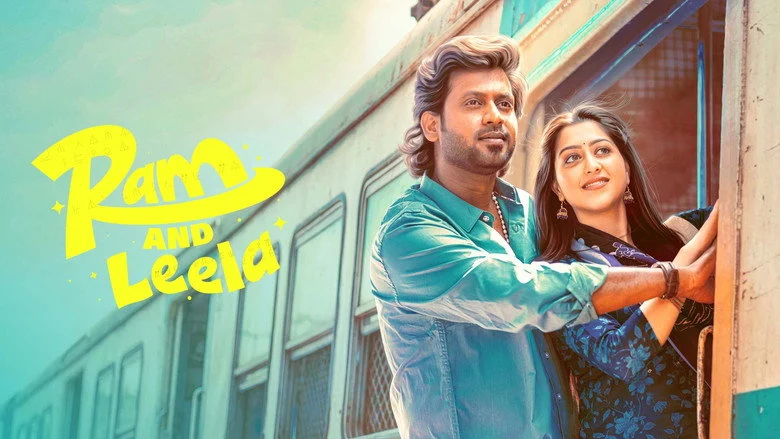
Rio Raj’s Comic Engine Powers the Early Train Encounters
Rio Raj, as the perpetually matrimonial-rejected Ram, is the film’s primary engine. His comic frustration, especially during the local-train courtship setup, carries the opening act with a charm that early reactions have rightly singled out. He plays the everyman with a sense of desperation that feels both funny and relatable.
His repeated, almost ritualistic, interactions with Vartika Jain’s Leela on the train are where the film finds its footing. Raj’s ability to sell the absurdity of his situation is the main reason the first half doesn’t completely derail, even when the writing around him begins to loop.
Kannan’s Screenplay: A Clever Hook, A Tired Payoff
As a writer-director, Kannan demonstrates a strong instinct for a marketable, high-concept premise. The central gimmick, the day-night identity change, is an easily communicable hook that sets the film apart in a crowded genre.
However, the screenplay’s linear structure is its undoing. The first half is a stretched sequence of train-watching and rejection gags that could have been trimmed by at least twenty minutes. The comic escalation leans too heavily on the core gimmick, sacrificing character depth for a repetitive setup that tests patience before the real plot kicks in.
The Genre-Core Execution: A Study in Repetition and Revelation
Romantic comedies live or die by their chemistry and their ability to escalate conflict. Here, the chemistry between Raj and Jain is adequate, but the emotional turning points are buried under the weight of the film’s own cleverness. The most praised scene, the comic reveal about the 6 pm condition, works because it directly engages with the premise’s absurd logic, but it arrives after a long, repetitive stretch of courtship.
The direction opts for a reveal-driven structure rather than organic character growth. The post-6 pm rule creates a situational comedy that is initially amusing, but as the film progresses, it becomes a crutch. The conflict, driven by a family secret rather than a traditional antagonist, lacks the dramatic friction needed to sustain a 143-minute runtime. The second half, which carries the twist and resolution, feels more active, but by then, the novelty has worn thin.
This is where the film’s identity crisis emerges. It wants to be a quirky, premise-driven entertainer, but it doesn’t trust its own premise enough to avoid padding. The cinematography, centered on the routine-based observation of the train journeys, reinforces the repetitive nature of the setup rather than adding visual variety.
Supporting Cast: The Unseen Pillars of a Wobbly Structure
Munishkanth, a veteran of Tamil comedy, is listed in the ensemble, and his presence signals an intent to build a robust humor ecosystem around the lead. While scene-level details are thin, his casting suggests a reliance on experienced comic actors to fill the gaps in the screenplay. Chetan Kadambi and Malavika Avinash, as part of the family-and-conflict framework, provide the necessary social pressure that grounds the otherwise fantastical premise.
Deepa Venkat’s inclusion in the supporting cast adds a layer of credibility, though the film doesn’t offer her a moment that stands out. The supporting cast’s primary function seems to be to react to Ram’s predicament, and while they are competent, they are not given the material to elevate the film beyond its central gimmick.
The Censor Board and the Audience’s Verdict
The film’s journey to the screen involved a title change from Ram in Leela to Ram and Leela, a minor censorship adjustment that hints at the production’s sensitivity to regulatory norms. However, there is no political controversy here; the film’s battles are purely with its own pacing.
One review succinctly called it “a few late laughs in an overdone comedy, ” which sums up the sentiment of early viewers. The audience has praised the freshness of the premise and Raj’s comedy, but complaints about the repetitive setup and the predictable twist-heavy design are equally loud. This is a film for Rio Raj fans and those who prefer light, premise-driven entertainers, but it will frustrate anyone looking for a tighter, more character-focused narrative.
If you are in the mood for a Tamil romantic comedy that tries something different, you could do worse, but you should also temper your expectations. For more on the genre’s highs and lows, browse our Tamil Romance reviews.
Ram and Leela is a film that banks entirely on its central idea, and while that idea is a good one, it’s not enough to carry the weight of its own repetitive structure. It’s a watch for the committed Rio Raj fan, but for the casual viewer, the stretched setup might feel like a long journey with a mildly satisfying stop.
In the end, Ram and Leela is a clever concept in search of a tighter film, earning a modest 2.5 out of 5 for its ambition and its lead’s comic energy, but losing points for its inability to move beyond its own hook.
For a more balanced take on relationship chaos, see how Bethlehem Kudumba review handles familiar warmth.
If you prefer your romance with a sharper edge, Pyaar Prema verdict shows the limits of a single hook.