There is no grand establishing shot, no swelling background score to announce the arrival of Sanjeev. The film simply begins, much like its 70-minute runtime suggests, compact, unassuming, and entirely dependent on the strength of its quieter moments. Anil Nakka, who both directs and stars, seems less interested in spectacle than in the slow burn of human connection, a choice that will either reward the patient viewer or test the restless one.
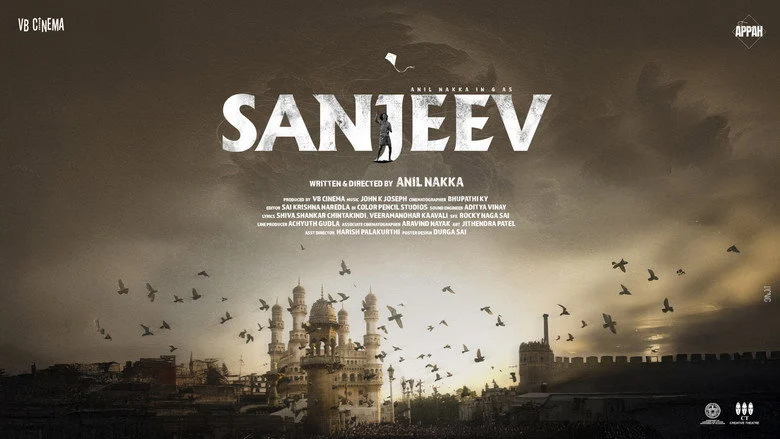
Nakka the Actor Keeps the Film Breathing, Even When the Script Struggles to Walk
Nakka carries the weight of the narrative on his shoulders, and for the most part, he manages it with a groundedness that feels refreshingly unactorly. His performance leans into the silences, letting gestures and glances do the heavy lifting where dialogue might have over-explained. There is an authenticity to his presence that suggests a director who understands his own material from the inside out.
Yet the screenplay gives him precious little to sink his teeth into. The character arc feels sketched rather than fully drawn, and one wishes the writing matched the commitment of the performance. It is a film that trusts its lead implicitly, perhaps too much, leaving the actor to fill gaps that a sharper script should have closed.
Direction and Screenplay: A Study in Economy That Sometimes Feels Economical to a Fault
Nakka’s direction shows a clear eye for composition, favoring static frames and natural light that give the film a documentary-like intimacy. He knows when to hold a shot and when to cut away, a discipline that many debutants lack. The restraint is admirable, but it occasionally borders on the inert, with scenes that feel more like pauses than progressions.
The screenplay’s primary weakness is its reluctance to commit to a central conflict. For a drama, there is surprisingly little dramatic friction, and the narrative meanders through its short runtime without ever landing a decisive emotional blow. The structure feels more like a series of observations than a story with a spine.
That said, the film’s brevity works in its favor in one crucial way, it never overstays its welcome. At 70 minutes, it functions more like a feature-length short, and the lack of padding means the film’s quieter virtues have room to register. It is a modest work, but it knows exactly what it wants to be.
Genre-Core Execution: Drama That Favors Whisper Over Shout
As a drama, Sanjeev operates in a register that is almost aggressively low-key. There are no shouting matches, no tears spilled for the camera, no convenient catharsis. The genre’s traditional beats, confrontation, revelation, resolution, are all present but muted, as if the film is allergic to its own potential for melodrama. This is both its strength and its limitation.
In the absence of conventional dramatic peaks, the film relies on the cumulative effect of small moments. A shared glance between Nakka and Laya Miryala carries more weight than any monologue might, and the film trusts its audience to read between the lines. It is a gamble that pays off in fits and starts, though one wishes the script had given its performers more substantial material to work with.
The pacing, dictated by a runtime that barely exceeds an hour, ensures the film never drags, but it also prevents any single scene from landing with real impact. The drama unfolds in a flat line rather than a curve, and the result is a viewing experience that is more contemplative than gripping.
Supporting Cast: Miryala and Kavali Add Texture to a Sparse Canvas
Laya Miryala brings a quiet warmth to her role, serving as an effective counterpoint to Nakka’s more internalized performance. Her scenes carry a sense of lived-in familiarity, and she manages to suggest a history between the characters that the script never explicitly states. It is the kind of supporting turn that elevates a film without drawing attention to itself.
Veeramanohar Kavali and Hareesh Palakurthi round out the cast with understated contributions that fit the film’s overall tone. Their presence signals a casting strategy that prioritizes naturalism over star power, a choice that aligns with the film’s documentary-like aesthetic. The ensemble works as a unit, even if individual characters remain underdeveloped due to the tight runtime.
A Slim Release With No Controversy and Even Less Noise
Sanjeev arrives without the baggage of controversy, political subtext, or any notable behind-the-scenes drama. The film’s release strategy appears to match its aesthetic, quiet, unassuming, and largely beneath the radar of mainstream discourse. For a debut feature, this is a double-edged sword; it avoids the noise that often distracts from the work, but it also risks being overlooked entirely in a crowded release calendar.
For Telugu drama audiences who actively seek out smaller, more introspective work, this film will likely hold some appeal. It is not a film that will find its audience through marketing or hype, but rather through word of mouth among those who value restraint over bombast. The film’s existence, modest as it is, feels like a statement in itself.
If you appreciate the quieter corners of Telugu cinema, our Telugu Drama reviews might point you toward more discoveries.
Sanjeev is a film that respects its audience’s intelligence, but it may also test their patience. For those willing to meet it on its own terms, there is a certain reward in its sincerity and the conviction of its lead performance. For everyone else, the 70-minute runtime at least ensures the commitment is minimal. Watch it for Nakka’s promise as a filmmaker, not for the film itself, and you will leave with a sense of curiosity about what he does next.
Sanjeev (2026) is a sincere but underwhelming debut that earns a modest 2.5 out of 5 for its earnestness and restraint, even as it struggles to justify its own existence.
For a sharper take on similar rhythms, Modha Rathri review offers a more pointed execution of familiar dramatic beats.
If you prefer your Telugu dramas with more narrative drive, Ram Leela verdict shows what happens when high concepts meet uneven pacing.