The moment Trimurthulu disrupts the Chief Minister’s plan to project her son as a future leader should crackle with tension. Instead, it lands with the thud of a template that Bollywood and Telugu cinema retired a decade ago.
Shilpa Tulaskar’s antagonist is reduced to a power-and-strategy figure with no layered backstory, which makes the political confrontation feel like a formality rather than a genuine escalation. The scene that should define the film’s stakes becomes its most criticised beat, with critics calling the narration “outdated” in execution.

Vadde Naveen’s Sincerity-First Cop Can’t Carry a Shaky Script
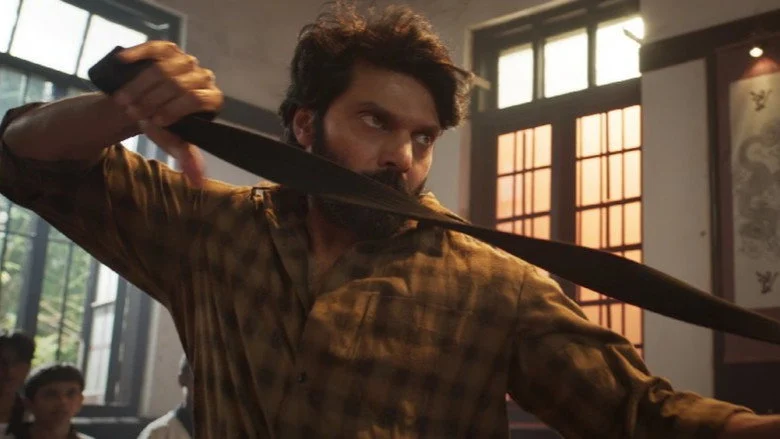
Vadde Naveen’s return to the screen after a gap was the film’s biggest talking point, and his honest-constable persona is built on a clear moral identity. The repeated-transfer motif gives him a functional anchor, but the role demands more than sincerity to sustain a 2-hour-33-minute runtime.
His performance works best in the quiet beats, the family strain from constant postings, the weight of living with consequences. Yet the script never gives him the large emotional variations needed to elevate the material beyond its familiar frame.
The Old Police Station Mystery: A Promising Hook Buried in Routine Narration
The transfer to the old police station where his father once served is the film’s most positively noted structural element. The discovery of a 20-year-old unresolved case tied to his family gives the story a genuine dramatic hook that connects personal history to the crime plot.
Critics acknowledged that this father-son emotional thread provided a clear point of curiosity, and the basic mystery premise worked as an engine for suspense. But the execution around this promising setup is where the film falters, with the screenplay depending on a familiar righteous-cop template.
The transitions from transfer-based setup to old-case investigation to political confrontation lack freshness, and the pacing was criticised for reducing impact. The film’s intent to mix action, suspense, comedy, and family emotion is visible, but the craft never matches the ambition.
Raashi Singh and Devi Prasad Ground the Emotional and Investigative Threads
Raashi Singh’s Lakshmi anchors the family side of the narrative, giving the repeated transfers their emotional consequences. Her presence humanises Trimurthulu’s struggle, even if the role stays within conventional bounds.
Devi Prasad’s Srinivasulu links the present mystery to the father’s past, supporting the generational thread that gives the film its strongest hook. The ensemble also includes Raghu Babu and Baba Baskar, whose casting signals comic-support placement, though no verified scene-level detail was available to analyse their specific contributions.
The Box Office Reality and Audience Divide
The film opened to ₹0.20 crore India net and collected ₹0.78 crore in its first week, according to Filmivilla and Filmibeat, a figure that confirms its flop status. Yet the IMDb rating sits at 7.7, a striking gap from the critic aggregate of 2.1 that labelled the film a “shady mess.”
Audiences appreciated Vadde Naveen’s return and the honest-cop setup, but complaints about old-fashioned presentation and predictable narrative mirror the critical consensus. The political beats were viewed as lacking tension, and the runtime was considered excessive for the material on offer.
For those curious about how this compares to other recent outings in the same space, our Telugu action reviews section has more context on where this film lands in the current landscape.
Transfer Trimurthulu is a film caught between a workable premise and an execution that never escapes its dated instincts. The father-son thread and the old-case mystery deserved a sharper screenplay, but Kamal Teja Narla’s debut feature settles for routine narration and predictable confrontations.
If you’re a Vadde Naveen fan, the sincerity of his cop act might carry you through parts of the first half. For everyone else, this is a skip unless you have a high tolerance for familiar police-drama templates stretched past their limits.
Transfer Trimurthulu is a film that means well but delivers little, earning a modest 2 out of 5 for its honest intentions and wasted potential.
For a sharper take on a debut director’s uneven vision, check out Balan Boy verdict.
If you prefer performances that elevate thin material, Revolver Rinko review offers a different kind of comeback story.