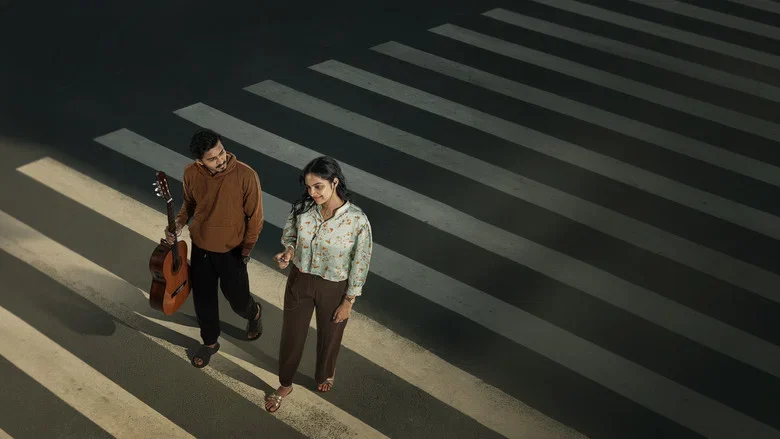
The estate gates creak open on a woman who cannot remember why the sound is familiar. Rejin S. Babu’s Bouma wants us to feel that shiver in our spine, but mostly we feel it in our watch-checking wrist.

A Singer With No Memory And A Police File With Too Many Names
The premise is genuinely promising: a struggling vocalist returns to a decaying estate tied to a past she can barely reconstruct, while a parallel police inquiry circles a string of missing women on the same grounds.
Two investigations, one location, a protagonist whose own recollection is the crime scene. That’s a strong spine for a mystery.
Babu and co-writer Donny Kadammanitta set up the convergence early, letting the singer’s fractured recall and the procedural file bleed into one another. It’s a structure that demands rigorous clue-planting and an emotional logic to the forgetting.
What we get instead is a film that treats amnesia as a mood board rather than a mechanism. The estate is shot with real texture, but the screenplay keeps mistaking atmosphere for evidence.

When Memory Becomes A Convenient Excuse For Withholding
The central engine should be the gap between what the singer senses and what she can prove. That gap is where suspense lives.
Here, the film uses her blankness as a get-out-of-jail card, delaying information whenever the plot needs a breather. Every time a question gets too sharp, she conveniently can’t recall.
That’s not mystery construction, that’s narrative evasion. A thriller earns its final reveal by letting the audience assemble the pieces alongside the detective and the witness.
Bouma keeps the pieces in its pocket and then pulls them out with a flourish we didn’t earn. The result is a third act that explains rather than detonates.
The parallel police track fares slightly better, mostly because it gives the film a ticking clock. But the two strands never truly interrogate each other; they just share a zip code.
Aditi Balan Holds The Frame While The Script Slips Away
Aditi Balan carries the singer with a watchful stillness that the material doesn’t always deserve. Watch her in the early estate scenes: she doesn’t play confusion as wide-eyed panic, but as a held breath.
Her shoulders stay slightly raised, her gaze keeps darting to doorways before settling. It’s a performance built on physical vigilance rather than dialogue.
There’s a moment where she stands at a threshold and lets her hand hover over the frame before touching it, as if the wood might remember more than she does. That’s the film Bouma could have been.
Dileesh Pothan, meanwhile, brings his usual grounded weight to a role the screenplay underuses. He’s given the posture of authority but not the scenes to exercise it.
The supporting ensemble, including Lenaa and Madhupal, drift through the estate like furniture with speaking parts. They register as faces, not functions.
Sharan Velayudhan’s Lensing Deserves A Better Movie
Cinematographer Sharan Velayudhan understands what the screenplay doesn’t: this story is about surfaces that conceal depth. He shoots the estate in long, patient corridors of shadow, letting doorways frame characters like suspects in their own lives.
There’s a recurring visual motif of windows shot from inside, the glass catching reflections of the singer while the world outside stays illegible. It’s a clean, intelligent idea.
Christo Xavier’s score, by contrast, keeps telling us how to feel when the images already know. The strings swell on cue, nudging tension that the editing hasn’t earned.
Sooraj E.S.’s cut moves briskly through the first hour, then loses its nerve in the second. Scenes that should build toward revelation instead circle the same information.
Just as he demonstrated a tighter spatial discipline in Summer Holidays, Babu shows flashes of compositional control here, but the pacing betrays him.
The Missing Women Deserve More Than A Plot Device
Here’s the film’s most uncomfortable failure. The missing women are the story’s moral center, the reason the investigation matters, the reason the estate’s secrets should curdle in our stomachs.
Bouma treats them as set dressing. They exist to give the police something to do and the singer something to remember.
Compare that to the way a film like Disco at least tried to locate its violence in a social world. Bouma keeps its violence abstract, which is safer and far less interesting.
The A certificate suggests the filmmakers intended something adult and unsparing. What’s on screen is neither.
Atus Films Bets On Atmosphere Over Anatomy
Atus Films is positioning Bouma as a prestige-adjacent Malayalam mystery, the kind of mid-budget thriller that can travel on festival buzz and OTT afterlife. That’s a reasonable bet in a market that has rewarded moody regional crime.
But the theatrical math is unforgiving. Without a star who can open a weekend or a hook that travels beyond the trailer, a 115-minute memory thriller needs extraordinary word of mouth.
The film’s ensemble is its commercial insurance: Pothan and Balan bring credibility, and the supporting roster signals seriousness. Whether that translates to footfalls in a crowded November corridor is another question.
What’s clear is that the Malayalam thriller space is getting crowded, and audiences are learning to distinguish between films that respect their attention and films that merely withhold it.
The patient, place-driven mystery is a tradition worth protecting across contemporary Malayalam thrillers, but tradition alone doesn’t fill seats.
The Verdict: A Mystery That Forgets To Investigate
Bouma ends where it began, with a woman standing at a threshold, uncertain what she’s walking into. The difference is that by the final frame, we’ve stopped caring whether she remembers.
That’s the quiet tragedy of a film like this: it has the bones of something haunting, a singer, an estate, a buried crime, and it uses them to tell a story that never quite commits to its own darkness.
Aditi Balan deserves a movie that trusts her stillness. The audience deserves a mystery that trusts theirs.