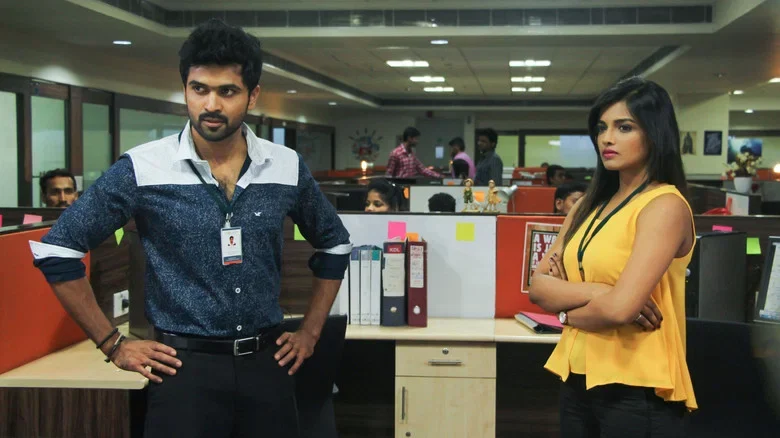
Rakesh Varre opens his film with a self-defence coach named Krish standing in a Vizag training hall, his body coiled with the kind of physical certainty that suggests he has never met a problem his fists couldn’t solve.
Then he meets Asha, a woman whose entire screen identity is built around returning lost objects to strangers, and the film’s central joke begins to curdle into something far more unsettling.

When a Self-Defence Coach Meets a Rival His Fists Cannot Touch
The premise of Maya Lady is deceptively simple: boy meets girl, girl has a mysterious past, and a third figure named Roopa keeps crashing into their courtship with the persistence of a recurring nightmare.
What makes the setup genuinely interesting is that Krish’s profession is rendered useless by the nature of his romantic problem. He can pin a man to the mat, but he cannot pin down the truth about the woman he loves.
Varre, who also directs and co-writes, leans into this contradiction with a certain scruffy conviction. His Krish is not a brooding action hero but a confused man-child who keeps trying to apply physical solutions to emotional problems that require entirely different tools.
The result is a film that wants to be both a breezy romantic comedy and a psychological thriller about obsession, possession, and concealed identity. That tonal tightrope act is the film’s greatest risk and, for much of its runtime, its most frustrating liability.
The Gentle Woman Who Returns Lost Things Has a Past She Won’t Discuss
Madhumita Sarcar’s Asha is the film’s most intriguing creation, a woman whose compulsive habit of returning lost items to their owners reads initially as a charming quirk and gradually as something closer to a compulsion.
Sarcar plays her with a soft-spoken stillness that makes her refusals to discuss her past feel less like coy narrative withholding and more like a genuine psychological defence mechanism.
When she finally does crack, the film shifts registers so abruptly that you can feel the screenplay straining to justify its own tonal pivot. The romantic comedy furniture is still on stage, but the lights have changed and nobody told the actors.
This is where Maya Lady becomes a fascinating mess. The film wants to interrogate the instability of romantic perception, but it keeps retreating to the safety of meet-cute rhythms and comic interruptions whenever the psychological tension threatens to become genuinely uncomfortable.
The comparison to Dark Chocolate is instructive here. Both films are contemporary theatrical releases that gamble on unreliable protagonists and shifting audience sympathies, but where that film committed to its unreliable narrator with a certain cold-blooded discipline, Maya Lady keeps hedging its bets.
Roopa as the Disruptive Force Who Refuses to Let Go
The film’s most potent weapon is Roopa, the woman who repeatedly enters Krish’s life and refuses to disengage from him or Asha with the tenacity of a creditor who knows exactly where the money is buried.
She is not a conventional antagonist. There are no threats, no shadowy henchmen, no physical confrontations. Her power lies in her refusal to be ignored, in the way she occupies the frame of Krish’s life with the quiet persistence of a debt that cannot be discharged.
The screenplay wisely keeps her motivations opaque for long stretches, allowing the audience to fill in the blanks with their own suspicions. Is she a spurned lover? A stalker? A woman with a legitimate claim to Krish’s past that he has conveniently forgotten?
By the time the film answers these questions, the answer feels less like a revelation and more like a narrative necessity, a box that needed to be ticked so the third act could proceed.
The supporting cast, including Satya and Indraja, are given little to do beyond occupying space and delivering exposition with varying degrees of conviction. Their presence registers as functional rather than essential, which is a polite way of saying the film could have used them more sharply or not at all.
The actor’s earlier work in VISA – Vintara Saradaga suggested a performer capable of finding small, humanising details in underwritten roles, but here the screenplay gives him almost nothing to work with beyond a few reactive beats.
The Vizag Setting and the Visual Grammar of Deception
Cinematographically, the film adopts a deliberately flat visual palette for its romantic passages, all warm afternoon light and soft focus, before shifting to cooler, harder compositions once the psychological machinery kicks into gear.
It is a legible strategy, but it is also a somewhat obvious one. The visual language of the film announces its tonal shifts rather than allowing them to emerge organically from the performances or the writing.
The editing, particularly in the second half, struggles to maintain momentum during the film’s more introspective passages. Scenes that should build tension instead linger, and the film’s two-hour-plus runtime begins to feel like a deliberate provocation rather than a necessary dramatic choice.
There are moments, particularly in the final act, where the film’s ambition genuinely shines through. The confrontation between Krish and the rival he cannot defeat physically is staged with a certain starkness that suggests Varre has a genuine instinct for psychological staging.
But those moments are isolated, surrounded by long stretches of narrative throat-clearing that undercut their impact. The film’s thematic ambitions are clear, but its execution is uneven in ways that suggest a filmmaker still learning to trust his own instincts.
The Uncomfortable Question of Who Krish Actually Fell For
The film’s central question, which woman has Krish actually fallen for, is a genuinely provocative one, and the screenplay deserves credit for refusing to resolve it with a neat romantic bow.
But the resolution, when it comes, feels less like an earned revelation and more like a narrative convenience. The film wants to leave its audience unsettled, but it also wants to send them home happy, and those two impulses are never fully reconciled.
The final act gestures toward something genuinely uncomfortable, a recognition that romantic perception is always already a form of projection, but it pulls its punches at the crucial moment.
The result is a film that is more interesting to think about after the fact than it is to actually watch. Its ideas are sharper than its execution, its ambitions more impressive than its achievements.
This is a film that wants to interrogate the instability of romantic perception, and it deserves credit for attempting that interrogation in a commercial Telugu cinema context that rarely rewards such ambition.
The thematic kinship with Abadameva Jayathe is worth noting here. Both films use comedy as a Trojan horse for darker psychological material, but where that film maintained a tighter grip on its tonal balance, Maya Lady keeps threatening to collapse into incoherence.
The Commercial Gamble of a Mid-Budget Romantic Thriller
The film arrives in a theatrical marketplace that has become increasingly hostile to mid-budget original IP, particularly in the Telugu industry where star-driven spectacles and franchise extensions dominate the release calendar.
Varre’s decision to both direct and star in the film is a significant financial risk, one that places the entire commercial burden on a relatively untested leading man’s shoulders.
The production banners behind the film have not been aggressively marketed, which suggests either a lack of confidence in the product or a deliberate strategy to let the film find its audience through word of mouth.
Either way, the film’s theatrical prospects are uncertain. It lacks the star power to open big, the critical buzz to build momentum, and the franchise recognition to sustain interest beyond its opening weekend.
The film’s best hope lies in the growing appetite for contemporary Telugu comedys that blend genre elements in unexpected ways, a trend that has produced some of the most interesting work in the industry in recent years.
Whether Maya Lady can capitalize on that trend remains to be seen, but its willingness to take risks in a risk-averse market is at least worth acknowledging.
A Film That Wants to Be Two Things at Once and Succeeds at Neither
The central problem with Maya Lady is not that it is ambitious. It is that its ambitions are fundamentally incompatible with each other.
The film wants to be a romantic comedy that turns into a psychological thriller, but it never fully commits to either register, leaving both feeling underdeveloped and unsatisfying.
The comedy is not sharp enough to sustain the first half, and the thriller elements are not disciplined enough to carry the second. The result is a film that feels like two different movies stitched together with visible seams.
And yet, there is something genuinely compelling about the film’s refusal to play it safe, its willingness to take a familiar romantic premise and push it into uncomfortable territory.
Varre’s performance, particularly in the film’s final act, suggests a performer capable of more than the material gives him. There are moments of genuine emotional rawness here that hint at a much better film struggling to get out.
But those moments are too few and too far between to redeem the film’s structural problems. Maya Lady is a fascinating failure, a film whose reach exceeds its grasp in ways that are both frustrating and, occasionally, genuinely exciting.
It is not a film that works, but it is a film that suggests its makers might one day make something that does. And in an industry that too often rewards safety over ambition, that is worth something.
The film’s final shot, which I will not spoil here, gestures toward a more interesting movie than the one we have just watched. It is a tantalizing glimpse of what might have been, and a reminder that the gap between ambition and execution is often the most interesting thing about a film.
Maya Lady is now playing in theaters. It is a risk-led gamble that does not fully pay off, but it is a gamble worth taking.