Vishwadev Rachakonda’s Fire Star Yagna summons three ghosts of his own making to a mansion and dares them to exist. Shashank Srivatsavaya’s psychological chamber piece is a high-wire act that never quite decides whether it wants to fall.
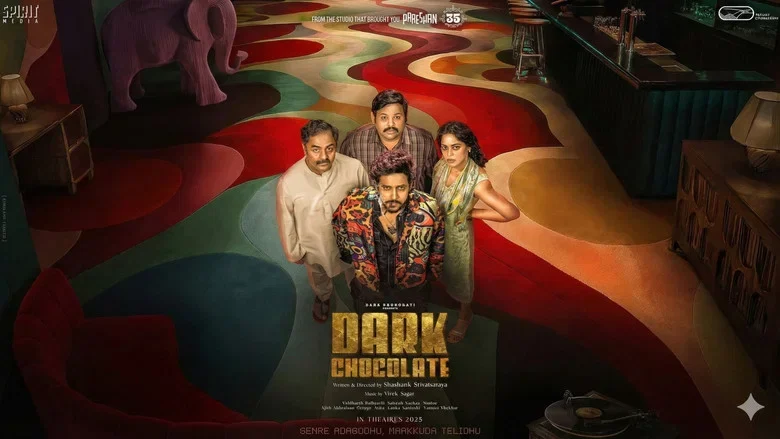
When a Fading Star Declares His Guests Imaginary, the Film Finds Its Pulse
The setup is deliciously cruel. Yagna, a former matinee idol whose career has curdled into box-office humiliation, lures three figures from his past to an isolated mansion under the guise of a comeback summit.
Then he tells them they aren’t real. That single declaration rewires the film’s entire dramatic engine, turning what could have been a conventional revenge potboiler into a contest over perception itself.
It’s a premise that echoes the structural ambition of Lambodhara 2.0, another recent Telugu effort that reached for conceptual daring but stumbled on execution. Here, the confinement is the point.
The Mansion Becomes a Stage, and the Audience Becomes the Jury
What distinguishes the second act is how ruthlessly Yagna’s authority erodes. He tries to eliminate the figures he believes he conjured, yet every attempt to assert control makes him look more unhinged.
Srivatsavaya, who also writes and edits, keeps the camera close enough to catch the micro-shifts in Yagna’s expression whenever a guest contradicts his version of events. The comedy, such as it is, curdles into dread.
The film’s smartest structural gamble is refusing to confirm whether the visitors exist independently. That ambiguity places the viewer in Yagna’s fractured headspace, and it’s a strategy that the more convoluted identity maze of KillR attempted with less discipline.
Rachakonda Holds the Center, but the Film Around Him Wobbles
Rachakonda’s performance lives or dies on a single technical demand: making every line plausible both as deliberate manipulation and as hallucination. His Yagna carries himself with the brittle grandiosity of a man who has confused fame with reality.
Watch his posture when he addresses the assembled guests, shoulders squared, chin lifted, voice pitched to fill a room that may not contain anyone. It’s a physical performance built on the terror of being watched by no one.
Bindu Madhavi’s Hamsa registers as a wary, grounded counterweight, but the screenplay gives her little to do beyond react. The remaining figures function largely as dramatic furniture, their presence felt but their interiority unexplored.
The restrained exhaustion Rachakonda brings to Yagna’s quieter moments recalls the psychological weight of his turn in Black Gold, though that film gave him a clearer external adversary to push against.
The Ambiguity Is the Point, but the Pacing Tests Patience
Sathish Saakar’s camera work favors shadowed corridors and tight framings that make the mansion feel like a holding cell. Vivek Sagar’s score, meanwhile, leans on low drones that underscore Yagna’s mounting paranoia.
The problem is rhythm. The first half lingers on setup, and the second half’s escalation of strange incidents starts to feel repetitive rather than cumulative. The film knows it wants to disorient, but it mistakes repetition for depth.
Still, there’s something admirably stubborn about a Telugu thriller that refuses to offer a clean external villain. The conflict is entirely internal, and that choice signals a tonal maturity worth noting across contemporary Telugu thrillers.
Spirit Media and Waltair Productions Bet on Concept Over Spectacle
Produced by Siddharth Rallapalli and Rana Daggubati under Spirit Media and Waltair Productions, the film is a modest-budget gamble on a star vehicle that deliberately withholds the star’s usual heroic register.
That’s a risky proposition in a theatrical market that rewards scale and familiarity. The A certificate and confined-location premise narrow the audience further, and advance bookings suggest a slow start.
For Daggubati’s Waltair, the film represents a test of whether prestige-leaning Telugu content can find theatrical footing. For Rachakonda, it’s a bid to reframe his screen persona away from conventional leading-man territory.
A Chamber Piece That Refuses to Explain Itself, for Better and Worse
The final confrontation forces Yagna to question his own sanity, and the film wisely resists a tidy resolution. Whether that ambiguity feels earned or evasive will depend entirely on the viewer’s tolerance for unresolved questions.
What lingers is the image of a man performing for an audience that may exist only in his head, a metaphor for celebrity that cuts deeper than any conventional thriller climax.
Dark Chocolate is a flawed, fascinating experiment that trusts its audience more than it probably should. That trust, frustrating as it is, feels like something worth defending.