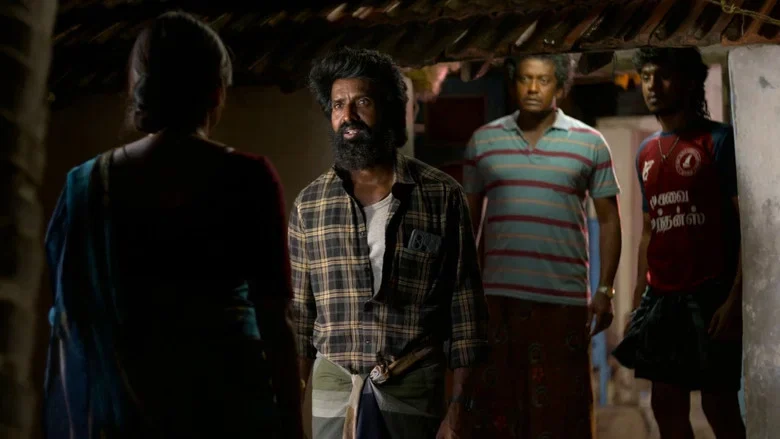
Dheeran Arunkumar’s Black Gold opens on a commodity most of us never think about twice: the human hair on our heads. By the time the credits roll, that everyday material has been transformed into a violent, international battlefield.
The film’s central conceit is genuinely singular. It treats Indian women’s dark, long, strong hair as a high-value export, a trade controlled by commercial mafias who kill for supply. It’s a premise that could have been a gimmick. Instead, it becomes the film’s gravitational center.

An Unusual Economy Becomes a Familiar War Zone
The screenplay wastes little time establishing the stakes. Hair moves through a shadow economy, and the men who control that flow are not petty criminals. They are industrialists with blood on their hands.
Vetri’s protagonist is positioned inside this structure rather than outside it. He is not an investigator looking in. He is a man already entangled, already compromised, already paying for his proximity to the money.
That choice matters. A lesser film would have handed us a righteous outsider and a clean moral ledger. Black Gold refuses that comfort, and the film is stronger for it.
The narrative escalates through rivalry, betrayal, and violence, with Livingston’s father character supplying the emotional counterweight. The family-duty dimension gives the criminal machinery something to grind against.
Vetri Carries the Weight Without Asking for Sympathy
Vetri’s performance is the film’s spine. He plays a man under pressure without ever announcing that pressure to the audience. His stillness in moments of threat does more work than any raised voice could.
There is a scene where he simply listens to his father speak, and the camera holds on his face. You can see the calculation happening behind his eyes, the cost of every decision registering in real time.
The physical exhaustion he brings to the later confrontations recalls the psychological weight of his turn in Lakshmikanthan Kolai Vazhakku. Both roles require him to carry moral compromise without theatrical release.
Priyalaya’s Renu functions as the film’s emotional counterweight. She moves through love, anger, and compassion with a maturity that keeps the character from becoming a symbol. Her best moments are the quiet ones, where she simply looks at Vetri and you understand everything that has gone unsaid.
Livingston brings warmth to the father role. His loyalty to his son is never questioned, which makes the family’s entanglement in the criminal world that much more painful to watch.
The Direction Finds Texture in the Margins
Dheeran Arunkumar directs with a focus on atmosphere over spectacle. The camera lingers on the physical spaces of the trade: warehouses, loading docks, the quiet rooms where deals are made. The texture is gritty without being showy.
This is a film that understands how to build tension through accumulation rather than explosion. The violence, when it comes, lands harder because the film has earned it through patience.
The comparison to other contemporary Tamil thrillers is instructive. Where Enemy Of The Smuggler leaned on kinetic set pieces, Black Gold trusts the slow build. The result is a film that feels more interested in the psychology of its characters than in the mechanics of its plot.
The cinematography favors close framing and natural light, keeping the audience in intimate proximity to the characters. The world feels lived-in rather than staged.
Where the Film Loses Its Grip
For all its strengths, the screenplay occasionally struggles to balance its competing interests. The hair-trade premise is so rich that the conventional crime-thriller beats feel almost redundant by comparison.
The middle section, while never boring, relies on familiar patterns of double-cross and escalation. The film’s most distinctive element is its setting, not its structure, and there are moments when the latter threatens to overwhelm the former.
The ensemble cast is large but unevenly deployed. Several performers are given little to do beyond filling out the criminal ecosystem. Their presence adds texture, but not much else.
These are not fatal flaws. They are the kind of structural hitches that keep a good film from becoming a great one. The film’s ambition is clear, even when its execution wobbles.
The Commercial Reality of a Mid-Budget Crime Drama
MM Studios is betting on a premise that is neither franchise nor star vehicle in the conventional sense. The film’s commercial prospects depend on whether audiences are willing to follow Vetri into a world this morally murky.
The theatrical market for Tamil crime thrillers has been volatile in recent years. Films like Bouma have demonstrated that audiences will show up for intelligent, atmospheric genre work, but only if the marketing manages to communicate what makes the film different.
Black Gold‘s advantage is its premise. The human-hair trade is a genuine conversation starter, a detail that could drive word-of-mouth in a crowded release window.
The film’s challenge is that it asks audiences to invest in a protagonist who is not entirely sympathetic. That is a risk, but it is also the source of the film’s integrity.
A Closing Thought on Ambition and Restraint
Black Gold is not a perfect film. It is, however, a film with a point of view, and that is increasingly rare in a market that rewards familiarity.
The ending, without giving anything away, refuses the easy catharsis of a clean victory. The characters are left with the consequences of their choices, and the film does not pretend those consequences are simple.
It is a conclusion that lingers, not because it is shocking, but because it is honest. The world of Black Gold is one where money moves faster than morality, and the film never forgets that.
For viewers willing to follow Vetri into that world, the journey is worth taking. For those seeking easy answers, the film offers none.