The lights go out across a Chennai apartment block, and two strangers are left standing on a terrace with nothing but each other and the hum of a generator. Eashwar Gopala Krishnan’s debut asks whether that is enough to build a film on.
A Blackout Becomes the Only Character Who Arrives on Time
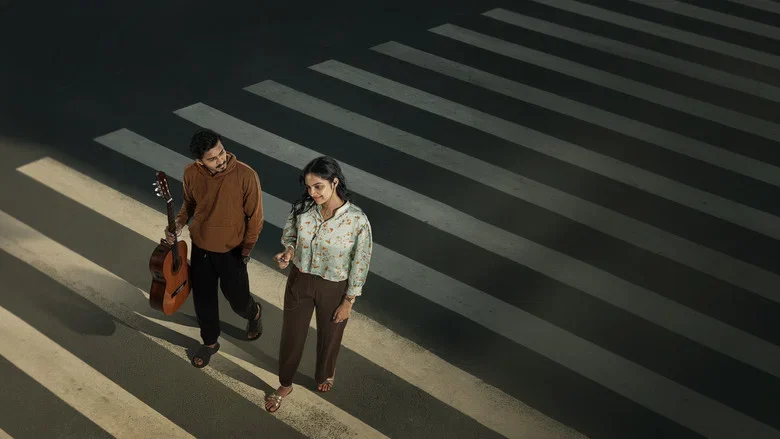
The premise is almost aggressively modest: a freelance illustrator and a struggling music director, both stalled in their creative lives, share a terrace during a citywide power cut. No antagonist arrives. No plot machinery cranks into gear.
What the film gambles on is the blackout itself as a dramatic agent. It strips the city of its electrical distractions, replaces streetlight with generator glow, and forces two people to remain in place long enough to speak.
That constraint is the film’s entire architecture, and to Gopala Krishnan’s credit, he treats it as a discipline rather than a limitation. The terrace becomes a chamber, and the evening becomes the plot.
Two Creative Careers as a Map of Private Failure
The choice to make both characters working artists is the screenplay’s sharpest decision. Illustration and music direction are professions that require daily negotiation with self-doubt, and the film uses that shared terrain to bypass small talk.
Sacchin Nachiappan’s illustrator carries the visible fatigue of someone whose work lives in isolation. His stillness in the early terrace sequences, the way he keeps his hands occupied and his gaze elsewhere, suggests a man who has forgotten how to be asked about himself.
MV Namritha’s music director supplies the counterweight. She occupies the frame with a restlessness that reads as ambition running out of road, and her professional frustration gives the conversation its first real spark.
The film’s emotional engine is not romance in any conventional sense. It is recognition, the slow realization that the person standing three feet away has been losing the same argument with themselves.
The Silence Before the Conversation Is Where the Acting Lives
Gopala Krishnan understands that the most interesting stretch of any two-hander is the portion before anyone says anything useful. The early terrace scenes are built on distance, on bodies angled away from each other, on the refusal to make eye contact.
Nachiappan plays the awkwardness with a tight physical vocabulary. His shoulders stay squared, his responses arrive a beat late, and his one attempt at levity lands with the flatness of a man out of practice.
Namritha answers with stillness of her own, letting her character’s guardedness read in the way she holds a mug or watches the skyline instead of her companion. When the two finally settle into a rhythm, the shift is visible in their posture before it is audible in the dialogue.
The supporting presence of Arun Krishnan is credited but dramatically opaque, and the film does not appear to depend on him for its emotional weight. That is a notable structural risk in a story this contained.
A Sunset, a Blackout, and a Camera That Knows When to Hold
The visual progression from ordinary evening to full darkness is the film’s most reliable asset. The light falls gradually, the terrace loses its edges, and the city’s noise thins into distant chatter and mechanical hum.
Composer AKR’s score appears to understand the assignment, staying sparse enough that the ambient soundscape can do the emotional labor. The absence of music in the crucial early passages is a deliberate and effective choice.
Where the direction becomes harder to defend is in sustaining variation across a single location. The film runs a lean duration, and that compression works in its favor, but the visual grammar risks settling into repetition once the conversation takes hold.
The pacing, at least as the evening is structured, moves from accidental proximity to disclosure without a conventional midpoint reversal. Whether that reads as organic or underpowered will depend entirely on how much the viewer invests in the two performers.
The Chamber Drama Tradition, and Where This One Sits
Contained two-handers have a long and distinguished lineage in Tamil cinema, and the film’s willingness to trust conversation over incident places it in a lineage that includes Angelina, which similarly anchors its tension in a single pressurized situation.
What this film does differently is refuse the thriller impulse almost entirely. There is no ticking clock beyond the eventual return of electricity, and no external threat waiting in the stairwell.
That restraint is admirable, though it also exposes the screenplay to a harder test. Without a plot engine, the dialogue has to carry the full weight, and the film’s success depends on whether the writing earns its silences.
The broader landscape of contemporary Tamil dramas has been trending toward exactly this kind of intimate, location-driven storytelling, and this film fits that movement with unusual discipline.
What the Film Refuses to Give You, and Why That Matters
There is no villain here, no betrayal, no third-act revelation that recontextualizes the evening. The antagonists are stalled careers, urban loneliness, and the quiet shame of not having made the work you meant to make.
That choice gives the film a purity that will frustrate viewers expecting escalation. It also means the emotional payoff depends on whether the final conversation feels earned rather than merely scheduled.
On that count, the film is more convincing in its middle passages than in its resolution. The movement toward mutual recognition is graceful, but the closing note risks arriving before the characters have genuinely earned it.
The comparison to something like Maya Lady is instructive: that film tried to bolt thriller mechanics onto a romantic premise and strained under the weight. This one chooses the opposite risk, and mostly survives it.
A Small Film With a Very Specific Commercial Ceiling
The production footprint here is modest to the point of invisibility, and the release is positioned as a limited Tamil theatrical title rather than a wide commercial play. The banners behind it are not operating at franchise scale.
That makes the film’s box-office exposure almost entirely dependent on word of mouth among viewers who actively seek out short-form, dialogue-driven cinema. It is not a release built to survive a crowded weekend.
The theatrical lifecycle for films of this size is unforgiving. Without a recognizable star or a genre hook, the window between limited release and streaming migration tends to be brief.
Nachiappan’s leverage as a lead remains untested at this scale, and the film’s commercial fate will likely be determined by festival or platform interest rather than theatrical legs. That is not a failure of the film, but it is a fact of its market.
The runtime confusion in public listings, with some sources reporting forty-three minutes and others over an hour, does the film no favors. It signals a release that has not been carefully positioned.
The Verdict: A Patient Film That Trusts You to Sit Still
Sooriyan Maraindha Maalai is a film about the moment before connection, and it is most alive when nothing is being resolved. The blackout is not a gimmick here; it is a permission slip for two people to stop performing.
Nachiappan and Namritha build something quietly credible in the space between their characters, and Gopala Krishnan has the discipline to let that space breathe. The result is a film that will reward the viewer willing to meet it on its own terms.
What lingers afterward is not the resolution but the hum. The generator, the distant voices, the terrace going dark, and two people discovering that being heard is a form of light.