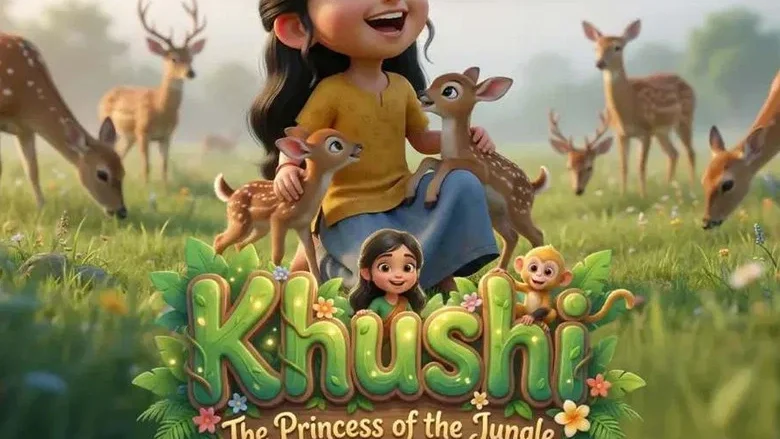
The first thing you notice is the light, dappled, digital, impossibly clean, the kind of sunbeam a rendering engine places where a cinematographer would have argued for shadow.
ManoramaMAX’s Children’s Day offering arrives as Malayalam’s first AI-produced animated original, and that provenance is visible in every frame before a single character speaks.
A Hundred Minutes of Discovery Without a Single Hostile Force
Khushi and Chottu step out of an ordinary human world and into a hidden forest, and the film’s dramatic engine is nothing more elaborate than that threshold crossing.
She talks to animals. He follows her. That is the premise, and for a very long stretch it is also the entire plot.
Children’s animation has survived on thinner scaffolds, but the genre’s real masters understood that wonder requires friction to register as wonder at all.
The 3D forest teems with glowing creatures and communicative fauna, yet nothing in it wants anything from these children, no territory to defend, no hunger, no grudge.
When every encounter resolves into a lesson, the adventure stops breathing.
Bundu, Tara, and Golu Form a Species Checklist, Not a Story
The companion ensemble is assembled with taxonomic care: a monkey, an elephant calf, a porcupine, one for each shelf of the toy aisle.
What they lack is function beyond variety.
Tara lumbers, Bundu scampers, Golu bristles, and the film treats their visual contrast as sufficient characterization, leaving the group to ornament a journey rather than drive one.
Compare this to the deliberate, patience-rewarding atmosphere of Sooriyan Maraindha Maalai, a contemporary release that understands mood must be earned through withheld information.
Here, nothing is withheld, because nothing was ever at stake.
Suraj Venjaramoodu’s Narration Is the Only Adult Presence in the Room
His voice is the film’s one concession to professional performance, and it matters more than the material deserves.
He narrates rather than inhabits, a warm, measured register that treats the audience with genuine courtesy, no winking, no condescension toward children who can smell condescension at forty paces.
But narration that explains wonder is narration that has already conceded the images cannot carry it alone.
The restraint he brings to this unseen role echoes the controlled register of his work in Maya Lady, where vocal and physical economy did the heavy lifting a script refused to do.
Khushi herself, meanwhile, is defined entirely by her ability to communicate with the forest, an imaginative hook, not a character with an interior.
We learn what she can do. We never learn what she wants.
The Missing Antagonist Is Not a Gap, It’s a Structural Collapse
No villain is named in any material surrounding this release, and the absence registers on screen as a flatness the animation cannot compensate for.
Conflict in children’s fantasy does not require menace, but it does require resistance, a rule the forest will not bend, a loss the protagonist cannot undo.
This forest bends for Khushi at every turn.
The result is a hundred minutes that move without escalating, an adventure whose midpoint and climax occupy the same emotional altitude.
The screenplay’s only structural logic is accumulation: more creatures, more glow, more forest.
The thematic sibling to this failure of escalation is Aadu 3, which stretched a franchise past its breaking point precisely by confusing volume of incident for growth of story.
At least that film had a prankish goat with an agenda.
AI Production Is a Cost Story, Not an Aesthetic One
The film’s technological identity is its marketing identity, and the two are indistinguishable in execution.
Lighting falls evenly across surfaces that should have texture; foliage repeats in patterns the eye learns to predict within minutes; character rigs hold a softness that reads as unfinished rather than stylized.
None of this is scandalous. It is simply visible.
There is a real argument that AI-assisted pipelines will democratize children’s animation in languages the market has ignored, and this release is genuine evidence for that case.
But democratized production does not solve the harder problem, which is that a director with a point of view, and this production has not disclosed one, is what turns a rendered forest into a place.
The broader movement toward patient, culturally specific storytelling across contemporary Malayalam fantasy has shown what regional imagination can do when it is trusted with darkness and contradiction.
This one sands all of that away in favor of safety.
ManoramaMAX Bets on a Demographic, Not a Franchise
For the platform, the calculus is legible: a Children’s Day drop, a recognizable narrator, a four-to-twelve target, and a production method that keeps costs far below conventional 3D animation.
That is a streaming-library play, not a theatrical one, and it should be evaluated as such.
The commercial question is not opening-weekend gross but completion rate, whether a child who starts this film on a Saturday morning stays through the credits, and whether a parent queues a second viewing.
On the evidence of the film’s own internal rhythms, the second viewing is the harder sell.
ManoramaMAX has built real equity in Malayalam-language originals, and burning audience patience on underdeveloped children’s content is a cheap way to spend it.
A Forest That Never Says No
What lingers is not a scene but a suspicion: that the film’s most advanced technology was deployed in service of its least ambitious idea.
Khushi can hear the animals, and the animals have nothing to tell her except that the forest is lovely.
Children deserve better than lovely. They deserve a forest with teeth.