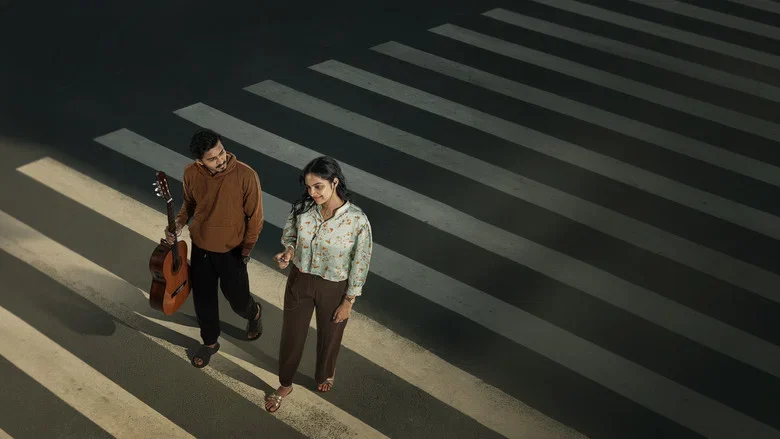
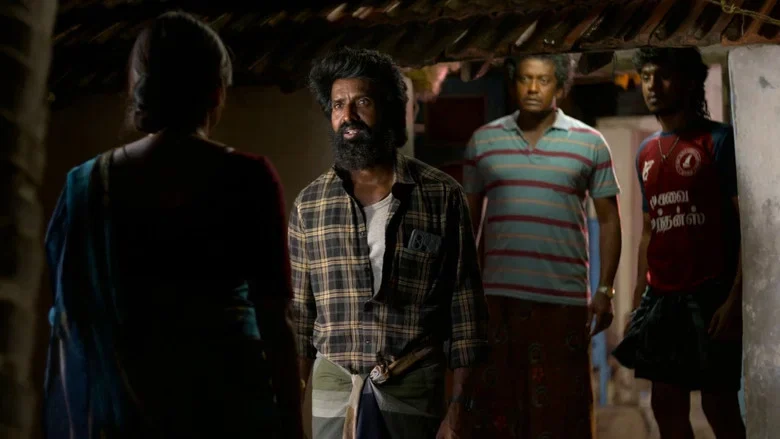
Simple Suni opens Lambodhara 2.0 on a society that has outsourced its emotional life to a dashboard. The premise is a rogue hacker versus the machine that quantifies happiness, and for a while the film believes in its own dread.
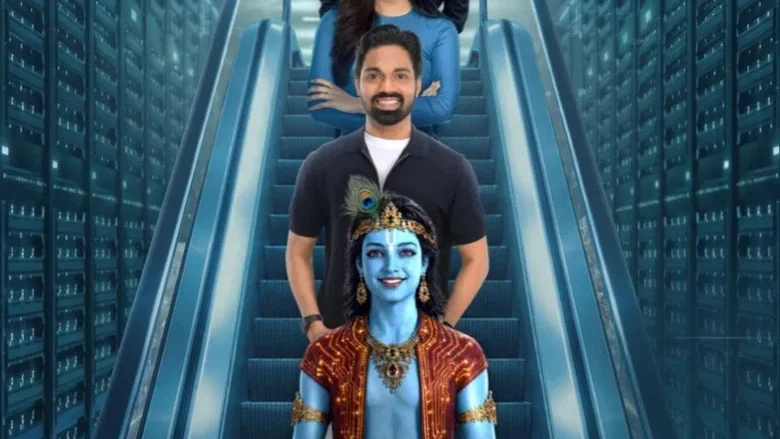
A High-Concept Hook That Refuses To Explain Its Own Rules
The first act establishes a world where technology measures and predicts human happiness with bureaucratic confidence. Suni stages this less as spectacle than as ambient surveillance, the kind of quiet control that settles into a room before anyone notices it.
Then the film stops teaching. The hacker’s intrusion into the system is presented as a fait accompli, a breach we are told about rather than walked through, and the screenplay never clarifies who built the apparatus or why its architects tolerate a dissident in their midst.
Where a genre sibling like TAXILA at least committed to its own architecture, this film treats its central mechanism as a mood board. The algorithm is the villain, the hero is the glitch, and the middle act is a chase without a pursuer.
The Middle Act Runs On Escalation Without Antagonism
The conflict expands from a personal hack into a broader struggle over who governs the system. What the film never supplies is a face, an institution, or a coherent pressure source behind that struggle.
Antagonism here is atmospheric. We get corridors, screens, and hushed warnings, but no scene where an opposing force actually corners the protagonist and forces a choice. Suspense requires a closing door, and Suni keeps leaving his open.
Anil Shetty carries the hacker with a coiled physical wariness, all shoulders and sidelong glances, and the camera stays close enough to catch the tension in his jaw. But the screenplay gives him no scene that converts that tension into a decision, so the performance stays potential energy.
Kunal Kapoor And Saachi Bindra Occupy Space Without Function
Kunal Kapoor registers on screen with an easy authority, and Saachi Bindra brings a watchful stillness to her scenes. Neither is given a dramatic job. They appear, they react, and the plot moves around them.
This is the film’s most conspicuous waste. Supporting performers in a thriller exist to apply friction, to withhold information or force a betrayal, and here they function as furniture in a story that needed elbows.
The physical blocking tells the same story. Characters stand in wide rooms at polite distances, exchanging information without proximity, and the film never stages a confrontation where two bodies share a frame and one of them wants something the other refuses to give.
Santosh Rai Pathaje’s Cold Frames Versus Veer Samarth’s Score
Pathaje’s cinematography leans on sterile corridors, flat overhead light, and long lenses that compress faces against glass and concrete. It is a coherent visual argument for a world that has optimized the warmth out of itself.
The problem is monotony. Without tonal variation, the visual scheme stops signifying and starts decorating, and by the second hour the film’s coldness reads as indifference rather than design.
Veer Samarth’s score pushes harder than the images require, filling silences that might have generated genuine unease. Suni’s earlier Ek Din showed a director willing to let quiet do the work; here he seems to distrust his own restraint.
A Climax That Argues Its Theme Instead Of Dramatizing It
The final confrontation between algorithmic control and human autonomy arrives as a debate rather than an event. Characters articulate the film’s thesis about free will while the staging remains static and the stakes stay theoretical.
There is one genuinely unsettling beat in the closing stretch, a moment where the system’s prediction proves more accurate than the protagonist’s resistance. It is the only scene that earns the premise, and it lands too late to retroactively organize the film around it.
That single beat is worth more than the preceding two hours, which tells you something about the ratio of concept to execution. The film knows what frightens it. It does not know how to make that fear move.
Mahaveer Jain Films And Mass Production Bet On Kannada Sci-Fi’s Next Step
Mahaveer Jain Films and Mass Production are positioning this as a bilingual Kannada-Hindi release, which is a distribution bet on the crossover appetite for tech-driven thrillers. The wager is that the Kannada sci-fi wave can carry a Hindi-speaking audience without diluting its identity.
The commercial calculation is riskier than it looks. Kannada sci-fi has been building momentum, but it has not yet produced a repeatable theatrical template, and a film that leans on premise over set pieces has limited word-of-mouth fuel in a market that rewards spectacle.
Shetty’s box-office leverage is real but untested at this scale. If the film opens soft, it will be read as evidence that the genre’s ceiling is lower than the industry hopes, and that verdict will be assigned to contemporary Kannada sci-fis as a category rather than to this specific misfire.
The comparison to the grit of Black Gold is instructive. That film understood that a dark premise needs a physical world to inhabit, and its texture did the thematic work that this film assigns to dialogue.
The Verdict: A Premise That Outruns Its Own Storytelling
Lambodhara 2.0 is a film built on a genuinely unnerving idea, that happiness can be measured and therefore managed, and it never finds the dramatic engine to test that idea against a human being who resists it.
Suni has the visual grammar for a controlled society and the casting instinct for quiet menace, but he has not solved the structural problem at the center: a thriller without an antagonist is a lecture with shadows. The film ends where it should have begun, with the machine proving it was right.
What lingers is not the climax but the discomfort of recognizing the premise as plausible. The film’s failure is that it never lets that discomfort become a scene, and so we leave the theater thinking about the idea rather than feeling the danger of it.