The opening frame lands you in a period battleground where two cosmic forces square off before a single line of dialogue is spoken. Sundar C wants you to feel the weight of myth immediately, and for about ninety seconds, he earns it.
Then the film cuts to a trembling police constable, and the entire enterprise reveals its central gamble: a goddess epic smuggled inside a procedural about a woman who can barely hold her service revolver steady.
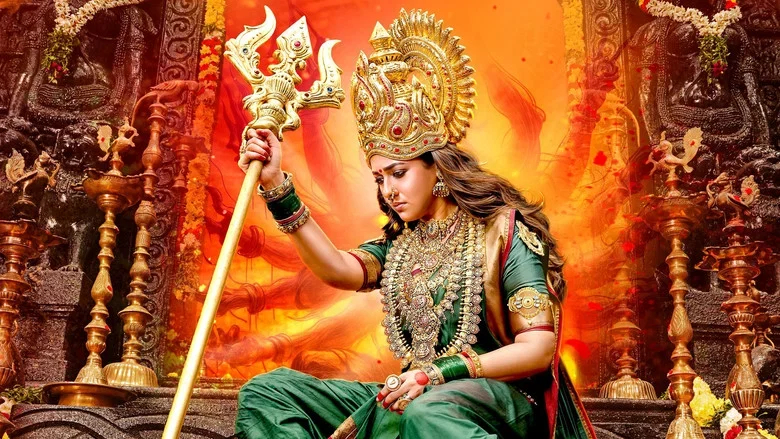
When A Goddess Epic Borrows A Cop Drama’s Spine
The structural conceit is ambitious on paper. An ancient queen’s sacrifice to protect her son collides with a present-day officer’s discovery that her identity is tethered to Mahasakthi herself.
Sundar C stages the ancient timeline with ritual gravity, all torchlit corridors and hushed invocations, before yanking the audience into contemporary Tamil Nadu with a tonal jolt that never quite resolves.
That collision is the film’s engine and its liability. The causal bridge between the two eras leans heavily on exposition delivered by supporting figures whose dramatic function amounts to pointing at scrolls and murmuring prophecies.
Just as the filmmaker stripped away decorative excess in Disco, he attempts a leaner mythological grammar here, but the two-timeline architecture demands connective tissue the screenplay never fully supplies.
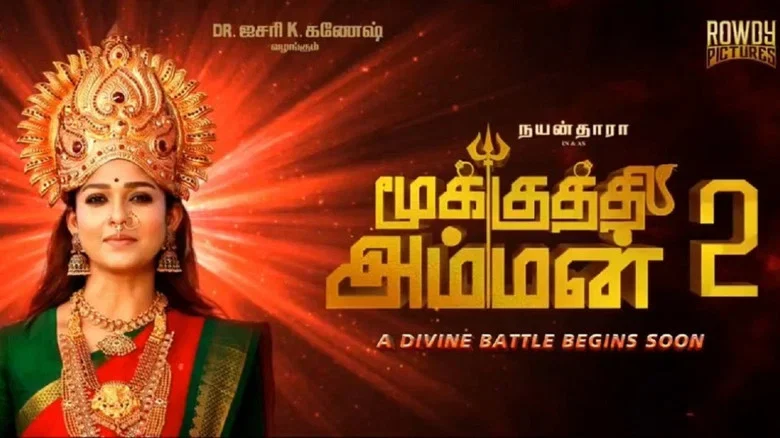
Nayanthara’s Dual Register Carries The Weight
Nayanthara’s goddess arrives with a stillness that commands the frame. She holds her chin level, speaks in a measured lower register, and lets silence do the intimidating rather than volume.
The constable, by contrast, is all flinch and stammer, shoulders hunched forward as if bracing for impact. The physical contrast between the two performances is the film’s most persuasive argument for its own premise.
The restrained exhaustion she channels in the officer’s early scenes recalls the psychological weight of her turn in Toxic, though here the register is comic fear rather than hardened resolve.
Regina Cassandra’s antagonist is a different story. She is positioned as a dark sorceress of considerable power, yet her objective remains frustratingly opaque, and the screenplay gives her menace without motive.
She glides through her scenes with predatory calm, but the film never lets her articulate what she wants beyond generic dominion. A villain without a thesis is a special effect, not an adversary.
The Supporting Ensemble As Decorative Furniture
Urvashi and Yogi Babu appear in the margins with comic business that lands intermittently, but neither is given a scene that meaningfully intersects with the central conflict.
The royal relatives and temple elders function as a chorus of reactions rather than agents, filling frames with appropriate awe or terror without advancing a single plot thread.
Duniya Vijay occupies a key supporting position, and his screen presence carries a physical authority the film never quite weaponizes. He stands, he glowers, he exits. The role asks nothing more of him.
This is the film’s quietest failure: a cast assembled for texture rather than function, leaving the goddess-versus-sorceress confrontation to carry the entire dramatic load alone.
Sundar C’s Tonal Control Slips Between Genres
The director’s instinct for escalation is evident in the trailer’s architecture, moving from period mythology to present-day dread before teasing an expanded divine universe. On screen, that escalation is uneven.
Gopi Amarnath’s camera distinguishes the timelines cleanly, bathing the ancient world in amber firelight while the contemporary scenes settle into cooler, flatter tones that mirror the officer’s emotional numbness.
The problem is the seams. Comedy sequences arrive on the heels of supernatural dread with no transitional buffer, and Hiphop Tamizha’s score lurches between devotional swell and slapstick stinger without warning.
That tonal whiplash is precisely the trap that swallowed Manithee, another Tamil fantasy that mistook genre plurality for dramatic range, and Mookuthi Amman 2 stumbles into the same ditch.
The runtime compounds the issue. At nearly two and a half hours, the film has room for three additional divine entities to arrive in the final act, but that expansion feels like franchise seeding rather than narrative necessity.
The Commercial Calculus Behind A Diwali Bet
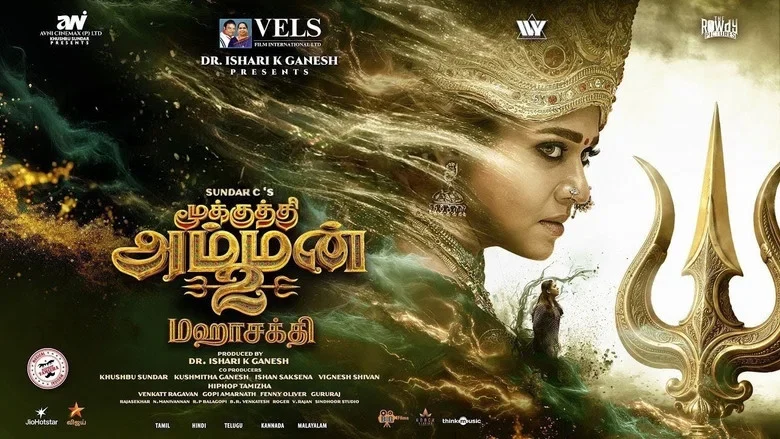
Avni Cinemax, Rowdy Pictures, and Vels Film International have staked a Diwali weekend on the proposition that devotional fantasy remains a reliable theatrical draw in Tamil cinema.
The advance booking figures reported at ₹4.27 crore across six show dates suggest genuine audience appetite, though the film’s ability to sustain that momentum depends entirely on word-of-mouth surviving its second half.
For Nayanthara, this is a strategic return to the goddess role that defined her 2020 collaboration with RJ Balaji, now refashioned under Sundar C’s broader mythological ambitions.
The sequel’s commercial viability hinges on whether audiences accept the shift from intimate devotional comedy to sprawling two-timeline spectacle. That is a significant tonal leap for a franchise built on intimacy.
Across contemporary Tamil fantasy, the pattern is clear: scale is easy to manufacture, but coherence is not. This film tests whether spectacle can compensate for a screenplay that never fully commits to its own rules.
The Unresolved Divine Equation
The climax stages the goddess-versus-sorceress confrontation with appropriate visual grandeur, but the emotional resolution lands muted because the antagonist was never given enough interiority to make her defeat feel earned.
The teased arrival of additional divine entities in the final beat plays as a promise rather than a payoff, leaving the film’s mythological universe feeling assembled rather than discovered.
What lingers is Nayanthara’s constable, not her goddess. The trembling officer who discovers she is more than she believed is the film’s genuine emotional center, and the screenplay never quite trusts that discovery enough to let it breathe.
Mookuthi Amman 2 wants to be a franchise cornerstone. What it actually is, is a confident performance trapped inside an overbuilt mythology that mistakes volume for depth and expansion for storytelling.
The goddess may have returned, but the film never quite figures out what she came back to say.