The mango trees of Thotavaripalem arrive on screen before the boys do, their canopies heavy with fruit and with the weight of a season’s income. Srikar Nayan G.’s Summer Holidays wants us to feel that weight, even as it keeps its gaze fixed on the children who must carry it.
Two Boys, Two Prisons, One Village Summer
The film opens in Hyderabad, where Arun Dev’s Ravuri Venkatesh, RV to everyone, lives under a father who measures love in rank cards.
When the tenth-rank result lands instead of the promised first, the cricket kit and academy admission evaporate, and the boy’s face registers a quiet, practiced disappointment that suggests he has rehearsed this collapse many times.
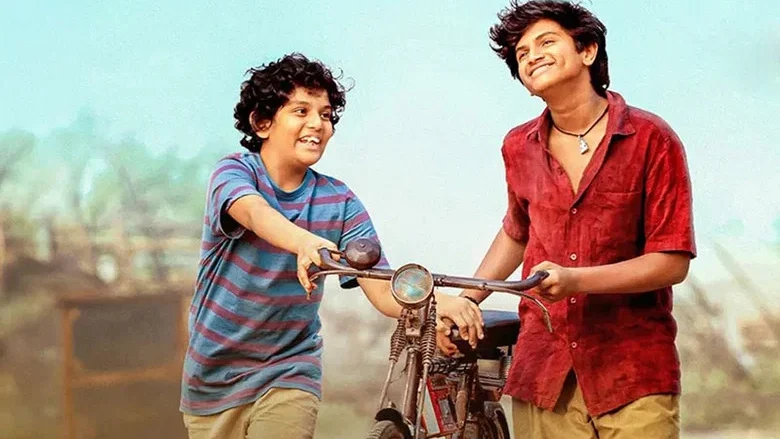
His mother, Vasuki Anand in a performance of protective stillness, ferries him to his grandmother’s village for the summer. There he meets Rohan Roy’s Kasi, a newspaper-delivering boy who works a leased mango orchard before school and smiles through a debt burden inherited from his late father.
The juxtaposition is clean and deliberate: RV has emotional freedom restricted by academic expectation, while Kasi has material freedom restricted by work and family obligation. Neither boy’s prison is presented as the more legitimate one, and that restraint is the screenplay’s most adult instinct.
When A Child Actor Trusts The Camera, The Camera Trusts Back
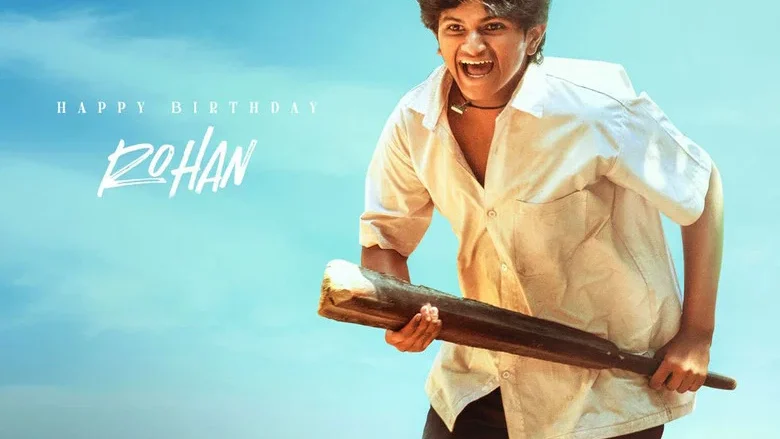
Rohan Roy is the film’s engine. His Kasi moves through the village with a kinetic cheerfulness that never quite masks the calculation underneath, the way he counts mangoes in his head while joking with RV, the way his grin tightens a half-beat before he changes the subject.
Arun Dev plays RV as a boy who has learned to shrink. Watch his shoulders in the early Hyderabad scenes: rounded forward, eyes downcast, hands perpetually in pockets as if apologizing for taking up space. In the village, those shoulders gradually open, and the physical transformation is the performance’s entire argument.
The friendship scenes work because the two actors listen to each other rather than performing at each other. There is a moment in the orchard where Kasi explains his sari plan for his mother, and RV’s face does something complicated, envy, recognition, and a dawning shame all crossing in the space of a breath.
Jayasudha’s grandmother anchors the village with a warm, no-nonsense presence, though the screenplay gives her little to do beyond feeding children and dispensing folk wisdom. Her casting is a gift to the film’s texture; her writing is not.
The Screenplay Keeps Promising Escalation It Never Delivers
Here is where the film’s goodwill starts to curdle. The setup establishes real stakes, Kasi’s lease with Varma, the debt tied to his father’s death, the sari he wants to buy his mother, and then the middle section treats these as background furniture rather than dramatic pressure points.
Rajeev Kanakala’s Varma appears in scattered scenes as an economic gatekeeper, but the screenplay never lets him become a genuine obstacle. He is a threat in theory, a mild inconvenience in practice. When the third-act resolution arrives, it feels less like a victory than a concession the film forgot it owed us.
The predictability isn’t the problem; children’s films can be predictable and still emotionally devastating. The problem is that the screenplay doesn’t earn its predictable beats. Kasi’s mango plan should build toward a moment of genuine jeopardy, and instead it resolves with a shrug that suggests even the writers grew tired of the orchard.
Just as Nitesh Tiwari’s Ramayana struggled to convert mythological scale into intimate emotional stakes, this film mistakes the establishment of conflict for its escalation. Both films believe that naming a problem is the same as dramatizing it.
The Second Half Loses The Thread It Was Holding
The first hour moves with a gentle, observational rhythm, school bells, newspaper bicycles, the particular light of a Godavari summer afternoon. The second hour starts reaching for plot mechanics that don’t suit its temperament.
Vasuki Anand’s mother character, so effective in the early scenes, becomes a narrative device after the interval, appearing mainly to facilitate RV’s emotional arc rather than to exist as a person with her own interiority. It is a waste of an actor who knows exactly how to hold a frame without speaking.
The film’s most praised sequences, the boys’ friendship, the orchard work, the sari objective, all belong to the first half. The second half substitutes incident for development, and the substitution is visible in the editing, which starts cutting on dialogue rather than on glances.
Where the screenplay finds its footing again is in the quiet moments between RV and his grandmother, when the film remembers that it is about inheritance, not of property, but of values. Those scenes carry a warmth the plot mechanics cannot replicate.
A Director Who Trusts Faces More Than Dialogue
Srikar Nayan G. directs with a documentary patience in the village sequences, letting the camera rest on faces and hands rather than filling every silence with exposition. The mango orchard is shot with a tactile appreciation for dappled light and dusty leaves that suggests genuine affection for the setting.
The Hyderabad sequences are less assured. The father’s pressure is communicated through repeated close-ups on rank cards and stern expressions, a visual shorthand that grows tiresome by the third iteration. We understood the dynamic the first time; the film doesn’t trust us to remember.
The score, when it appears, does the emotional work the screenplay should be doing, swelling at moments that haven’t earned the swell, receding when the actors are doing something more interesting on their own. The best scenes are the quietest ones, where the film forgets it’s supposed to be a film.
There is a visual intelligence at work in the contrast between the city’s vertical, enclosed spaces and the village’s horizontal openness. RV’s world shrinks to doorframes and desks; Kasi’s expands to horizons and riverbanks. The direction understands this geometry even when the script doesn’t.
The Sari, The Debt, And The Summer That Changes Everything
Kasi’s desire to buy his mother a sari is the film’s most concrete emotional engine, a child-sized goal with adult-sized weight.
Every rupee he earns from the mango trees is a step toward a visible, tangible expression of love, and the film is smart enough to keep this goal in the foreground even when the plot wanders.
The resolution, when it comes, is gentle and earned in the way that small kindnesses are earned. RV returns to the city changed, though the film is careful not to overstate the change. He doesn’t become a different person; he becomes a slightly more aware one, and that modesty is the film’s saving grace.
The final image of the mango orchard, emptied of its fruit and its purpose, carries a melancholy the rest of the film hasn’t quite prepared us for. Summer ends. The trees remain. The boys grow up. The film understands this even when it doesn’t fully dramatize it.
The emotional fallout of Kasi’s labor and RV’s transformation echoes the unresolved tensions analyzed in #Cult, where a Telugu narrative also grapples with characters who cannot fully articulate what they’ve lost. Both films find their truth in what goes unsaid.
The Commercial Arithmetic Of A Small Film With A Big Heart
Summer Holidays arrives from producer Dheeraj Mogilineni with modest expectations and a clear target: family audiences, school-holiday crowds, and viewers nostalgic for the rural Telugu dramas of an earlier era. The film’s commercial life will depend on word-of-mouth in tier-two and tier-three markets, where the Godavari setting and child-actor pairing carry genuine appeal.
The theatrical marketplace for children’s coming-of-age dramas in Telugu cinema is narrow but loyal. This film doesn’t need to be a blockbuster to succeed; it needs to be the film that grandmothers take their grandchildren to see on a Sunday afternoon, and on that measure, it delivers.
Arun Dev and Rohan Roy are the film’s commercial assets, and their performances justify the marketing focus. Whether either actor builds on this foundation remains to be seen, but the film’s investment in their naturalism rather than precocity is a welcome corrective to the over-rehearsed child performances that often dominate the genre.
The film’s modest scale signals a welcome tonal maturity across contemporary Telugu dramas, proving that a story about mango trees and schoolboys can hold a screen without explosions or elaborate set pieces. Whether audiences reward that restraint is the question the box office will answer.
The Uncomfortable Truth About Nostalgia
Summer Holidays wants us to believe that one summer can change a child’s life, and for its first hour, it almost convinces us. The mango orchard, the newspaper bicycle, the grandmother’s kitchen, these are not just settings but arguments about what childhood should be, and the film makes them with conviction.
But nostalgia is a tricky currency. The film spends it generously in the setup and then discovers it has nothing left to buy the resolution.
The predictable developments that critics have noted are not failures of imagination; they are failures of nerve. The film is afraid to let its children fail, and so it protects them from consequences that might have made the ending mean something.
The sister performance of Vasuki Anand in Epic – First Semester suggests what this film might have been: a drama willing to sit with discomfort rather than resolve it. Here, she is given too little to do, but her presence in the frame reminds us of the emotional complexity the screenplay keeps avoiding.
What remains, after the credits, is not the plot but the faces, Rohan Roy’s grin, Arun Dev’s slowly opening shoulders, the particular way summer light falls through mango leaves. The film’s failures are structural; its pleasures are sensory, and sensory pleasures, in the end, are what we remember.
Summer Holidays is a film that believes in the small, accumulated moments that shape a child’s understanding of the world. It doesn’t always trust those moments to carry a narrative, and that lack of trust is its undoing.
But when it does trust them, when it lets the boys sit in silence, when it lets the orchard breathe, when it lets the grandmother’s hand rest on a grandson’s head, it becomes something worth holding onto. A summer, like a childhood, is over too soon. So is this film’s best self.