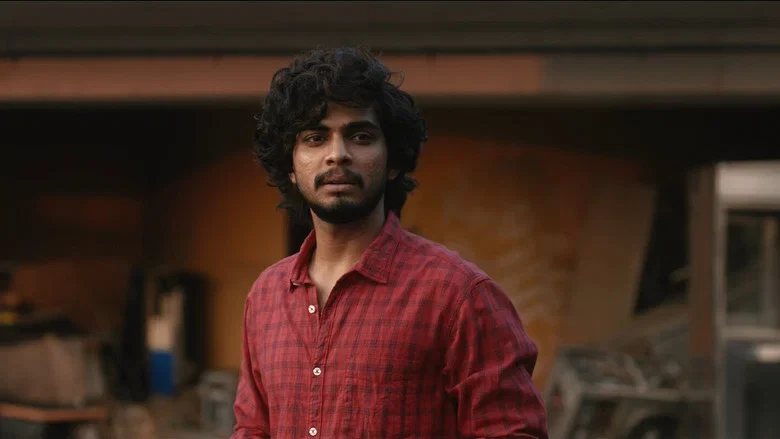
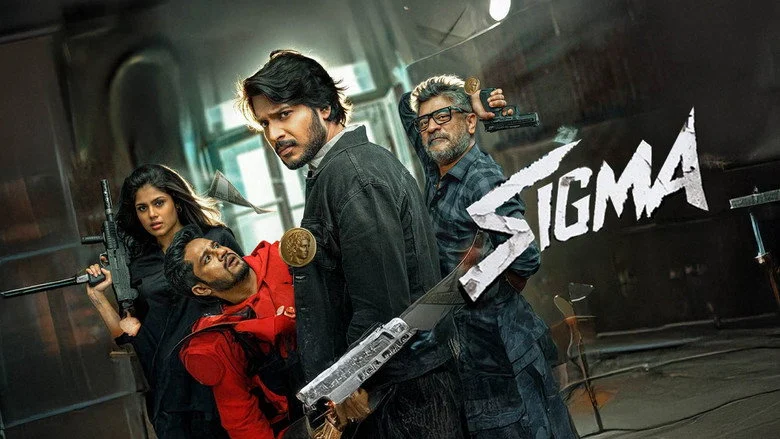
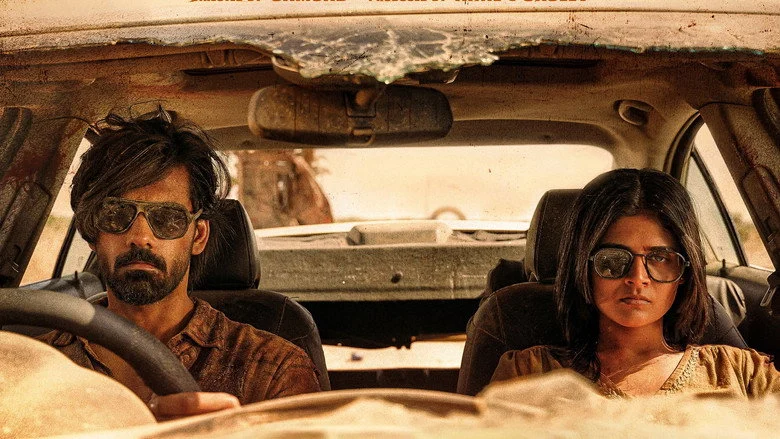
The village bus stand where Madhava first watches Geetha walk past is shot in a single, unbroken wide, dust hanging in the afternoon light, her silhouette receding, his hand frozen mid-wave.
It’s a lovely image, and it’s also the film’s entire problem in miniature: Anil Kumar T. M. trusts atmosphere to do the work of drama.

When First Love Is Engineered to Fail, the Heartbreak Feels Like Homework
The opening act establishes Madhava and Geetha as village students whose romance is inseparable from place, shared benches, shared cycles, shared shorthand glances across a classroom. The film’s smartest structural decision is making geography the villain: when they leave for different cities, the relationship doesn’t collapse from betrayal, it collapses from distance.
But the screenplay never earns Geetha’s decision to move on. She simply does, off-screen, between scenes, and the film treats her choice as a plot requirement rather than a human one.
Zaid Khan’s Madhava is left staring at a phone that won’t ring, and we’re asked to grieve a relationship we never quite saw become worth grieving.
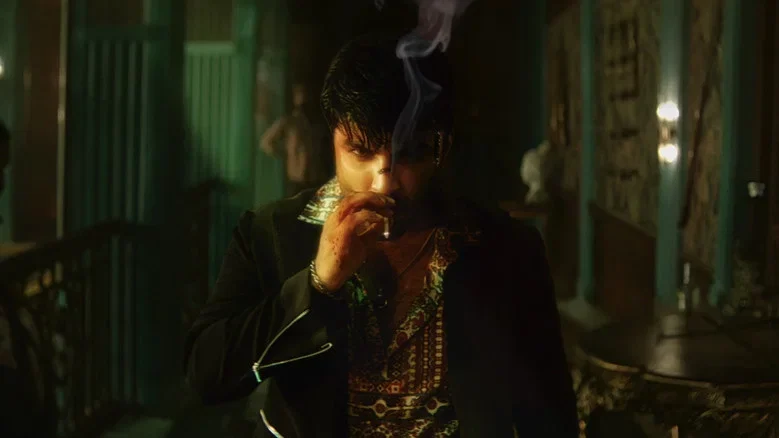
A Second Romance That Arrives Like a Prescription, Not a Pulse
Malaika Vasupal’s Ithi enters as the film’s corrective, warm, patient, emotionally literate, and entirely too well-adjusted to be interesting. She helps Madhava recover in a series of scenes that play like a checklist: the shared meal, the accidental hand touch, the late-night conversation that ends in silence.
Vasupal has a watchable stillness, and her best moment comes when she refuses to be a consolation prize, she tells Madhava, flatly, that she won’t compete with a ghost.
It’s the one line in the film’s back half that lands with real friction. The rest of the second act drifts, mistaking gentleness for tension.
Zaid Khan Registers Loss in the Shoulders Before the Face
Khan’s performance is built on postural collapse, the way Madhava’s spine curves when he’s alone, the way he stops meeting eyes in group scenes.
In the film’s strongest sequence, he sits across from Ithi at a restaurant table and says nothing for nearly a full minute while the camera holds on his hands.
It’s a controlled, unshowy turn, and it recalls the quiet domestic register of Aadarsha Kutumbam House No, where emotional restraint was also the point. But Khan is underserved by a script that keeps telling us he’s broken rather than letting us watch him break.
Anil Kumar T. M. Stages Silence Better Than Confrontation
The director has an instinct for negative space, empty frames, held pauses, the camera lingering a beat after a character exits.
Those choices give the film a melancholy hum that’s genuinely its own, a tonal register closer to the patient unease of Enemy Of The Smuggler than to the kinetic romantic dramas the premise suggests.
What he can’t stage is a fight. The film’s one real confrontation, Madhava finally confronting Geetha at a railway platform, is blocked so timidly that the emotional stakes evaporate. Arjun Janya’s score swells on cue, J. S. Wali’s camera stays safely at medium distance, and the scene ends before it begins.
The Climax Chooses Ambiguity Over Conviction
The ending, without spoiling its mechanics, refuses to resolve Madhava’s emotional arc with any declarative gesture, he simply walks, and the frame holds, and the credits roll. It’s a choice that will read as mature to some and evasive to others, and I suspect it’s closer to the latter.
The film’s thematic sibling in this respect is Garividi Lakshmi, another recent Telugu drama that mistook an unresolved ending for profundity. Ambiguity only works when the audience has been given enough to argue about; here, we’re given too little.
Loki Cinemas Bets Small, and the Market May Not Notice
Loki Cinemas has mounted a modest, dialogue-driven Kannada romance with no franchise scaffolding and no star-vehicle machinery, a gamble in a theatrical market that rewards scale.
The reported opening-day net of ₹0.53 crore suggests the film is playing to a niche, and the conflicting lifetime gross figures reflect a release that never found a real theatrical foothold.
For Khan, this is a credibility-building detour rather than a commercial swing; for the Kannada romance space, it’s another reminder that contemporary Telugu dramas and their Kannada cousins are increasingly competing for the same emotionally literate, OTT-conditioned audience, and losing that audience to streaming windows that arrive faster every quarter.
The Verdict: A Film That Mistakes Quiet for Depth
Cult is a well-performed, gently photographed romance that never quite decides what it’s about, first love, second chances, or the slow erosion of self that follows heartbreak. Khan and Vasupal deserve a sharper script; Anil Kumar T. M. deserves a producer who pushes him past his own restraint.
What lingers, finally, is not the romance but the silence around it, the sense of a film standing at a platform, watching something leave, and choosing not to run after it. That’s a mood. It isn’t yet a movie.