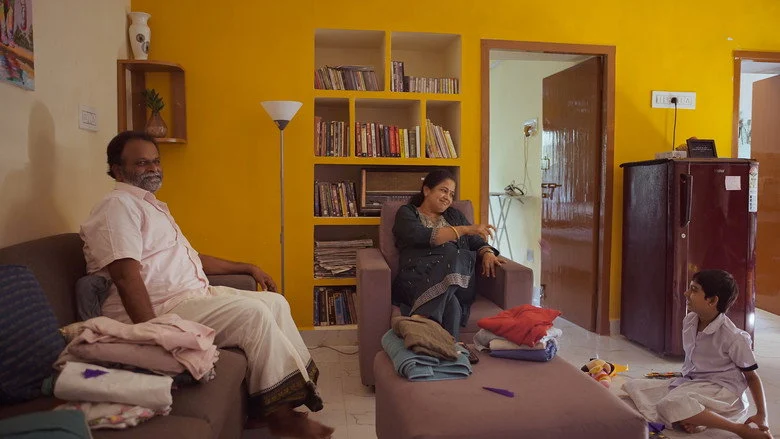
The house has a number, and the number has a problem. Trivikram Srinivas builds a middle-class fortress out of domestic routine, then hands Venkatesh a key that doesn’t fit.

The Perfect Family Is A Load-Bearing Wall Waiting To Crack
House No. 47 opens as a stage set for propriety: brass lamps, stacked steel tumblers, the choreography of a household that has rehearsed its own respectability. The film’s central dramatic wager is that this choreography is exhausting someone.
When the disruptive incident lands, it doesn’t shatter the facade so much as expose how much labor went into maintaining it. The family doesn’t unravel; it gets audited.
Trivikram’s screenplay keeps the crime mechanism deliberately opaque for long stretches, and this withholding is both the film’s structural engine and its most frustrating habit. The audience is asked to trust a house that refuses to show its ledgers.
Venkatesh Plays The Straight Man In A House Full Of Liars
The lead performance is built on a specific physical discipline: Venkatesh keeps his shoulders squared in group scenes and drops them only when he’s alone in a doorway or a corridor. That drop is the whole character.
His comic timing in the domestic stretches is generous rather than greedy, he feeds lines to the ensemble and takes the reaction shot instead of the punchline. It’s the work of an actor who understands that in a house this crowded, restraint reads as authority.
The performance foil is instructive. Where the romantic melancholy of Haiku asked its lead to sustain a single emotional register across a fractured timeline, AK47 demands rapid tonal gear-changes from sitcom warmth to something colder behind the eyes. Venkatesh handles the first gear beautifully and the second with visible effort.
Srinidhi Shetty Holds The Frame; The Ensemble Holds The Furniture
Srinidhi Shetty occupies the family-centered premise with a watchful stillness, she’s often framed at the edge of a doorway or mid-staircase, listening. It’s a smart spatial choice that positions her as the household’s observer rather than its ornament.
Nara Rohith’s addition to the cast registers as texture rather than architecture; he carries a scene’s weight without ever becoming the scene’s subject. The broader ensemble of relatives and neighbors functions as a chorus of middle-class anxiety, and the film wisely avoids naming every cousin.
What the supporting ranks lack is a genuine opposing force. The film’s conflict is internal, secrets, not villains, and that choice gives the drama integrity while starving the second half of a face to push against.
The Camera Lives Inside The House, And That’s The Point
The visual grammar is contained by design: wide frames that trap four or five family members in the same room, then tighten to singles only when someone is lying. The house’s architecture becomes the editing rhythm, corridors for transitions, thresholds for confrontations.
Trivikram’s staging favors verbal friction over kinetic set pieces, and the dialogue-driven comedy lands because the camera respects the pause before a punchline. The crime-action escalation in the latter stretch, however, fights this grammar; the film wants to open up just when its claustrophobia was working.
The tonal transitions are where the direction shows strain. A domestic squabble and a violent consequence share the same frame size and the same lighting temperature, and the audience is left to do the calibrating.
Just as he demonstrated a tighter spatial discipline in Nizhalilirundhu Velicham, the filmmaker here strips away decorative camera moves to prioritize raw psychological friction, but that discipline serves a contained drama better than a genre hybrid.
The Secrets Surface, But The Reckoning Arrives Late
The second half escalates through exposure: relationships fray, alliances shift, and the house stops being a home and becomes a crime scene with a dining table. The problem is pacing, the film takes its time reaching the confrontation and then rushes the emotional accounting.
The final act wants to reconcile family reckoning with action payoff, and the two impulses don’t fully braid. The resolution lands as a negotiated settlement rather than a catharsis.
The screenplay resists the kinetic sensationalism that overtook Garividi Lakshmi, opting instead for a deliberate, suffocating dread, but dread needs a pressure valve, and AK47’s valve opens a beat too late.
Haarika & Hassine Bet On A Star-Driven Hybrid In A Crowded Market
For Haarika & Hassine Creations and producer S. Radha Krishna, this is a calculated bet on the Venkatesh–Trivikram pairing as a bankable theatrical proposition rather than a streaming acquisition. The reported ₹5.36 crore in pre-release presales across 2.99 lakh tickets and 4, 433 shows signals genuine exhibitor confidence in the opening weekend.
The commercial question is durability. Trivikram’s brand has always been dialogue and family texture, and this film leans on both while asking audiences to accept a crime-action detour that the marketing materials kept deliberately vague.
The Telugu family entertainer is a crowded lane, and the film’s willingness to mix genres without a clearly sold antagonist makes its second-week hold the real test. Venkatesh’s theatrical leverage remains strong among family audiences; whether that audience follows him into the darker corridors of House No. 47 is the unresolved wager.
This patient character study signals a welcome tonal maturity across contemporary Telugu dramas, proving that tension thrives without manufactured plot theatrics, even when the plot itself could use one more clean theatrical beat.
The House Stands, But The Foundation Is Worth Inspecting
What lingers is not the crime or the comedy but the image of a family performing its own happiness for an audience of neighbors. The film’s final gesture suggests that the house survives because someone inside it finally stopped pretending, and that admission costs more than any secret.
Aadarsha Kutumbam House No: 47 is a well-built home with a hairline crack running through the living room. You’ll notice it every time the camera holds still.