In a packed Chennai courtroom, a young lawyer with a perpetually cheerful demeanor walks in, her confidence a sharp contrast to the weary faces of the judicial veterans. She is about to argue a case that will test not just the law, but her own fractured emotional core.

Keerthy Suresh’s Delicate Balancing Act
Keerthy Suresh anchors the film not with loud proclamations, but with small, precise gestures. In one revealing moment, she smiles at a client right before a verdict is read, only to have her eyes betray a deep, personal sorrow. She plays the internal war between professional optimism and personal grief with a restraint that defines her best work.
It is a performance that asks us to read between her lines, trusting the audience to spot the cracks in her cheerful armor.

Praveen S. Vijaay Directs with a Purposeful Hand
Director Praveen S. Vijaay understands that a courtroom drama’s tension lives in the silences between arguments, and he stages these moments with a clear sense of rhythm. The screenplay is linear, which serves the narrative’s clarity, though it lacks the narrative curveballs that elevate the genre.
The film’s primary flaw is its predictability: the structure of the case is telegraphed early, stripping the final act of the genre’s essential element of surprise.
The Courtroom as a Battleground of Wits
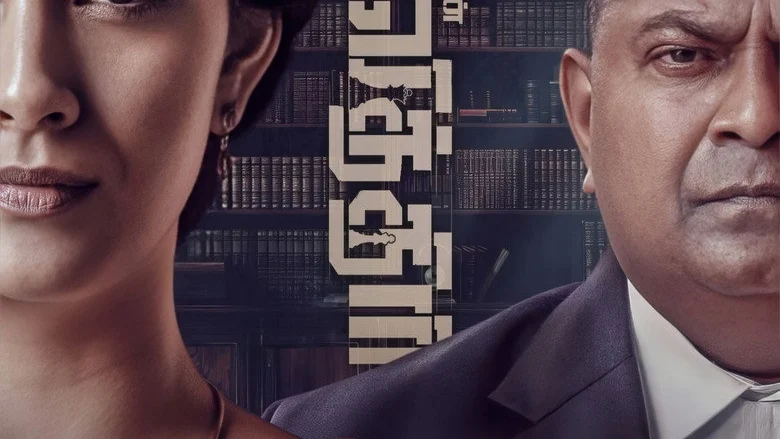
This is a courtroom drama that favors dialogue over action, placing its faith in the verbal duel between two formidable lawyers. The central conflict, pursuing social justice while drowning in personal turmoil, gives the genre a needed emotional weight.
The execution is most effective when Vijaay lets the camera simply hold on a speaker, letting the intensity of a cross-examination do the work. In one sequence, Mysskin’s character dismantles a witness with surgical precision, and the editing matches this rhythm perfectly.
However, the film’s adherence to a standard template means it never quite reaches the electric heights of the best legal thrillers. It is competent, emotionally grounded, but structurally safe.
For readers who enjoy this kind of focused storytelling, we invite you to explore more Tamil Drama reviews.
Mysskin and the Weight of the Opposition
As the opposing lawyer, Mysskin brings a gravitas that the film desperately needs. His first appearance, a slow, deliberate walk to the bench, immediately establishes him as a threat that is both intellectual and psychological.
Where Keerthy Suresh’s character smiles to deflect, Mysskin’s gaze is a weapon. The one moment where he pauses mid-argument, revealing a flicker of doubt, is the film’s most nuanced scene. His casting signals a deliberate choice to give the protagonist a worthy, complex foil.
Audience Reception and the Political Void
With no official controversies reported, the film’s main conversation is with its audience. Early social media sentiment focuses on Keerthy Suresh’s performance as the primary draw, but critic responses have been divided, some praise the film’s sincerity while others note its lack of thrills.
The film’s target audience is the class of viewers who prefer quiet character studies over bombastic verdicts. It will work best for those who appreciate a performance-led drama, but it may test the patience of audiences expecting a pulsating legal thriller.
Keerthy Suresh delivers a performance that holds the whole enterprise together, but the film’s safe screenplay prevents it from being a must-watch courtroom classic. Watch it on OTT if you enjoy nuanced character work over narrative surprises.
For a different kind of moral inquiry, consider how LURK review handles a similar debate-driven conflict.
Meanwhile, Odyssey verdict contains weightier themes for those seeking epic scale.
Sathyavan Savithiri is a sincere, well-acted drama that I wish had taken more risks; it earns a solid 3 out of 5 for its craft, but settles for being good instead of necessary.