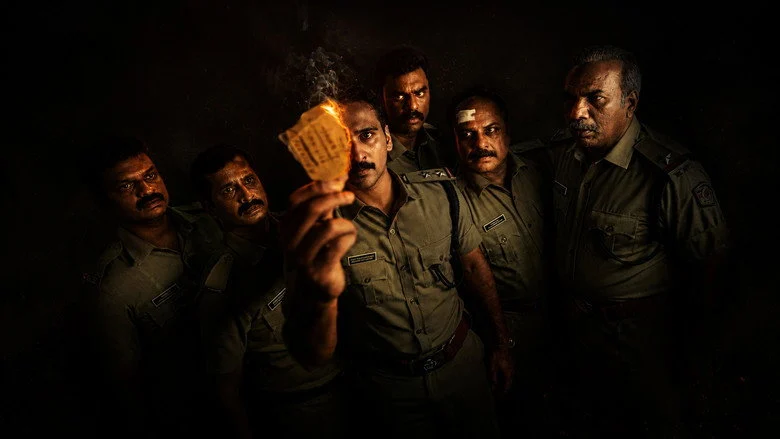
Somewhere in the misted hills of Mekkarai, a village has agreed to a schedule: every seven years, in June, its men die. Not dramatically, not all at once, just enough, just often enough, that the calendar itself has become a suspect. Into this arrangement walks a new police inspector, a book titled Dark Heaven that appears to know the future, and a masked figure who plays the violin while people stop breathing. It is a hell of a premise. For roughly seventy minutes, director Balaaji knows exactly what to do with it.
The Violin Case and the Curse Ledger
The film’s most effective piece of staging arrives early and wordlessly: the masked figure, violin in hand, framed against hill fog that Manikandan BK’s camera refuses to sentimentalize. The instrument is doing double duty, it’s a murder weapon’s accessory and a metronome, marking time until the next June. Balaaji understands that a curse is only as frightening as its bureaucracy, and here the bureaucracy is a library book with a body count. When the librarian’s daughter returns to Mekkarai 25 years after her father’s death, the film quietly sets its two clocks, the generational one and the investigative one, ticking against each other. Cinema Express called the first half “tense, ” and that’s accurate but undersells the craft: the investigation sequences build through accumulation rather than shock, each interview tightening the village’s collective silence until the inspector’s questions start sounding like accusations.
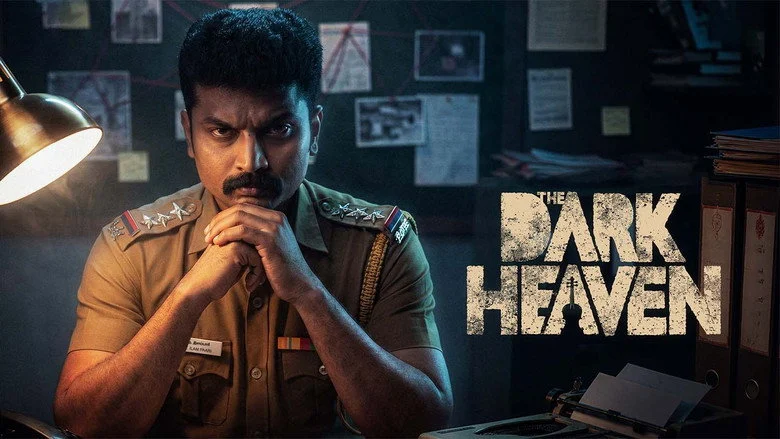
Sidhu Sid plays that inspector with a determined flatness that mostly works. He’s a rationalist dropped into a village that has already litigated the supernatural and moved on, and his refusal to blink reads as conviction rather than blankness. Opposite him, Tharshika and Rithvika Panneerselvam supply the emotional register the screenplay otherwise starves, grief, suspicion, the particular exhaustion of women who have watched this cycle repeat. Vela Ramamoorthy and Nizhalgal Ravi, meanwhile, do the heavy lifting of making the village feel inhabited rather than decorative; they give the superstition a face, and the face is tired, not credulous.
When the Threads Start Tangling
Here is where the film’s ambition outruns its discipline. Somewhere past the interval, The Dark Heaven stops trusting its own mystery and starts adding to it. The book’s predictive logic, the film’s cleanest, strangest idea, gets diluted by competing explanations: forest deity, human killer, curse, coincidence. The result is a second half that Cinema Express fairly described as carrying “confusing threads, ” and the confusion isn’t productive ambiguity; it’s the sound of a screenplay losing track of which rules it established. A thriller can lie to you. It cannot forget what it told you.
What rescues the back end, genuinely, is the climax. Balaaji earns his final reveal through misdirection rather than cheating: the killer is not easily predicted, and the film’s willingness to withhold rather than telegraph pays off in a sequence that lands with real force. It’s the kind of ending that retroactively papers over a saggy middle, though not entirely. Compare it to how HALF review structured its genre gambit, and you see the difference between a film that commits to its formal bet and one that keeps hedging.
Atmosphere as Argument
News Today noted the film “works particularly well when it combines its atmospheric setting with the central mystery, ” and that’s the correct diagnosis. Sakthi Balaji’s background score does the genre’s standard work, but the mist, the hills, the village’s architectural claustrophobia, these are doing thematic labor. The setting argues that secrets need geography; you can only hide this many bodies where the fog will take them. The song “En Samy Vettaiyadum” sits somewhat awkwardly against this texture, a commercial obligation in a film that’s otherwise committed to mood.
For a sharper look at how regional cinema handles the cost of dignity under pressure, our desk’s take on Enna Vilai verdict is worth your time, a different register, but a useful counterpoint to what Balaaji is attempting here.
Verdict
The Dark Heaven is a genuinely atmospheric crime thriller with a strong first half, a memorable villain conceit, and a climax that justifies the ticket. It is also a film that loses its nerve in the middle, mistaking complication for depth and letting its best idea, the predictive book, become one thread among many instead of the spine. Sidhu Sid’s inspector holds the center, but the screenplay doesn’t always hold him.
Watch it if you want a theatrical suspense experience with a payoff that respects your intelligence. Skip it if you need clean narrative logic from frame one, the second half will frustrate you.
Rating: 3/5