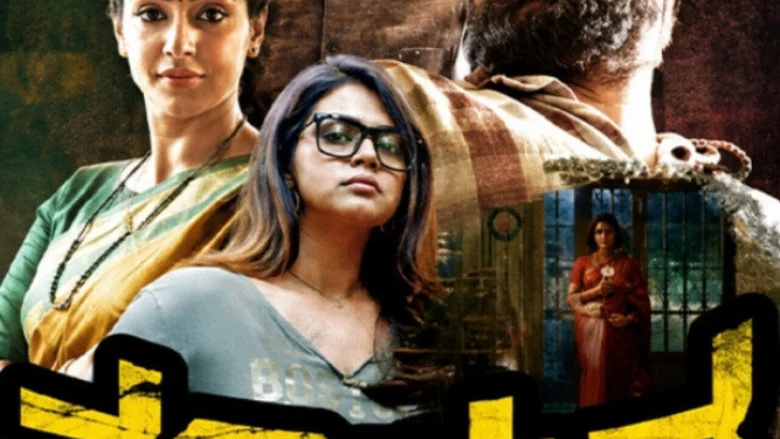
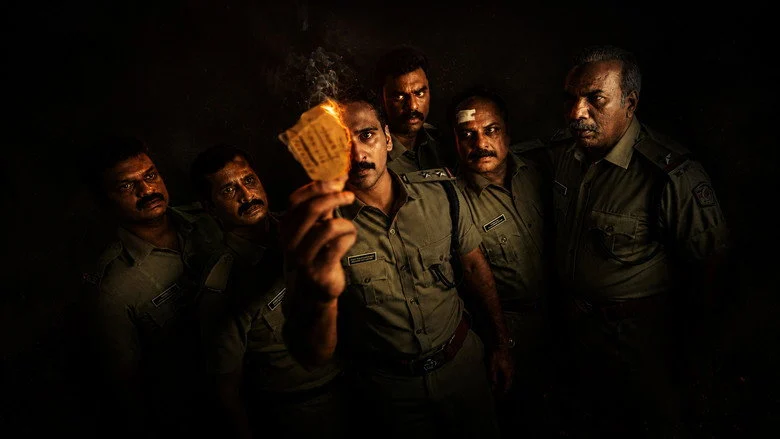
A girl with schizophrenia stumbles into the company of four criminals, and somewhere behind her the police close in. Bhushan’s Kannada crime mystery wants to weaponize that fragility. What it does with it is another matter.
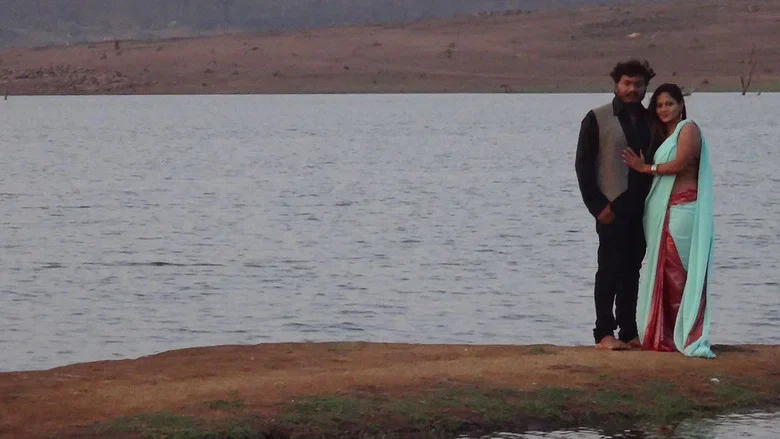
A Fragile Mind Held Hostage By A Plot That Won’t Look At It
The inciting incident is the film’s best idea: an accidental collision between psychological vulnerability and professional criminality, with no plan on either side. For twenty minutes, Manduka sits on genuinely uncomfortable territory.
Then the machinery takes over. The police-versus-criminals pursuit becomes the film’s organizing principle, and the girl who should be its destabilizing center gets repositioned as cargo to be located, protected, or hidden.
That is a structural betrayal, not a storytelling choice. When a thriller’s most volatile element becomes its most passive, the suspense has nowhere to live except in foot chases.
Four Villains, One Register, Zero Friction
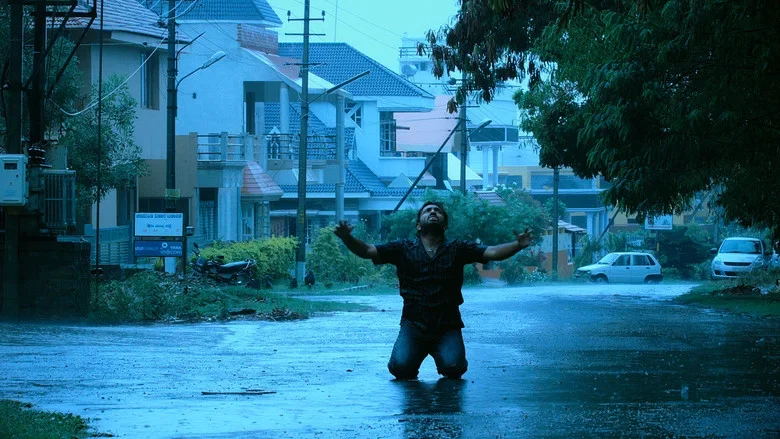
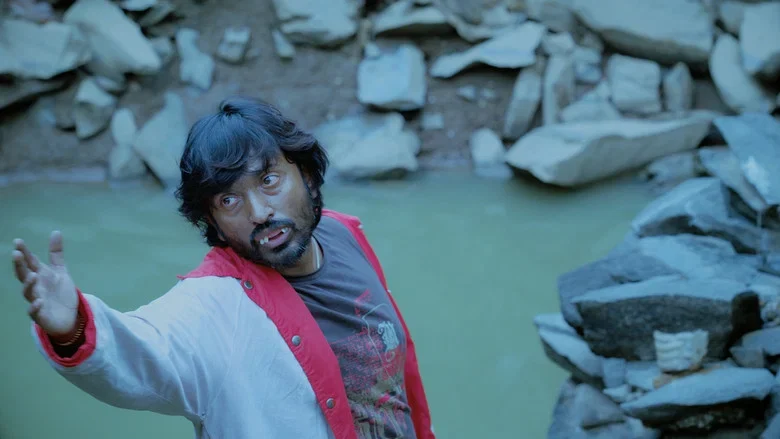
Bhushan casts himself among the antagonists, alongside three credited villain turns, and the group dynamic should be the film’s engine of divided motive and shifting loyalty. In practice, the four operate as a single mass with four faces.
Watch how they share space in the hide-and-seek stretches: bodies clustered, voices overlapping, no one holding a distinct angle on the girl or the money or the exit. A criminal group only generates tension when its members want incompatible things.
Here the incompatibility is asserted, never dramatized. The result is a pursuit with a countdown but no internal pressure, which is the same problem that hollowed out the identity games of KillR, a premise with built-in paranoia that never trusts its own material enough to sit still.
Anjala Plays A Condition, Not A Person
The heroine is credited simply as the heroine, and the film treats her with roughly that level of specificity. Anjala’s work is asked to carry the entire psychological weight of the premise, and the screenplay gives her almost nothing to grip.
Her body language defaults to a fixed wide-eyed stillness, a single pose redeployed whenever the scene needs to signal fragility. There is no drift between lucid and unmoored registers, no moment where her perception of a room visibly diverges from ours.
That divergence is the whole reason to build a thriller around schizophrenia. Without it, the condition functions as a plot label rather than a lens, and the audience is left watching a girl in danger instead of a girl whose danger we cannot fully verify.
The contrast with the emotional precision demanded of a genuinely fractured protagonist in #Cult is instructive: interior instability only reads on screen when the performer is given beats to contradict, not just a state to inhabit.
Bhushan The Writer Gives Bhushan The Director Nothing To Stage
Single-author control across writing and direction is supposed to produce unified intent. Here it produces a film that seems to have skipped the interrogation stage, where a script’s weak joints get found and reinforced.
The middle act runs on hide-and-seek as a default mode, and the camera covers it functionally: medium shots of corridors, cutaways to arriving vehicles, reaction inserts on the pursuers. Nothing in the framing expresses who is winning.
That is the tell. A pursuit thriller lives or dies on spatial legibility, the audience must be able to draw the map in their head and feel the walls closing. Manduka keeps the geography vague and substitutes cutting speed for tension.
The Kannada crime space has shown it can do better with atmosphere and moral murk, as the underbelly texture of City Lights demonstrated even when its plotting ran thin. Here the texture never arrives at all.
The Doctor, The Cop, And The Missing Middle
Two supporting figures carry the film’s institutional stakes, and both are stranded by the writing. Mahadevmuurthy appears as a doctor whose scenes never establish whether he is treating the girl, concealing her, or assessing her for someone else.
Manjunath Mirle’s police role has the opposite problem: he is the face of the pursuit but never the author of it, receiving orders and relaying them without a single decision that costs him anything.
Strip the names away and what remains is a set of royal relatives, temple elders, and uniformed functionaries moved around the board to keep the plot walking. Supporting players cannot generate gravity from positions the script never defines.
One Hundred And Four Minutes That Feel Longer Than They Are
Compact runtime is an asset only when the cutting has appetite. This one moves briskly through its setups and then idles in the pursuit, mistaking motion for escalation.
There is no score cue here worth describing, no lighting choice that tells us we have slipped inside the girl’s unreliable perception. The film is lit like a procedural and paced like one, which is fatal for a story that needs us to doubt what we are seeing.
When the climax arrives, it resolves the pursuit without resolving the perception question, the mystery of the girl’s mind is simply dropped once the criminals are accounted for. That is the film’s deepest failure of nerve.
A Small-Budget Kannada Thriller Betting Against Its Own Hook
The production economics here are modest by any measure, with reported budget figures in the low crores, which means the film’s commercial fate rests entirely on word of mouth in a crowded Kannada release corridor.
That math makes the creative choices harder to forgive. A stripped-budget thriller cannot out-chase bigger films; it survives by being the one that gets inside a character’s skull where money can’t follow.
Kannada crime cinema is currently the most interesting regional laboratory for exactly that kind of risk, and the wider landscape of contemporary Kannada thrillers has proven that an unreliable protagonist can carry a film further than a body count can.
The Verdict: A Premise Abandoned At The Door
Manduka opens with a genuinely unnerving proposition, that a woman’s testimony about her own life may be the least reliable evidence in the room, and then spends eighty minutes pretending it never said that.
What remains is a competent-enough pursuit picture whose most dangerous character is treated as a prop, and whose director, doubling as its chief villain, never gives his own film the confrontation it deserves.
The girl walks out of this story unexamined. So, unfortunately, does the audience.