The bus arrives before the hero does. Sumanth Bhat opens on steel and grease, and the film never stops treating that vehicle as a body with a pulse.
Shine S Shetty plays Shankara, a driver whose ambition was seeded in a schoolyard and calcified by years of swallowing disrespect. When he finally buys his own bus, the film’s horror engine is already idling.
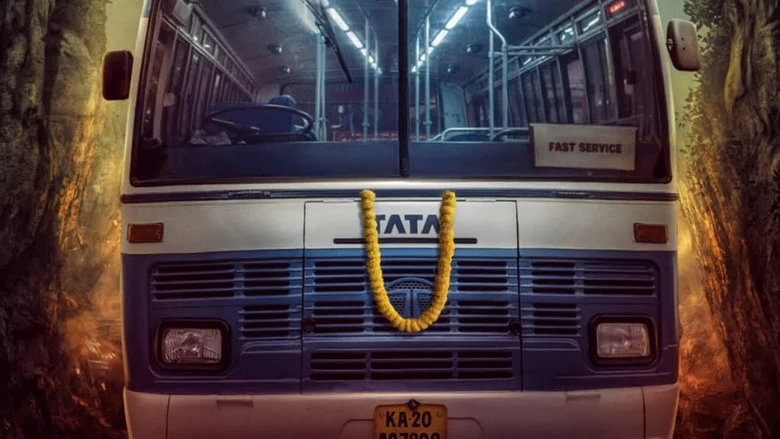
A Bus Is Not a Metaphor Until Someone Tries to Take It Away
Bhat’s screenplay earns its supernatural turn the hard way: through labour. Shankara’s employment under transport magnate Madhukar is staged as a slow accumulation of small humiliations, each one landing on Shetty’s face before it lands on the plot.
The trigger is Madhukar’s son, a spoiled intrusion that finally pushes Shankara out of the hierarchy. What follows is the film’s most quietly radical sequence: the family pledges its gold so he can buy the bus.
Deepak Rai Panaje’s Vittala and Krithi B Shetty’s Shanti turn that pledge into a shared financial wound rather than a plot convenience. The purchase is not triumph. It is collective risk dressed as independence.
Bhat refuses the easy uplift of that moment, which is precisely what makes the later horror land. The bus is named Shankarabharanna and becomes a visible statement, and then it becomes a trap.
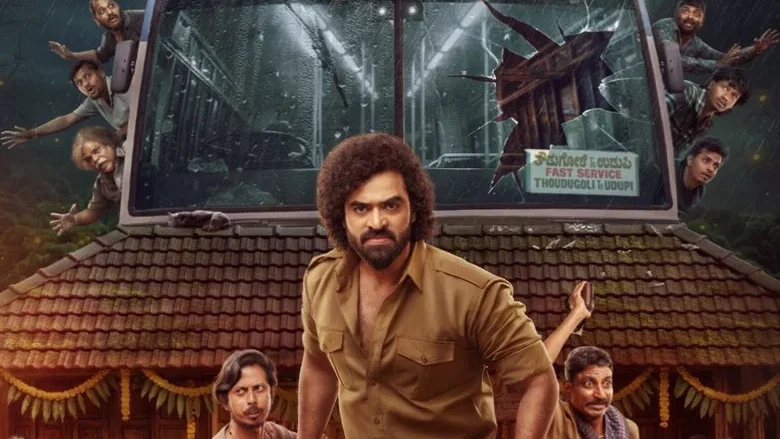
The Thoudgudi Route Turns Dignity Into a Haunted Corridor
When Shankara is assigned the abandoned Thoudgudi stretch, the film executes its genre transition with unusual patience. The route is introduced through local whispers about PT Sudha and a disturbing presence tied to the region’s past.
Sampath Raj’s Sudhakara is held back for most of the runtime, and that restraint is the film’s smartest structural gambit. He arrives as atmosphere before he arrives as antagonist.
The vehicle that represented livelihood becomes the corridor into buried history. Every kilometre Shankara drives is a kilometre he cannot afford to abandon, because the bus was bought with family gold.
That economic vise is what separates this from generic haunted-location cinema. The horror has a mortgage, and the screenplay never lets the audience forget the interest payments.
The screenplay resists the kinetic sensationalism that overtook Mr. Lucky, opting instead for a deliberate, suffocating dread built on place and obligation.
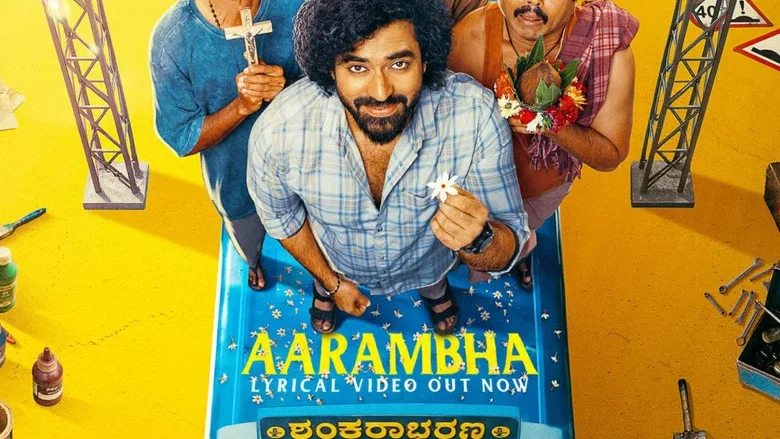
Shetty Drives With His Shoulders, and That Changes Everything
Performance-led cinema lives or dies on whether the body tells the story before the dialogue does. Shetty understands this instinctively, playing Shankara with a forward hunch that reads as both deference and momentum.
Watch his hands on the wheel in the early workplace scenes: the grip tightens before his jaw does. That sequencing is the whole character, a man who absorbs insult in the wrists and releases it only when he owns something.
The restrained physical exhaustion Shetty brings to the Thoudgudi passages recalls the psychological weight of the turn in Aakasamlo Oka Tara, though here the weariness is earned by class rather than romance.
Tanvi Ram’s Jenny occupies the support network with minimal screen time and maximum function, her belief in Shankara’s decision operating as the emotional hinge the family pledge swings on.
Sampath Raj, meanwhile, does his best work in stillness. His Sudhakara is introduced through the reaction of others rather than through menace, and the actor lets his shoulders carry the village’s buried authority.
Coastal Karnataka Folklore Becomes the Film’s Real Special Effect
Bhat’s direction treats Thoudgudi as a place with weather, not a set with fog machines. The abandoned stretch generates suspense through distance and silence rather than through jump-cut punctuation.
Just as he demonstrated tighter spatial discipline in Appa Kutty, the filmmaker strips away decorative camera moves here to prioritise raw psychological friction between Shankara and the road.
The first half moves with the rhythm of a workplace drama, accumulating humiliation and family sacrifice. The second half slows deliberately, trading momentum for atmosphere, and that trade is where the film divides its audience.
Viewers wanting a strictly realistic bus-driver drama will find the folklore turn jarring. Viewers wanting pure atmospheric horror will find the adventure-comedy classification accurate enough to be a warning.
This patient character study signals a welcome tonal maturity across contemporary Kannada thrillers, proving that tension thrives without manufactured plot theatrics.
The Box-Office Arithmetic of a Regional Hybrid
The commercial question here is not whether Shankarabharanna is good. It is whether a two-and-a-half-hour folklore hybrid can hold a theatrical window long enough to justify its existence in a market that rewards instant genre clarity.
Shine S Shetty’s box-office leverage rests on regional goodwill rather than pan-Indian muscle, which caps the ceiling but stabilises the floor. The film’s best commercial asset is its premise’s novelty, not its star’s reach.
The producing banners behind this release are betting on the coastal Karnataka folklore pipeline as sustainable IP rather than one-off curiosity. That bet only pays if word of mouth survives the second-half slowdown.
The theatrical franchise lifecycle for regional hybrids like this one depends on whether audiences treat the slower middle act as texture or as tax. Opening weekend will answer that question faster than any review.
The Uncomfortable Resolution of a Man Who Owns His Chains
Shankara’s arc ends where the film’s thesis began: ownership as dignity, and dignity as a trap. The buried truths of Thoudgudi do not liberate him so much as they reveal what the village, and by extension the transport hierarchy, always knew.
Bhat refuses to let the supernatural cleanse the social. The haunting is not a metaphor for class struggle; it is the residue of it, and the film’s climax understands that resolution is a luxury the working man cannot afford.
What lingers is not the ghost but the ledger. A family pledged its gold, a man named a bus after himself, and the road took more than it gave.
Shankarabharanna is a film about the price of self-respect, and its final image suggests that price is never paid once. It accrues, like interest, like folklore, like a route you cannot stop driving.