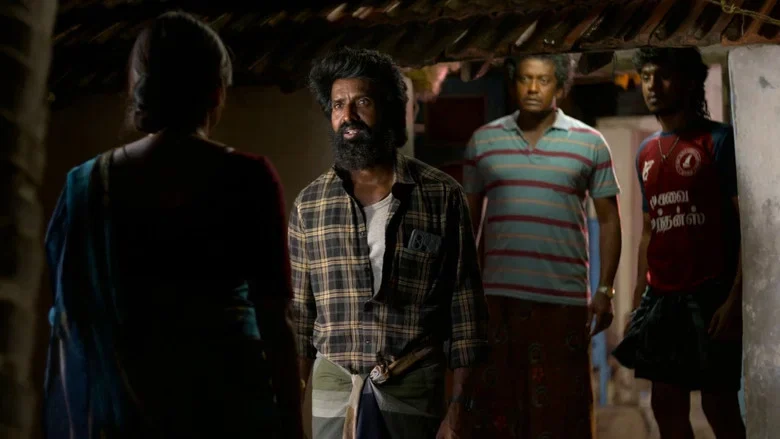
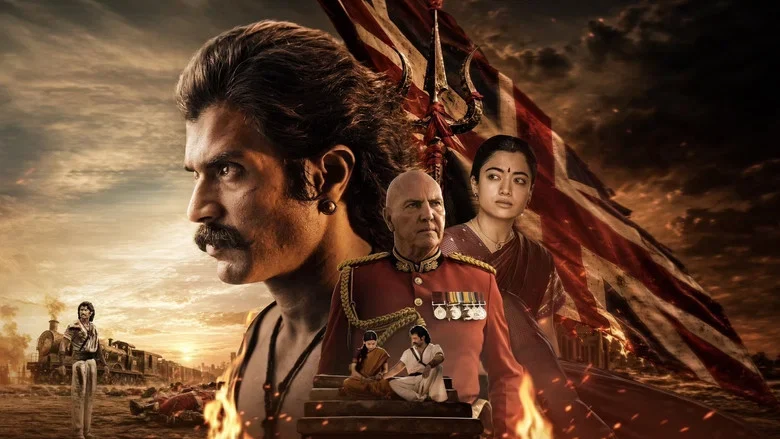
Amal Neerad opens on wet asphalt, a ring of thieves moving like a single organism through the dark, and for twenty minutes the swagger is genuinely seductive. Then the escape begins, and the film has to prove it has somewhere to go.

A Spiritual Successor That Inherits the Attitude and Not the Architecture
Fourteen years after the original Bachelor Party, Neerad returns to the same well of irreverent male camaraderie, now dressed as a crime-action ensemble piece. The 2012 film worked because its chaos was aimless by design; this one asks that same chaos to carry a survival plot, and the load shows.
The premise is clean enough: a crew of honor-bound thieves, loyalty tested, a dangerous exit through urban disorder. What the film never quite solves is why this particular escape should cost anything emotionally, since the bond is asserted in the first act and then simply assumed for the next ninety minutes.
Where a tighter spatial discipline governed the infiltration mechanics of O.M, here the geography of pursuit stays stubbornly vague. We are told the city is closing in; the frame rarely convinces us of it.

Kunchacko Boban Holds the Center While the Ensemble Splinters Around Him
Kunchacko Boban carries the film’s only sustained interior register, and he does it almost entirely through stillness. Watch him in the group sequences: while the others trade overlapping banter, he keeps his shoulders squared and his gaze fixed slightly past whoever is speaking, a man already calculating the exit.
That restraint is the film’s most useful instrument, and it echoes the controlled physical exhaustion Naslen brought to the far more disciplined Scene. Here, though, the surrounding performers are given so little individual texture that Boban’s quiet often reads as loneliness rather than authority.
Tovino Thomas gets the film’s most physically aggressive passages and commits to them with real weight, but the screenplay hands him momentum instead of motive.
Soubin Shahir lands the few genuine laughs with a loose, off-rhythm delivery that cuts against the film’s self-serious staging, and he is the only one who seems to know he’s in a comedy.

The Action Escalates While the Stakes Stay Flat
Neerad’s signature is the slow, held image, and the film’s best stretch is its middle hour, where the crew moves through neon-lit corridors and the camera refuses to hurry. The blocking is deliberate, the bodies arranged with real compositional care, and for a while the tension is architectural rather than verbal.
The problem arrives with the escalation itself. Each new obstacle is bigger than the last, yet the cost never compounds, because no member of the group is ever allowed a moment of genuine hesitation about the others. Loyalty without doubt is not a theme; it’s a decoration.
This is precisely the trap that swallowed the memory-thriller ambitions of Bouma, where a strong central conceit was asked to do work the script never built underneath it. Neerad’s film is louder and better staged, but the same structural thinness hums beneath the surface.
The Score Does the Emotional Labor the Script Declines
When the screenplay can’t locate a feeling, the background score arrives to announce one, swelling under reunions and near-misses alike until the music becomes a nervous tic.
The most effective sequence in the film is also its quietest, a wordless passage of the crew regrouping in a dim stairwell where the sound design drops to footsteps and breath.
That scene proves the film knew how to build pressure without volume. It simply didn’t trust the audience to sit in it for long, cutting back to shouted exposition whenever the silence threatened to become interesting.
Panorama and the Remake-Economy Question Facing Malayalam Crime Cinema
The producing banners behind this release are betting on a recognizable brand name and a stacked ensemble to carry opening-weekend footfall in a market that has grown unusually crowded with crime thrillers.
That bet is legible in the casting alone: nearly every bankable male face in the industry is deployed, and the marketing leans hard on the 2012 lineage.
But the sequel-and-successor pipeline is reaching its saturation point. Audiences who once turned out for nostalgia now expect the follow-through, and a film that coasts on a predecessor’s identity has a shorter theatrical tail than its opening Friday suggests.
The broader exhibition picture rewards original, patient character work over recycled swagger, and that shift is reshaping what contemporary Malayalam thrillers can sell on craft alone. Neerad’s film sits awkwardly on the wrong side of that curve.
The Escape Lands, and the Friendship Never Quite Does
The climax delivers the promised refusal to abandon a comrade, staged with real physical commitment and one genuinely arresting image of the group moving together through smoke. It is the film’s most confident sequence, and it almost earns the sentiment the script spent two hours asserting rather than dramatizing.
Almost. Because the ending asks us to feel the weight of a bond we were told about rather than shown being tested to the breaking point. The crew survives, the loyalty holds, and the audience is left with a handsomely photographed argument for friendship that never quite risks anything on its behalf.
Neerad remains one of the most visually assured filmmakers working in Malayalam cinema, and there are stretches here where that assurance is enough.
But a film about men who refuse to leave each other behind needs at least one moment where leaving would be the easier, smarter choice. This one never allows itself that cruelty, and so its warmth stays theoretical.