The first thing you notice in the dark is how long the film takes to breathe. Rajkumar Periasamy has built a spy thriller that treats silence as ammunition, and then spends nearly three hours reloading.

A Triple Identity Is A Structural Promise, Not Yet A Payoff
Dhanush carries three names here, Pazhanivel, Agent D-402, Thirukumaran, and the screenplay treats each as a separate nervous system, not a costume change. The undercover operative slips into a red-sanders syndicate, and the film’s central tension is whether the man inside the mole can stay a man at all.
Periasamy’s concept is genuinely shrewd: the mole is not just hiding from the criminals but from the institution that sent him, which means every scene of trust is also a scene of potential execution.
Temple Corridors As Surveillance Architecture
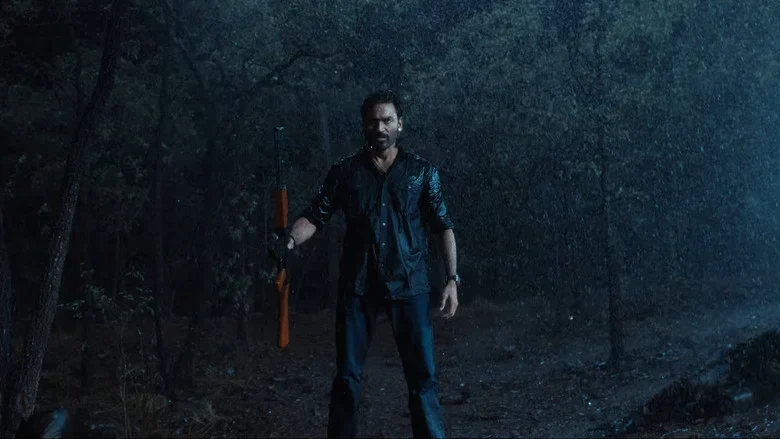
The Tirupati and Tiruvannamalai geography is the film’s most distinctive asset, and Periasamy uses sacred space with deliberate unease. Pilgrimage corridors become blind spots; darshan queues become cover; the crowd’s devotion becomes the operative’s camouflage.
It’s a visual idea that recalls the spatial discipline of Khushi – The Princess, where landscape was never decoration but a character with its own agenda. Here the temple town does similar work, though the film is less certain how to sustain it across a three-hour runtime.

Mammootty’s Stillness Is The Film’s Best Weapon
Burma “Siya” Karthikeyan is played with a stillness that borders on geological. Mammootty doesn’t raise his voice; he lowers it, and the effect is that everyone around him leans in, which is exactly the wrong instinct when the man is deciding whether to kill you.
Watch his hands in the syndicate scenes, they stay folded, patient, as though the criminal world is a ledger he’s already balanced. It is the strongest physical performance in the film, and it exposes the screenplay’s occasional weakness: when Mammootty is off-screen, the tension drops a register.
Dhanush’s Covert Register Echoes His Best Work
Dhanush’s operative is a study in controlled exhaustion, the jaw that never quite unclenches, the eyes that scan exits before faces, the way he accepts a glass of water from a criminal and drinks it as though it might be his last.
That specific physical grammar of a man performing calm recalls the restraint he brought to Kara, where the performance carried more weight than the plot around it.
Here, though, the dual-identity machinery asks more of him than the script earns. When the film finally lets him break, a brief, ugly moment of physical violence that contradicts his cover, it’s the most alive the movie gets.
Sai Pallavi’s Institutional Counterweight Is Underwritten
Nithya Reddy IPS arrives as the law-enforcement counterpoint to the embedded operative, and Sai Pallavi plays her with a clipped, procedural impatience that works whenever she shares a frame with Dhanush. Their scenes have the friction of two people who cannot afford to trust each other and cannot afford not to.
The problem is that the screenplay treats her as a structural function rather than a character with a private life, and by the third act her presence thins into exposition delivery.
The Syndicate’s Transnational Reach Is A Promise The Film Half-Keeps
Red-sanders smuggling gives the film a real-world spine, a commodity worth killing over, a supply chain that crosses borders, a criminal economy that feeds on poverty. The screenplay gestures at all of this with genuine ambition.
But the middle section sags under the weight of procedural detail, and the film’s refusal to clarify the antagonist hierarchy leaves the criminal world feeling less like an empire and more like a series of rooms.
The thematic kinship with Black Gold is obvious, both films treat crime as an ecosystem rather than a villain, but that film’s tighter running time gave its moral rot more room to breathe.
The Three-Hour Runtime Is A Structural Risk, Not A Verdict
Periasamy’s direction is patient to a fault. The first hour establishes cover, hierarchy, and geography with real care, but the exposition density is punishing, and the film keeps pausing to explain what it has already shown.
By the time the covert task force begins dismantling the cartel from within, the acceleration is welcome but feels earned late. A tighter assembly could have made the same points in two hours and forty minutes without losing a single beat of tension.
Wunderbar And RTake Are Betting On A Franchise Skeleton
Wunderbar Films and RTake Studios are not releasing a one-off here; they’re releasing a proof-of-concept for a spy franchise built around a star who can carry both mass and method.
The pre-sales figures, above ₹3.30 crore worldwide heading toward ₹5 crore, with a reported budget in the $21 million range, suggest the exhibitor confidence is real, but the three-hour runtime is a commercial liability in a market that rewards repeat viewing.
Dhanush’s theatrical leverage is genuine, and Mammootty’s presence broadens the film’s appeal across Tamil and Malayalam markets. But the undercover-espionage space is crowded, and this film’s commercial sustainability depends on whether audiences treat it as an event or an endurance test.
A Spy Thriller That Trusts Its Star More Than Its Script
What lingers after the credits is not the operation but the face, Dhanush’s operative staring at a temple lamp, a man whose entire life is a cover story he can no longer remember writing. That image carries more weight than the film’s final confrontation, which resolves with competence rather than revelation.
Periasamy has made a film about invisibility that occasionally disappears from its own narrative, and yet the central performance and the temple-town texture keep pulling it back. It is a near-miss with a real pulse, the kind of swing that signals a filmmaker worth watching, even when the swing doesn’t quite connect.
For a genre that increasingly relies on kinetic sensation, this one’s willingness to sit still with its own dread is a small, stubborn virtue, and a reminder that contemporary Tamil thrillers are still figuring out how to be patient without being ponderous.