The astrovan arrives in a remote village like a message from another planet, and a girl looks up. That single image carries Aakasamlo Oka Tara further than its screenplay sometimes deserves.
When a Wedding Night Becomes a Moral Reckoning
Pavan Sadineni opens on Kalpana, a studious teenager whose fixation on space travel is drawn with plain, unforced sincerity. Then her father marries her off, and the film’s real engine kicks in.
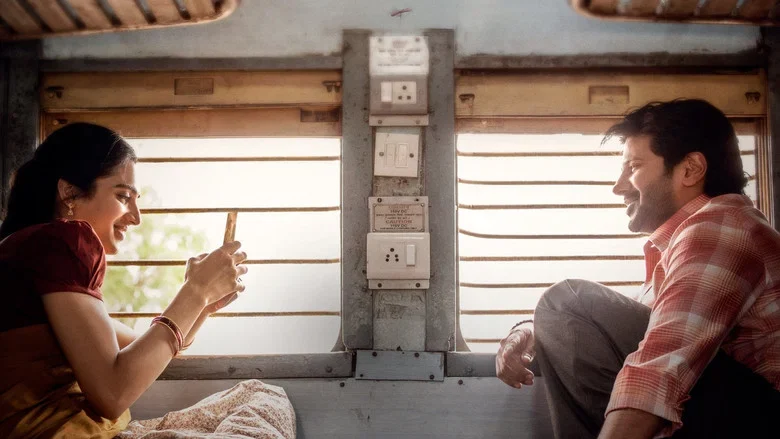
On the wedding night, Krishna discovers his bride is sixteen. Dulquer Salmaan plays the discovery not as outrage but as a slow, physical deflation, the shoulders dropping before the voice does.
It is the film’s cleanest dramatic idea: a socially sanctioned arrangement exposed as a moral crisis from inside the bedroom. Sadineni stages it quietly, and the silence does more work than any speech.

The District-Topper Result Is the Screenplay’s Smartest Mechanism
When Kalpana tops the district, the film converts an exam mark into a plot reversal. Krishna can no longer dismiss her ambition as childish fancy; the evidence is printed on paper.
His transformation is dramatised through labour rather than dialogue. Overtime driving shifts, surrendered savings, a rented room away from the hostile household, support becomes something you can weigh.
That material grounding elevates the middle stretch above standard motivational drama. Empowerment here costs money and hours, and the film knows it.
What it does not know is how to complicate its own momentum. Once Krishna commits, the outcome is never in doubt, and the screenplay settles into a comfortable, linear ascent.

Satvika Veeravalli Holds Two Ages in One Face
The debutant carries the film’s trickiest contradiction: a schoolgirl’s unguarded wonder sitting beside a fixed, adult certainty about the stars. Watch her in the results scene, the eyes widen, then narrow into resolve.
It is a performance built on small recalibrations rather than big declarations, and it keeps Kalpana from becoming a symbol. She reads as a person with homework and a countdown clock.
Salmaan, meanwhile, works in the opposite register. His Krishna is warm, slightly bewildered, and entirely without heroic posturing, a man who solves problems by taking another shift.
The contrast between his stillness and her forward-leaning energy gives the marriage its texture. The pair’s best scenes are the quiet ones, where neither is explaining the theme aloud.
The supporting ensemble, by contrast, is largely functional. Shruti Haasan and Ruhani Sharma register as significant presences, yet the writing gives them little to push against.
Where the Direction Loses Its Nerve
Sadineni’s staging is clean and legible, and he trusts his two turning points, the wedding night, the exam result, to carry the first hour. The camera stays close and unobtrusive, letting faces do the arguing.
Then the final act arrives, and the hostility evaporates. The abusive father apologises, the sister-in-law softens, the village swells with pride, all within a stretch too short to earn any of it.
This is where the film’s sincerity curdles into convenience. The patriarch who controlled every decision gets a redemption arc shorter than a song, and the earlier cruelty loses its weight.
The 159-minute runtime compounds the problem. Motivational beats repeat, and the middle sags where a sharper edit would have pressed harder on the family’s resistance rather than rehearsing encouragement.
Compared with the tighter emotional discipline on display in ENE Repeat, this film’s resolution feels less like catharsis and more like a negotiated ceasefire.
A Supporting Man Who Refuses to Become the Hero
Salmaan’s Krishna belongs to a lineage of quietly devoted men, but he resists the urge to convert sacrifice into spectacle. He never lectures, never grandstands, never claims her achievement as his own.
The warmth he brought to Bachelor Party D'eux is here redirected inward, less swagger, more stamina, and it suits him better than any showy lead turn would.
His finest moment is a small one: a look exchanged across a crowded room after the results are read, relief and pride arriving a half-second apart. No dialogue required.
The film’s collective antagonist, the in-laws, the village elders, the father’s grip on education and marriage, works while it stays faceless. It fails the moment it is asked to apologise.
The Commercial Arithmetic of a Crowded Telugu Slate
Geetha Arts, Swapna Cinema and Lightbox Media have pooled resources behind a family drama in a market currently saturated with them. The gamble rests on Salmaan’s crossover pull across Telugu, Malayalam and Tamil dubs.
That multilingual strategy is sensible for a film this gentle, but it also caps its ceiling. There is no spectacle hook, no franchise scaffolding, and no star-vehicle bombast to inflate opening weekend.
Instead, the producers are betting on word-of-mouth among family audiences, a slower, more fragile commercial engine than the one powering the louder releases around it.
The broader appetite for grounded, socially minded storytelling across contemporary Telugu dramas gives this film a real runway, provided the praise for its lead performances converts into ticket sales.
Whether that translates into a hit depends on numbers this review will not invent. What is clear is that the film’s economics are built on sincerity, not scale.
The Reconciliation That Undoes the Argument
The ending hands Kalpana her dream and her tormentors their redemption in the same gesture, and the two do not sit comfortably together. The village that policed her body now claims her glory.
That is not a plot hole so much as a philosophical surrender. The film spends two hours showing how rigidly a community enforces its rules, then asks us to believe those rules dissolve on contact with a certificate.
The thematic siblinghood with Summer Holidays is instructive here, both films love their villages, and both flinch from what those villages are capable of.
Still, Satvika Veeravalli’s final look skyward lands with genuine force. The girl who once watched an astrovan pass through has become the thing others will one day watch cross the sky.
It is a lovely image, and an honest one. The film earns that moment; it simply does not earn the forgiveness it hands out around it.
Aakasamlo Oka Tara is a warm, well-performed argument for a girl’s right to her own future, wrapped in a screenplay too eager to be liked by everyone in it. Its heroine reaches the stars; its filmmakers settle for a comfortable landing.