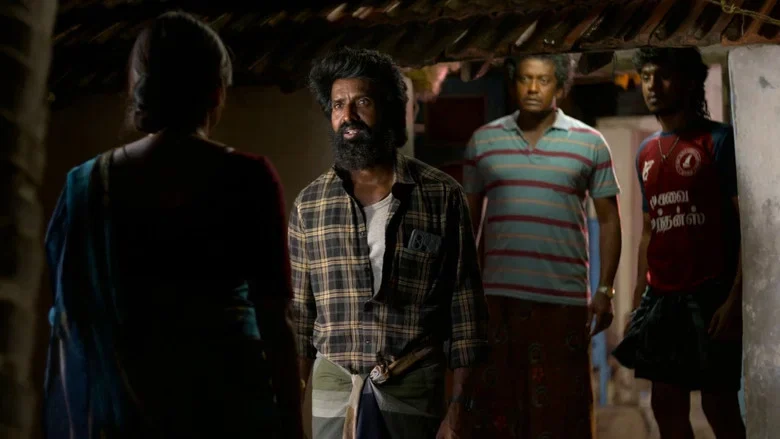
Nawin Ghanesh opens his survival thriller with a premise that sounds like a dare: a man hunting for the woman he loves, trapped in a city that cannot see or hear him. It is a high-concept hook that either becomes cinema or becomes a gimmick, and the film spends most of its runtime deciding which.

The Invisible Protagonist Is a Structural Gamble, Not a Character
Master Mahendran’s unnamed lead is less a person than a condition. The screenplay gives him an objective, find her, and a handicap, vanish from every eyeline, then drops him into a government hospital corridor and a swelling street protest.
What the film refuses to do is explain the invisibility. No scientific rationale, no curse, no cosmic joke. It simply is, and the audience is asked to accept it as the rules of the game.
That gamble works in isolated stretches. When Mahendran’s hand reaches for a shoulder and passes through a crowd that never flinches, the film achieves a specific, quiet horror: the terror of being present but unwitnessed.
A Protest Is a Strange Place to Hide a Love Story
The middle act trades the hospital’s fluorescent sterility for the roar of a mass demonstration. It is here that the film’s social conscience, the government-hospital crisis, collides with its survival mechanics.
Crowds become both cover and threat. The protagonist can move through them unseen, but he cannot shout for help, cannot warn, cannot coordinate. The screenplay uses this constraint well in theory.
In practice, the protest often swallows the personal stakes. The love interest, played by Rishika Rajveer, drifts to the margins of her own rescue story, and the film’s emotional engine sputters whenever the crowd noise rises.
This is the same tension that Appa Kutty tried to negotiate, a family thriller that wanted both intimacy and scale, and like that film, Pulse never fully resolves which register it trusts more.
Mahendran Carries the Silence, but the Script Leaves Him Alone
Mahendran’s performance is built on physical restraint. He does not emote broadly; he waits, he watches, he reaches. In the film’s strongest sequence, a wordless attempt to stop a hospital orderly from walking past him, his face does the work of a full monologue.
That register echoes the quieter, more interior work he brought to 29, where his character’s paralysis was emotional rather than supernatural. Here, the paralysis is literal, and the actor wisely refuses to overplay it.
The supporting cast, by contrast, is given almost nothing to do. Livingston and R. V. Udayakumar appear in roles that feel like set dressing, authority figures who exist to be ignored by the protagonist, and the film never asks them to register as people.
Cool Suresh and the KPY comedians are deployed for brief tonal relief that undercuts the dread rather than leavening it. The film does not know what to do with its own ensemble.
The Camera Believes in the Premise More Than the Script Does
Cinematographically, the film commits to the unseen condition. Shallow focus keeps the protagonist in soft foreground while the world stays sharp behind him, a visual grammar that reinforces his displacement without over-explaining it.
The hospital sequences are lit with a greenish institutional pallor that makes the corridors feel like holding pens. The protest scenes, by contrast, are shot in wide, jostling handheld, the frame crowded with bodies that never acknowledge the man moving through them.
Abhishek AR’s score is the film’s most assertive element. It pushes tension in places where the screenplay has not earned it, and the mismatch is often jarring, a horror cue arriving before the horror does.
This is a film that understands the grammar of dread better than the grammar of story, and the gap between those two competencies is where the whole enterprise starts to fray.
T-Series South Bets on a High Concept Without a Safety Net
T-Series South is backing a film with no established franchise, no star-vehicle safety net, and a premise that requires audiences to accept an unexplained supernatural condition. That is a genuine commercial risk.
The Tamil survival-thriller market has been increasingly hospitable to mid-budget experiments, and the film’s release window, a November worldwide rollout, suggests confidence in the concept’s novelty.
But the absence of a named antagonist, a clear villain, or a recognizable star vehicle leaves the film without the marketing hooks that usually drive opening-weekend footfall. The invisibility is the hook, and invisibility is hard to sell.
Mahendran’s box-office leverage is real but narrow; he is a character actor’s character actor, not a mass draw. The film’s commercial fate will depend almost entirely on word-of-mouth from viewers willing to follow a premise into uncomfortable territory.
This is the kind of risk that Shankarabharana also took, a folklore thriller that refused easy escapes, and the comparison is instructive: both films trust atmosphere over explanation, and both will divide audiences accordingly.
The Ending Refuses Catharsis, and That Is the Point
What the film does well, finally, is refuse the tidy resolution. The protest does not end because the hero wins; the hero survives because the protest moves on. The love interest is not saved so much as located, and the reunion is not a triumph but an exhaustion.
This is a bleak, specific choice, and it is the film’s most honest gesture. It insists that invisibility is not a superpower but a condition, a permanent state of being unheard that the climax does not cure.
The film’s final image lingers on that condition, and it is here that the whole enterprise finds its voice. For all its structural wobbles and tonal missteps, Pulse ends on a note that feels earned.
Contemporary Tamil thrillers have been increasingly willing to sit with discomfort rather than resolve it, and this film belongs to that lineage. It is not a clean thriller, but it is a committed one.
What remains is the question the film poses and refuses to answer: what does it mean to be present in a crisis and be unable to change anything? The film’s answer is not hopeful, and that is precisely why it stays with you.